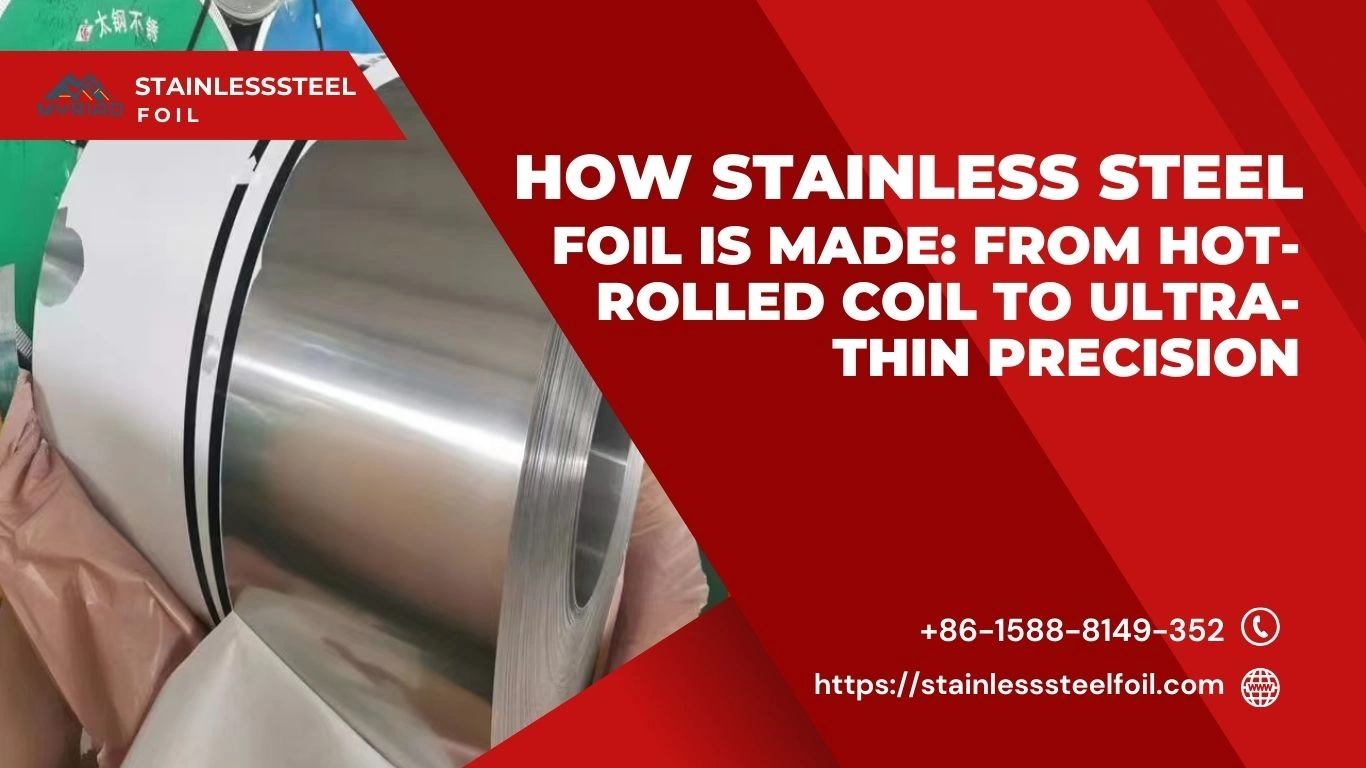
Stainless steel foil is a versatile material used in industries ranging from aerospace to medical devices. Its thin, durable, and corrosion-resistant properties make it ideal for high-precision applications. But how is this material transformed from a hot-rolled coil into ultra-thin precision foil? This blog explores the manufacturing process, types, applications, and key considerations when selecting stainless steel foil.
What Is Stainless Steel Foil?
Stainless steel foil is a thin, flat-rolled product typically ranging from 0.001 mm to 0.2 mm in thickness. It is made from various stainless steel grades, including 304, 316, and 309, each offering unique properties for different applications.
- Stainless steel foil roll – Supplied in continuous coils for industrial processing.
- Stainless steel foil tape – Used for sealing, EMI shielding, and heat-resistant applications.
- Ultra-thin stainless steel foils – Essential for electronics, sensors, and medical devices.
Applications of Stainless Steel Foil
-
Food packaging and storage
-
Electrical and electronic components
-
Architectural cladding
-
Automotive panels
-
Insulation and shielding
For a deeper understanding, read our guide on What is Stainless Steel Foil?.
The Manufacturing Process of Stainless Steel Foil
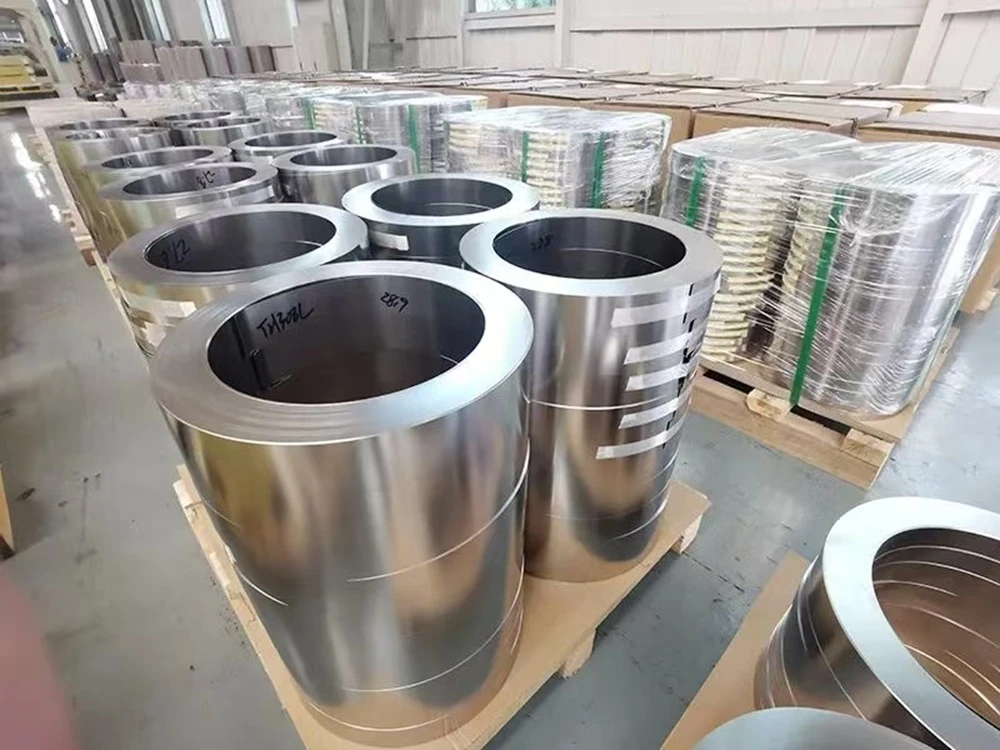
1. Raw Material Selection
The process begins with high-quality hot-rolled stainless steel coils, typically made from austenitic grades (304, 316, 309) due to their corrosion resistance and formability.
2. Cold Rolling for Thickness Reduction
The hot-rolled coil undergoes cold rolling, where it is passed through multiple rollers to reduce thickness. This step enhances strength and surface finish.
3. Annealing for Softening
After cold rolling, the material is annealed (heated and cooled) to relieve internal stresses and improve ductility.
4. Precision Rolling to Ultra-Thin Foil
For ultra-thin foils (below 0.1 mm), specialized Sendzimir mills or foil rolling mills are used. This requires extreme precision to avoid tearing.
5. Slitting & Finishing
The final foil is slit into desired widths, inspected for defects, and sometimes coated for specific applications.
For more details, explore our Stainless Steel Foil Products.
The Starting Material – From Ingot to Hot-Rolled Coil
The manufacturing process for thin-gauge foil begins with the production of the initial metal alloy.
1. Alloying and Casting
The journey starts in a furnace, where raw materials—iron, nickel, chromium, and other elements like molybdenum (especially for 316 stainless steel foil) and manganese—are melted and mixed precisely. This careful formulation ensures the final product meets the specific chemical composition standards for grades like 304 stainless steel foil. For instance, the exact balance of chromium and nickel in 301 stainless steel foil is what gives it its enhanced work-hardening capability.
Research Note: The quality of the initial melt is absolutely paramount. Impurities or incorrect alloy percentages can lead to defects, inconsistent performance, and failure to meet the precise standards required for ultra-thin applications.
2. Hot Rolling
Workers reheat the slabs to high temperatures, often exceeding 1,200°C (2,200°F), to make the steel malleable. They then pass the slabs through a series of massive rollers in the hot-rolling mill. This process reduces the thickness of the slab significantly and elongates it, transforming the slab into a hot-rolled coil.
-
Objective: To reduce the initial thickness of the slab from several inches to a manageable strip, typically between 2mm and 6mm thick.
-
Result: The hot-rolling process refines the internal grain structure of the steel, beginning the path toward the material’s final mechanical properties.
3. Annealing and Pickling
After hot rolling, the steel is tough and covered in a thick, dark layer of scale (oxides) formed during the high-temperature processes.
-
Annealing: This annealing process relieves internal stresses that built up during rolling, softens the metal, and recrystallizes its microstructure, preparing it for the more intense cold-rolling stages ahead.
-
Pickling: Pickling involves treating the coil with an acid solution (or using mechanical brushing) to clean the surface, leaving the metal bright and smooth.
This prepared, scale-free material is the feedstock for the intricate cold-rolling operations that follow. A full understanding of these foundational steps is essential for appreciating the subsequent precision work required to achieve ultra-thin gauges. You can find more general information about the material at https://en.wikipedia.org/wiki/Stainless_steel.
The Transformation – Precision Cold Rolling
The cold-rolling phase is the heart of stainless steel foils production. Unlike hot rolling, this process occurs at or near room temperature and is responsible for achieving the final thinness, precise dimensions, and desired mechanical characteristics.
1. Multi-Stand Cold Reduction
The annealed, pickled coil is fed through a sequence of high-precision cold-rolling mills.
-
Tandem Mills: For standard thickness reduction, the strip may pass through multiple mill stands sequentially, with each pass reducing the thickness by a small percentage while simultaneously increasing the length.
-
Reversing Mills: Reversing mills frequently achieve maximum reduction and tighter control. The strip moves back and forth through the same mill, often hundreds of times, while the roller gap decreases infinitesimally with each pass.
This cold work drastically hardens the steel—a process called work hardening. While this enhances the strength, it also makes the steel brittle and resistant to further reduction.
2. Intermediate Annealing
To continue the reduction process, manufacturers periodically soften the work-hardened strip. They achieve this through intermediate annealing, a highly controlled process where they heat the strip to a specific temperature and then rapidly cool it.
-
Goal: To temporarily reverse the effects of work hardening, allowing the steel to become ductile enough for further rolling.
-
Control: The temperature and holding time must be exact; they influence the grain size, which in turn affects the final strength and formability of the stainless steel foil. Too large a grain size can lead to an undesirable “orange peel” effect during forming.
Workers repeat the cycle of cold rolling, cleaning, and intermediate annealing until the strip reaches the target thickness for stainless steel foil.
3. The Quest for Ultra-Thin Stainless Steel Foil
Achieving thicknesses below 0.05mm (0.002 inches) requires specialized equipment, often using mills with extremely small work rolls or cluster configurations, such as Sendzimir mills.
-
Foil Mills: These specialized rolling setups are engineered for extreme precision. They maintain exceptionally tight tolerances—often measured in micrometers—and require constant monitoring to control thickness uniformity across the width and length of the strip.
-
Tension Control: Maintaining precise strip tension is essential during foil rolling. Too little tension causes wrinkling; too much tension can stretch or break the thin foil.
-
Lubrication and Cooling: They act as both a lubricant to reduce friction and a coolant to manage the heat generated by the intense pressure between the rolls and the metal strip.
This relentless pursuit of precision is what differentiates high-quality ultra thin stainless steel foils producers.
Finishing and Precision Processing
In some applications, especially where frequent handling or high-stress environments occur, manufacturers further treat the edges (through deburring or edge conditioning) to eliminate any sharpness caused by the slitting blades.
1. Final Annealing
The very last stage of annealing determines the final temper or hardness of the foil. Engineers adjust the final heat treatment based on the required application—whether it needs a soft, fully ductile condition for deep drawing or a high-strength, full-hard temper for shims or springs.
-
Bright Annealing: To achieve a highly reflective, clean, and oxidation-free finish, manufacturers often perform the final annealing in a furnace using a controlled, oxygen-free atmosphere, such as pure hydrogen. This eliminates the need for further pickling, producing a bright stainless steel foil surface.
2. Slitting and Edge Conditioning
The final, wide coil is seldom the size needed by the end user. It must be slit into narrower, precise widths.
-
Slitting: High-precision rotary cutters are used to cut the wide strip lengthwise into multiple narrow coils of stainless steel foil roll or strips. The accuracy of the slitting process is crucial, as the width tolerances for foil are extremely tight.
3. Surface Finish and Packaging
The desired surface finish can be adjusted through the final passes of the rolling process or by specialized surface treatments.
-
Surface Finishes: Common finishes range from 2B (smooth, slightly reflective) to BA (Bright Annealed, highly reflective).
-
Final Inspection: Every coil undergoes rigorous inspection for thickness variation, flatness, surface defects, and mechanical properties. This is a non-negotiable step in quality control.
-
Packaging: This often involves specialized wrapping and secure crating, especially for products like 304 stainless steel foil packaging used in high-tech industries.
The finished product is then ready to be shipped worldwide. You can explore the full range of product options and specifications at https://stainlesssteelfoil.com/products/stainless-steel-foil/.
The Annealing Process: Restoring Workability for Cold Rolling
Annealing represents one of the most important steps in stainless steel foil production. This heat treatment process softens the metal, relieves internal stresses, and restores the ductility needed for further thickness reduction. Without proper annealing, the material would crack or break during subsequent cold rolling operations.
Understanding the Annealing Cycle
The annealing process involves heating stainless steel to temperatures between 1010°C and 1120°C (1850°F to 2050°F) depending on the grade and thickness. At these temperatures, the crystalline structure of the metal recrystallizes, replacing the elongated, stressed grains created during cold working with new, equiaxed grains free of internal stress.
Modern foil production uses continuous annealing lines rather than batch furnaces. The strip passes through the furnace at controlled speeds, spending precisely calculated time at elevated temperature. Faster line speeds reduce cycle time but require higher temperatures to achieve complete recrystallization. Slower speeds allow lower temperatures but reduce throughput.
The atmosphere within the annealing furnace requires careful control. Most operations use either bright annealing in hydrogen-nitrogen atmospheres or open annealing followed by pickling. Bright annealing produces a clean, reflective surface without oxide scale, eliminating the need for subsequent pickling. Open annealing is less expensive but requires acid treatment to remove the oxide layer formed during heating.
Temperature Control and Its Effects
Temperature uniformity across the strip width directly affects final product quality. Modern furnaces use multiple zone controls and sophisticated monitoring systems to maintain temperature within ±5°C (±9°F) across the full strip width.
Excessive annealing temperature causes grain growth that reduces strength and can create visible surface texture called orange peel. Insufficient temperature leaves residual cold work in the material, reducing ductility and making subsequent rolling more difficult. Each grade and thickness combination requires specific temperature and time parameters to optimize results.
The cooling rate after annealing affects sensitization in certain grades. Slow cooling through the temperature range of 425°C to 870°C (800°F to 1600°F) can cause chromium carbide precipitation at grain boundaries, depleting chromium from adjacent areas and reducing corrosion resistance. Rapid cooling through this range prevents sensitization, maintaining the full corrosion resistance of the alloy.
Applications: Where Does Stainless Steel Foil Shine?
Countless demanding applications utilize the versatility and precision of the foil.
Aerospace and Defense
In aviation and rocketry, weight reduction is vital. Ultra-thin stainless steel foil serves as a critical material for heat shields, honeycomb structures, and precision gaskets in engine components. Engineers rely on it for its high strength and exceptional thermal stability, ensuring optimal performance in demanding applications.
Electronics and Communication
In electronic devices, the foil acts as RFI/EMI shielding to protect sensitive circuits from interference. Engineers frequently use stainless steel foil tape to ground and shield complex cable systems during assembly.
Automotive and Transportation
301 stainless steel foil is often specified for lightweight but durable components, such as seals and exhaust bellows, that must withstand continuous vibration and heat exposure.
Medical and Scientific Instruments
The biological inertness and high-purity surface of grades like 316 stainless steel foil make them suitable for surgical instruments, implantable devices, and laboratory equipment. Precision etching is a common secondary process for creating intricate medical parts.
Energy and Industrial
From specialized thermal barriers in energy generation to precision shims and diaphragms in metering equipment, stainless steel foil is a quiet, reliable workhorse.
Choosing the Right Manufacturer
Achieving the exact specifications for stainless steel foil requires more than just machinery; it requires expertise and a commitment to quality. The process demands meticulous control over alloy chemistry, rolling parameters, annealing cycles, and final slitting accuracy.
When selecting a supplier for your stainless steel foil roll needs, factors like traceability, quality certification, and the ability to consistently meet tight tolerances are paramount. A dedicated partner can guide you through choosing the best material, whether it’s 316 stainless steel foil for marine use or 304 stainless steel foil for general industrial applications.
To discuss your specific material needs or custom foil requirements, you can connect directly with specialists by visiting Contact us.
Summary
Stainless steel foil is a high-performance material with applications across multiple industries. From hot-rolled coils to ultra-thin precision foils, the manufacturing process ensures durability, corrosion resistance, and flexibility. Whether you need 304, 316, or ultra-thin foils, selecting the right grade and thickness is essential for optimal performance.
For more insights, visit StainlessSteelFoil.com or check our Stainless Steel Foil Products.
FAQs
What is stainless steel foil used for?
Stainless steel foil serves industries such as food packaging, electronics, construction, automotive, and chemical sectors because it resists corrosion, offers flexibility, and ensures durability.
What are the most common stainless steel foil grades?
The most common grades include 301, 304, 316, and 309, each with unique properties suitable for specific applications. Details at here.
How is ultra-thin stainless steel foil made?
Ultra-thin foils undergo multiple cold rolling passes, annealing, and surface polishing to achieve micrometer-level thickness.
How should stainless steel foil be stored?
Store foils in a dry, clean environment to protect them from scratches, moisture, and corrosive elements. 304 stainless steel foil packaging help ensure protection during transport.
Where can I buy high-quality stainless steel foils?
Visit StainlessSteelFoil.com for a wide range of foils, rolls, and custom solutions.