
Manufacturers rely on stainless steel strip for stamping to create durable, precise parts that resist corrosion. This material performs well in demanding environments, from automotive components to medical devices. Engineers choose the right grade, temper, thickness, and finish to ensure parts form correctly without defects while meeting performance needs.
At stainless steel foil, experts supply high-quality stainless steel strips tailored for stamping. Explore the products section for options, including specialized strips.
Stainless steel stands out as an iron alloy with at least 10.5% chromium, forming a passive oxide layer that protects against rust. Learn more about its composition and properties on Wikipedia.
Why Choose Stainless Steel Strip for Stamping?
Stamping operations benefit greatly from stainless steel strip. Manufacturers produce complex shapes efficiently in high volumes.
Key advantages include:
- Corrosion Resistance — Parts endure moisture, chemicals, and harsh conditions without degrading.
- Strength and Durability — High tensile strength supports structural applications.
- Formability — Austenitic grades stretch and bend deeply without cracking.
- Hygiene and Aesthetics — Smooth surfaces suit food processing and medical uses.
- Recyclability — Fully recyclable material supports sustainable production.
These properties make stainless steel strip ideal for progressive die stamping, deep drawing, and blanking.
Stainless Steel Grades for Stamping
Austenitic grades dominate stamping due to excellent ductility and non-magnetic nature.

Grade 304 Stainless Steel
Grade 304 serves as the most common choice. It contains 18% chromium and 8% nickel, balancing cost, corrosion resistance, and formability.
Manufacturers stamp it into kitchen sinks, appliance panels, and architectural trim. View details on 316 stainless steel coil for comparisons, though 304 handles most general needs.
Grade 301 Stainless Steel
Grade 301 offers higher strength through cold working. It work-hardens quickly, reaching full hard tempers for springs and fasteners.
Stampers select it for parts needing high yield strength after forming.
Grade 316 Stainless Steel
Grade 316 adds molybdenum for superior pitting resistance in chloride environments. Applications include marine hardware and pharmaceutical equipment.
Other Grades
- 430 (Ferritic) → Magnetic and cost-effective for simpler forms like appliance interiors.
- 410 (Martensitic) → Heat-treatable for hardness in cutlery and valves.
| Grade | Type | Key Properties | Typical Stamping Applications | Formability |
|---|---|---|---|---|
| 304 | Austenitic | Good corrosion resistance, versatile | Appliances, automotive trim, food equipment | Excellent |
| 301 | Austenitic | High strength via work hardening | Springs, clips, washers | Very Good |
| 316 | Austenitic | Superior pitting resistance | Medical devices, marine parts | Excellent |
| 430 | Ferritic | Magnetic, lower cost | Decorative trim, housings | Fair |
Temper Conditions in Stainless Steel Strips
Temper affects hardness, strength, and ductility. Cold rolling creates these conditions.
Common tempers:
- Annealed (Dead Soft) → Maximum ductility for severe deep drawing.
- Quarter Hard → Slight hardening for moderate forming.
- Half Hard → Balances strength and formability.
- Three-Quarter Hard → Higher strength with reduced ductility.
- Full Hard → Maximum strength for flat parts or springs.
Stampers match temper to draw depth and required final strength. For example, annealed 304 suits deep-drawn pots, while half-hard 301 fits brackets.
Surface Finishes for Precision Stamping
Surface finish influences tool wear, lubrication, and part quality.
Options include:
- 2B Finish → Cold-rolled, annealed, pickled; smooth and common for general stamping.
- BA (Bright Annealed) → Mirror-like for aesthetics or low friction.
- No. 4 Finish → Brushed for decorative parts.
- Rolled Finishes → Textured to retain lubricant during forming.
Precision stamping favors 2B for consistency and reduced galling.
Factors Influencing Material Selection
Engineers evaluate several factors:
- Corrosion Environment — Choose 316 for aggressive conditions; 304 suffices for mild exposure.
- Forming Requirements — Deep draws demand high elongation grades like annealed 304.
- Strength Needs — Higher tempers or 301 provide post-forming strength.
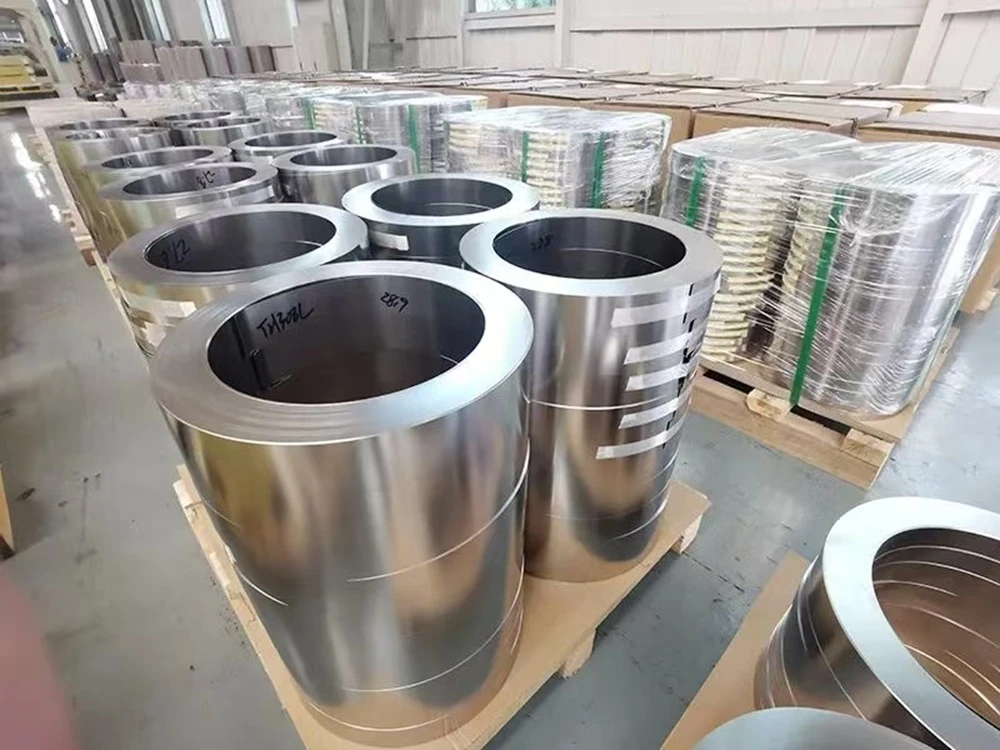
- Thickness and Width — Strips range from ultra-thin (0.001″) to thicker gauges.
- Cost Constraints — Ferritic grades reduce expenses for non-critical uses.
- Regulatory Compliance — Food and medical parts require specific certifications.
Testing prototypes validates selections before full production.
Stamping Process for Stainless Steel Strip
Stamping transforms flat strips into finished parts.
Steps include:
- Coil Feeding — Strips feed from coils into progressive dies.
- Blanking and Piercing — Cut outlines and holes.
- Forming and Drawing — Shape via bending or stretching.
- Trimming — Remove excess material.
- Secondary Operations — Deburr, polish, or coat.
Modern presses and lubrication manage work hardening.
Learn about the stainless steel coil production process that prepares strips.
Applications of Stamped Stainless Steel Parts
Stamped parts appear across industries:
- Automotive — Brackets, exhaust components, sensors.
- Home Appliances — Panels, frames, fasteners. Read how stainless steel strips perform in home appliances.
- Consumer Goods — Explore stainless steel coil uses in consumer goods production.
- Medical — Surgical instruments, implants, housings.
- Electronics — Connectors, shields, springs.
- Aerospace — Lightweight structural elements.
- Food Processing — Hygienic tanks, conveyors.
These parts deliver reliability in demanding settings.
Best Practices for Successful Stamping
Follow these guidelines:
- Use sharp tooling to minimize burrs.
- Apply adequate lubrication to prevent galling.
- Control blank holder force in deep drawing.
- Account for springback in die design.
- Inspect coils for edge quality and surface defects.
Partnering with experienced suppliers ensures consistent material.
Advantages of Using Stainless Steel Strip for Stamping
- Longevity: Parts last longer due to corrosion resistance.
- Precision: Uniform thickness ensures accurate stamping.
- Versatility: Suitable for decorative and functional applications.
- Sustainability: Stainless steel is recyclable, reducing environmental impact.
Explore more industry updates on the Stainless Steel Foil Blog.
Selecting the Right Supplier
Material quality depends heavily on the supplier. When choosing a stainless steel strip supplier:
- Verify certifications for quality assurance.
- Ensure consistent supply chain reliability.
- Request technical support for grade selection.
- Compare product range and customization options.
For premium stainless steel strip products, visit Stainless Steel Foil
Stainless Steel Strip vs Other Materials
| Material | Pros | Cons |
|---|---|---|
| Stainless Steel | Corrosion resistance, strength, recyclability | Higher cost |
| Carbon Steel | Lower cost, good strength | Prone to rust |
| Aluminum | Lightweight, corrosion resistant | Lower strength |
| Copper | Excellent conductivity | Expensive, softer |
Stainless steel strip remains the preferred choice for stamping where durability and corrosion resistance are essential.
Case Studies: Stainless Steel Strip in Industry
Automotive Industry
Stainless steel strip is used for exhaust systems and trim parts. Its resistance to heat and corrosion ensures long service life.
Electronics Industry
Thin stainless steel strips are stamped into connectors and shielding components. Precision and conductivity make them ideal for sensitive devices.
Medical Industry
316 stainless steel strip is stamped into surgical instruments. Its biocompatibility and resistance to sterilization processes make it indispensable.
Sustainability and Recycling
Stainless steel is 100% recyclable. Using stainless steel strip in stamping supports sustainable manufacturing practices. Recycling reduces energy consumption and conserves resources.
Learn more about stainless steel’s role in consumer goods here.
Future Trends in Stainless Steel Strip for Stamping
- Advanced alloys: Development of new grades with enhanced properties.
- Precision manufacturing: Improved stamping techniques for micro-components.
- Sustainability focus: Increased use of recycled stainless steel.
- Automation: Integration of robotics in stamping operations.
Summary
Selecting the optimal stainless steel strip for stamping involves matching grade, temper, and finish to application demands. Grades like 304 and 301 provide versatility, while careful choices ensure efficient production and long-lasting parts.
Manufacturers achieve superior results by prioritizing formability, strength, and corrosion resistance. Suppliers like stainless steel foil deliver precision strips that meet exact needs.
Browse the blog for more insights. Ready to source materials? Visit the contact page.
FAQs
What grades of stainless steel strip are best for stamping?
Grades 304, 316, and 430 are commonly used, depending on the application.
How does thickness affect stamping operations?
Thinner strips allow precision stamping, while thicker strips provide strength for larger components.
Can stainless steel strip be recycled?
Yes, stainless steel is fully recyclable, supporting sustainable manufacturing.
Where can I buy stainless steel strip for stamping?
You can explore a wide range of products at Stainless Steel Foil.
How is stainless steel strip produced?
It involves melting, rolling, annealing, and slitting processes. Learn more in the production guide.
Who should I contact for technical support?
Reach out to the experts via the Contact Us page.