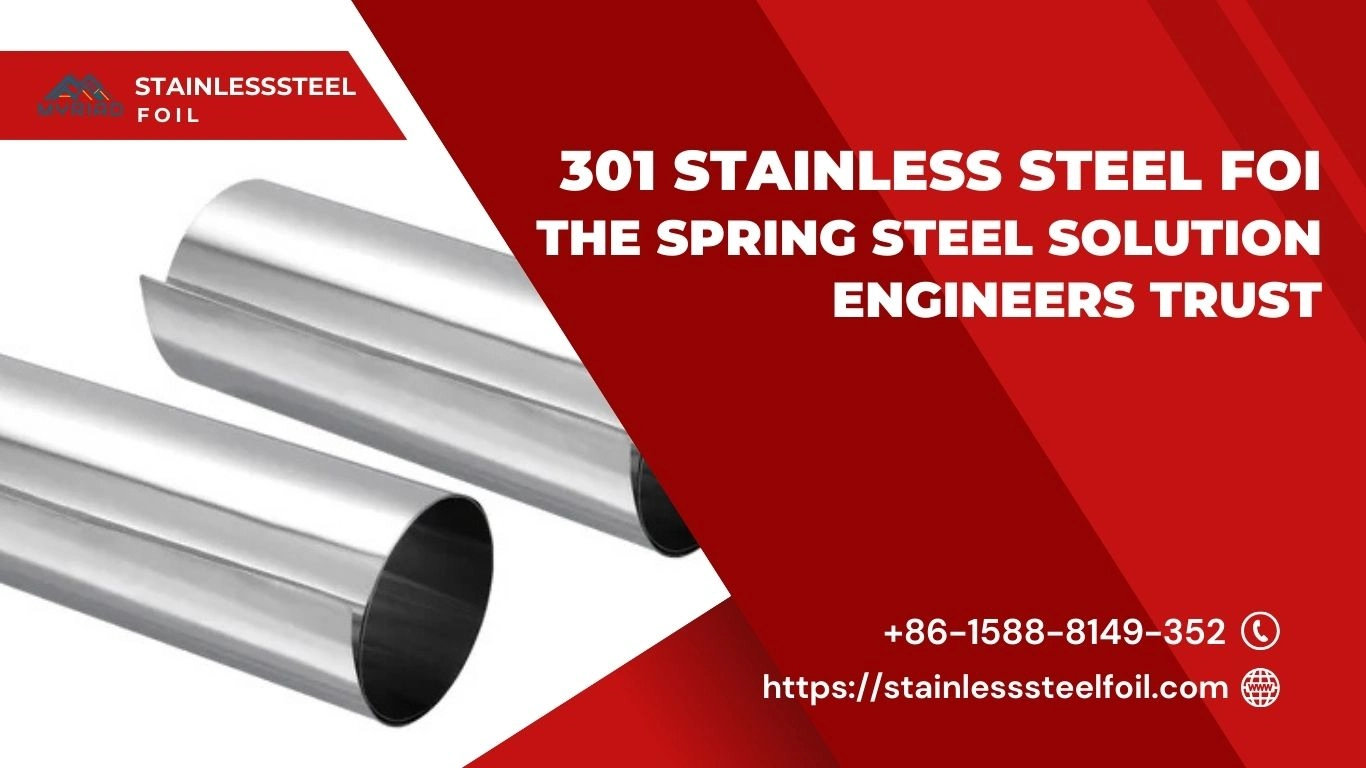
301 Stainless Steel Foil holds a respected position in engineering, manufacturing, and industrial design due to its strong mechanical response, reliable corrosion behavior, and exceptional work-hardening ability. Engineers rely on this material when they require thin metal solutions that deliver strength, elasticity, and long service life without excessive weight.
Stainless steel itself belongs to a broad alloy family defined by chromium content that supports corrosion resistance through surface passivation. According to material science references, stainless steel alloys maintain durability because chromium reacts with oxygen to create a protective oxide layer that resists rust and environmental degradation .
Manufacturers increasingly choose 301 Stainless Steel Foil when applications demand repeated flexing, tight tolerances, and dependable performance under stress. Industries that use springs, electrical components, precision shims, medical devices, and aerospace assemblies depend on this grade because it performs consistently even after extensive forming.
For buyers and engineers seeking premium foil materials, Stainless Steel Foil provides specialized products, technical expertise, and dependable supply options through its official platform:
What Is 301 Stainless Steel Foil?
301 Stainless Steel Foil is an austenitic chromium-nickel stainless steel alloy supplied in ultra-thin gauges. It contains lower nickel content than 304 stainless steel, which enhances its ability to increase strength through cold working.
This alloy gains significant tensile strength during rolling and forming without losing ductility. Engineers select it when they need a material that bends, flexes, and springs back repeatedly without cracking.
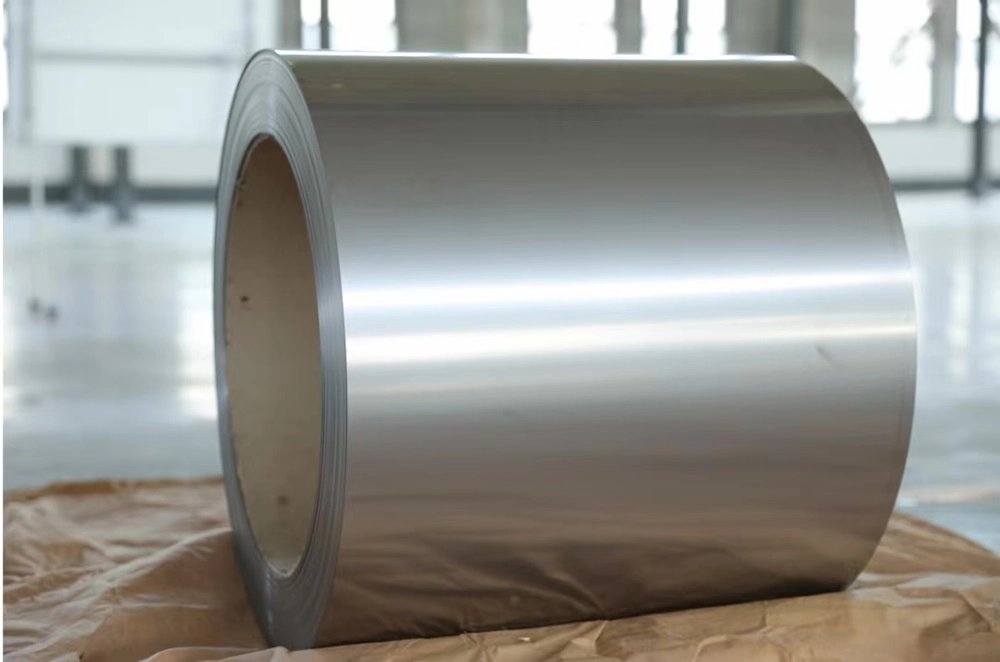
A detailed technical breakdown of this grade appears in the official material guide: what is 301 Stainless Steel Foil?
Key Material Characteristics
Austenitic crystal structure
High work-hardening rate
Excellent fatigue resistance
Stable corrosion performance in indoor and mild outdoor environments
Magnetic behavior after cold working
Chemical Composition of 301 Stainless Steel Foil
The chemical balance of 301 Stainless Steel Foil supports its unique mechanical behavior. Lower nickel content increases strength gain during deformation, while chromium ensures corrosion protection.
Typical Composition Table
| Element | Percentage Range |
|---|---|
| Chromium (Cr) | 16.0 – 18.0% |
| Nickel (Ni) | 6.0 – 8.0% |
| Carbon (C) | ≤ 0.15% |
| Manganese (Mn) | ≤ 2.00% |
| Silicon (Si) | ≤ 1.00% |
| Iron (Fe) | Balance |
This composition allows manufacturers to produce thin foils that respond predictably during stamping, rolling, and forming processes.
Mechanical Properties That Define Spring Performance
301 Stainless Steel Foil earns its reputation as spring steel because of its mechanical response after cold reduction. Engineers use this alloy when designs demand elastic recovery, high tensile strength, and long fatigue life.
Mechanical Performance Overview
| Property | Annealed | Cold Rolled |
|---|---|---|
| Tensile Strength | ~75 ksi | Up to 185 ksi |
| Yield Strength | ~30 ksi | Up to 150 ksi |
| Elongation | 40% | 5–10% |
| Hardness | Rockwell B | Rockwell C |
Cold rolling transforms this alloy into a high-strength material suitable for springs, clips, and retaining rings.
Why Engineers Prefer 301 Stainless Steel Foil for Spring Applications
Engineers consistently specify 301 Stainless Steel Foil for spring components because it provides predictable performance during repeated stress cycles.
Reasons Behind Industry Preference
Cold working increases strength without heat treatment
Thin gauges maintain resilience under compression and tension
Dimensional stability supports precision assemblies
Surface quality suits electronic and medical environments
Design teams trust this alloy when tolerance control and mechanical reliability matter.
Thickness Range and Dimensional Precision
301 Stainless Steel Foil supports a wide thickness range that suits precision manufacturing.
Typical Thickness Availability
| Thickness (inches) | Thickness (microns) |
|---|---|
| 0.0005 | 12.7 |
| 0.001 | 25.4 |
| 0.002 | 50.8 |
| 0.005 | 127 |
| 0.010 | 254 |
Consistent gauge control allows manufacturers to maintain uniform spring rates and mechanical consistency across large production volumes.
Manufacturing Process of 301 Stainless Steel Foil
The production of stainless steel foil follows controlled rolling and finishing steps that preserve structural integrity and surface quality.
A comprehensive overview of stainless steel coil processing appears here: stainless steel coil production process guide
Key Production Steps
Melting and alloy formulation
Hot rolling into slabs
Cold rolling to thin gauges
Annealing for grain refinement
Precision slitting and inspection
Each stage contributes to strength development and surface uniformity.
Surface Finishes and Functional Benefits
Surface finish influences friction, reflectivity, cleanliness, and corrosion response.
Common Finish Options
| Finish | Application Benefit |
|---|---|
| Bright Annealed | Clean appearance, low friction |
| 2B Finish | Balanced texture, forming reliability |
| Matte Finish | Reduced glare, industrial handling |
Medical and electronic manufacturers often request bright annealed foil for contamination control.
Corrosion Resistance and Environmental Stability
301 Stainless Steel Foil resists oxidation, moisture exposure, and mild chemical contact. Chromium content forms a stable passive layer that protects the surface from degradation.
For sustainability and corrosion resistance insights, review: environmental benefits stainless steel coil
This alloy performs well in indoor, dry, and controlled outdoor environments. Designers may select higher alloy grades for marine or chemical immersion conditions.
Comparison: 301 Stainless Steel Foil vs Other Grades
Understanding grade differences helps engineers select the right material.
Comparison Table
| Grade | Strength After Cold Work | Corrosion Resistance | Typical Use |
|---|---|---|---|
| 301 | Very High | Moderate | Springs, clips |
| 304 | Moderate | High | Food, appliances |
| 316 | Moderate | Very High | Marine, chemical |
Manufacturers working in corrosive environments may consider alternatives like 316 Stainless Steel Coil:
Applications Across Industries
301 Stainless Steel Foil supports numerous industries due to its balance of strength and flexibility.
Major Application Areas
Precision springs and washers
Electrical connectors
Medical instrument components
Aerospace clips and brackets
Consumer electronics assemblies
Manufacturing examples using stainless steel coil appear here: stainless steel coil is used in the production of consumer goods
Environmental and Recycling Advantages
Stainless steel remains one of the most recycled industrial materials worldwide. Manufacturers recycle offcuts and end-of-life products without quality loss.
Recycling benefits include:
Reduced raw material consumption
Lower lifecycle emissions
Long-term material reuse
Quality Standards and Compliance
301 Stainless Steel Foil typically meets international standards such as ASTM A666 and ASTM A240. Manufacturers rely on chemical verification, mechanical testing, and surface inspection to ensure consistency.
Suppliers maintain traceability records to support aerospace, medical, and electronics compliance.
Summary
301 Stainless Steel Foil is a versatile and reliable material trusted by engineers and manufacturers worldwide. Its high tensile strength, excellent corrosion resistance, and formability make it suitable for a wide range of applications, from automotive components to medical devices.
For more information on 301 Stainless Steel Foil, visit What Is 301 Stainless Steel Foil?. Explore our Blog for additional insights or Contact Us for personalized assistance.
By understanding the properties and applications of 301 Stainless Steel Foil, you can make informed decisions for your engineering and manufacturing needs. stainless steel on Wikipedia and Explore our product offerings at Stainless Steel Foil.
FAQs
What makes 301 Stainless Steel Foil suitable for springs?
Its high work-hardening rate increases strength after cold rolling while maintaining elastic recovery.
Does 301 stainless steel resist corrosion?
It resists oxidation and moisture in mild environments but performs best indoors or in controlled conditions.
Can 301 Stainless Steel Foil become magnetic?
Cold working alters its microstructure, which can introduce magnetic properties.
What thickness options are available?
Manufacturers supply foil thicknesses from 0.0005 inches up to 0.010 inches depending on application needs.
Is 301 Stainless Steel Foil recyclable?
Yes. Stainless steel retains value through repeated recycling without property loss.