304 Stainless Steel Coil: Properties, Standards & Testing

304 stainless steel coil is flat-rolled, chromium-nickel austenitic stainless steel supplied as a wound strip or sheet rather than individual cut lengths. It combines corrosion resistance with useful forming and welding characteristics, but the grade name alone does not define strength, hardness, surface finish, or dimensional accuracy. For an engineering specification, identify the applicable product standard, delivered condition, dimensions, and inspection requirements together.
This guide connects the manufacturing route to the properties and checks that matter when selecting material for a part. It also explains how to submit a defined specification—or request help with unresolved requirements—to Myriad.
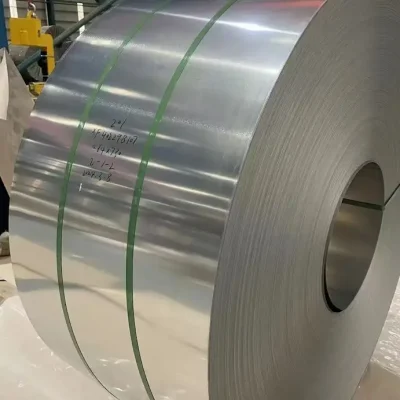
304 Stainless Steel Coil Testing Examples
Hardness Testing
Chemical Composition Analysis
Tensile Strength Test


Table of Contents
What Is 304 Stainless Steel Coil?
“304” identifies the alloy; “coil” identifies its delivery form. Type 304 is commonly identified as UNS S30400. The continuous flat product can be supplied as wider coil or slit into narrower strip for feeding, stamping, forming, and other downstream operations. “Coil” is not a fixed thickness category and does not, by itself, mean foil, spring temper, or a particular surface finish.
304 is a chromium-nickel grade, rather than the molybdenum-alloyed grade typically associated with 316. Chromium supports the protective passive surface, while nickel helps stabilize the austenitic structure. Outokumpu identifies 304/1.4301 as a standard Cr-Ni alloy available in both hot- and cold-rolled flat products. Outokumpu Core range
Use a named chemistry basis when writing numerical limits. ATI’s published 304 strip data gives the following composition, in weight percent. These are producer-published reference limits, not a replacement for the ordered standard edition or a chemical analysis of the offered coil. ATI 304 product data.
| Element | 304 strip reference, wt.% |
|---|---|
| Chromium | 17.5–19.5 |
| Nickel | 8.0–10.5 |
| Carbon | 0.07 maximum |
| Manganese | 2.00 maximum |
| Silicon | 0.75 maximum |
| Phosphorus | 0.045 maximum |
| Sulfur | 0.030 maximum |
| Nitrogen | 0.10 maximum |
| Iron | Balance |
304L is a separate low-carbon specification choice, not a label to substitute automatically. Its lower carbon limit matters when welding and subsequent exposure create a concern about intergranular corrosion. Specify the required grade and certification explicitly; a product description combining “304/304L” does not establish the certification of the coil offered. ATI 304-family technical data.
304 Stainless Steel Coil Standards: Specify More Than a Grade Name
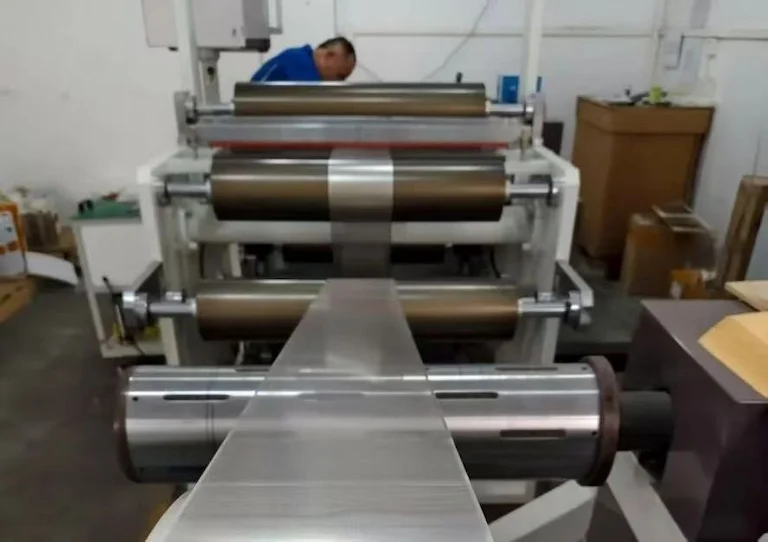
A useful specification separates alloy identity, product requirements, and test methods. A grade cross-reference helps identify a material family; the applicable product standard establishes the delivery requirements. A test method explains how a property is measured. None of these three roles replaces the others.
| System | Commonly cross-referenced designation | Relevant flat-product reference | What to confirm before accepting a substitution |
|---|---|---|---|
| United States | Type 304 / UNS S30400 | ASTM A240/A240M; applicable general requirements in ASTM A480/A480M | Edition, product form, delivered condition, units, dimensional requirements, and exceptions |
| United States, annealed or cold-worked material | Type 304, with the specified condition | ASTM A666/A666M | Whether the specified condition and required mechanical properties match the order |
| Europe, including national EN adoptions | 1.4301 / X5CrNi18-10 | EN 10088-2 for general-purpose sheet, plate, and strip | Product form, thickness, condition, finish, and the applicable delivery requirements |
| Japan | SUS304 | JIS G 4305 for cold-rolled plate, sheet, and strip | Cold-rolled versus hot-rolled scope, condition, properties, and dimensional requirements |
| China | 06Cr19Ni10, commonly cross-referenced to 304 | GB/T 3280 for cold-rolled plate, sheet, and strip | The actual grade, ordered edition, delivery requirements, and certificate results |
The scopes are described in the public references for ASTM A240, ASTM A480, ASTM A666, EN 10088-2, JIS G 4305, and GB/T 3280. Designation references include the Japan Stainless Steel Association cross-reference and Baosteel’s grade comparison. The latter is a designation reference, not proof that a coil meets a flat-product standard.
Cross-referenced grades are not automatically interchangeable orders. Compare chemistry limits, mechanical requirements, dimensions, condition, inspection provisions, and the actual certificate against the drawing. For pressure-containing or other code-governed parts, have the responsible engineer confirm the applicable code and permitted material specification separately.
Use a stated edition rather than an undated “meets international standards” claim. This guide uses publicly available scope information and producer data; it does not reproduce or verify every clause of the purchased standards. The contractually applicable edition and its product-specific provisions govern acceptance.
For thinner material supplied as foil, see our stainless steel foil guide.
How 304 Stainless Steel Coil Is Produced
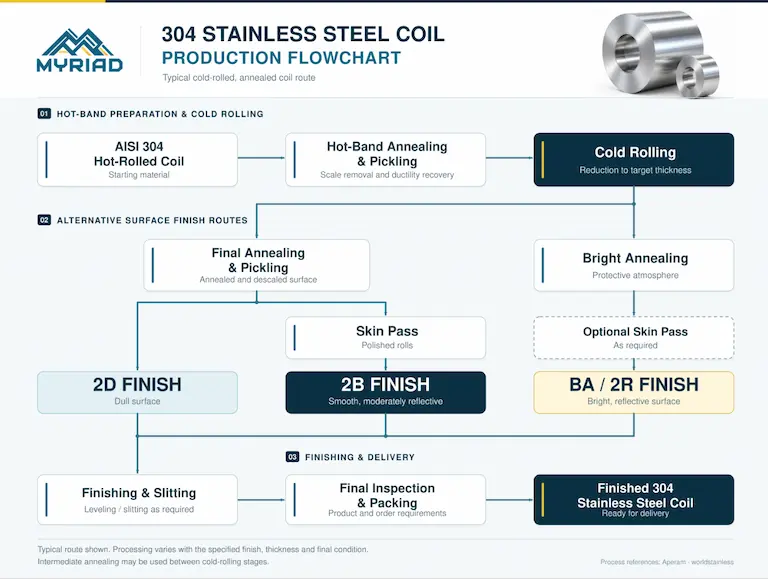
The production route determines more than the alloy chemistry. Rolling changes thickness and deformation history; heat treatment changes the delivered structure and properties; finishing establishes the usable surface, edges, and geometry. Trace these steps to the final requirements rather than treating a process name as a quality guarantee.
| Stage | What the stage does | Engineering implication / item to verify |
|---|---|---|
| Melting, refining, and casting | Produces the alloy and casts feedstock; routes commonly include electric-arc melting and AOD refining | Confirm heat identity and chemical analysis rather than inferring chemistry from appearance |
| Hot rolling | Reduces reheated feedstock to a hot-rolled flat product | Identify whether the order is for hot-rolled product or material that will receive further cold reduction |
| Annealing and descaling, where applicable | Adjusts material condition and removes process scale | Confirm the resulting condition and surface; a process label alone does not define the final mechanical values |
| Cold rolling | Further reduces thickness and introduces cold work | Verify final thickness, strength/hardness requirements, and shape rather than assuming all cold-rolled coil is soft |
| Final condition and finish selection | May include annealing, bright annealing, a light finishing pass, or further temper rolling, depending on the product | Distinguish the finished surface from the required mechanical condition |
| Leveling, slitting, and recoiling | Establishes final geometry, strip width, edges, and coil presentation | Confirm camber, edge/burr requirements, coil dimensions, and suitability for the feeding equipment |
The upstream route is outlined by SSINA’s stainless steel production guide.
Individual products do not necessarily pass through every stage in exactly the same sequence.
Cold-rolled does not automatically mean cold-hardened in the delivered condition. Material cold-rolled to thickness may subsequently be annealed; material intentionally temper-rolled after softening retains a different mechanical condition. Ask for the final property requirement and test result, not just confirmation that cold rolling occurred.
Shape control and mechanical-property control require separate confirmation. Roll setup, tension, and subsequent leveling affect how strip behaves when uncoiled, slit, or fed into tooling. A coil that meets tensile requirements can still be unsuitable for a process if camber, edge wave, burrs, or coil presentation are outside the agreed limits.
304 Stainless Steel Coil Properties: Strength, Hardness, and Formability
Read the mechanical values with their conditions
Annealed reference values are a starting point, not a universal 304 coil specification. The following values are published by ATI for annealed 304 flat products at room temperature. They do not establish Myriad’s guaranteed range or the measured properties of an offered lot. ATI technical data, mechanical-properties section
| Property | ATI-published annealed 304 reference | How to use it |
|---|---|---|
| Ultimate tensile strength | 75 ksi minimum / 515 MPa minimum | Reference for the stated product condition; confirm the ordered limit and actual result |
| 0.2% offset yield strength | 30 ksi minimum / 205 MPa minimum | Helps distinguish yielding from maximum tensile strength |
| Elongation | 40% minimum, using the source’s 2 in. or 51 mm gauge-length basis | Compare only with an applicable specimen and gauge-length requirement |
| Hardness | 92 HRB maximum | Confirm that the scale and method are valid for the actual material thickness |
The source’s inch-pound and SI figures are separately rounded specification values. They should not be treated as exact arithmetic conversions. State the governing unit system on the order and check the applicable standard before setting an acceptance threshold.
A different product-standard basis can give different reference numbers without indicating a defective material. Outokumpu’s EN-based table lists cold-rolled 304/1.4301 at 20°C with a 0.2% proof strength of 230 MPa minimum and tensile strength of 540–750 MPa. Its product-form labels and footnotes must remain attached to those figures; do not merge them with the ATI table into a new specification. Outokumpu mechanical properties, Table 5
Choose strength and hardness for the operation
Cold work increases strength and generally reduces the remaining forming margin. A harder condition may be useful for a part requiring greater resistance to permanent deformation, but a deeply formed part may need a more ductile condition. Specify the required strength or hardness and verify the part in the intended tooling; a temper name alone does not predict a successful bend or drawing operation.
Hardness does not replace a specified tensile test. Hardness measures resistance to indentation, while a tensile test measures behavior under uniaxial loading. Hardness conversions are approximate and material-dependent; an acceptance change requires agreement rather than an assumed conversion. ASTM E140 conversion limitations
Match corrosion resistance to the actual exposure
304 is a candidate for many formed components, but “stainless” is not a universal corrosion guarantee. Assess the contacting fluid, temperature, chloride contamination, cleaning chemicals, crevices, and surface condition. Corrosion tables are conditional: a general corrosion-rate entry does not automatically address pitting, crevice corrosion, or stress-corrosion cracking. BSSA guidance on interpreting corrosion data
How to Inspect Finished 304 Stainless Steel Coil
Build the inspection plan around what the part and order require. The table below is a planning guide, not a claim that every coil requires every test or that Myriad performs all of these tests in-house. Agree the sampling, methods, limits, and records before manufacture or shipment.
| Check | Practical method / basis | What the record should identify |
|---|---|---|
| Grade and chemistry | Traceable material analysis; suitable laboratory analysis when further verification is required | Heat/lot identity, element results, grade, and specification |
| Tensile, yield, and elongation | The applicable product-standard test provisions; ASTM E8/E8M is one relevant tensile-method family | Specimen dimensions, direction, gauge length, method, units, and results |
| Hardness | An appropriate Rockwell, superficial Rockwell, or Vickers method for the thickness and required condition | Scale, test force where applicable, specimen preparation, locations, and readings |
| Thickness and width | Calibrated equipment suitable for the gauge and surface; agreed measurement positions | Actual values, units, tolerance limits, and sampling positions |
| Shape | Agreed camber/flatness or uncoiling checks under defined support and measurement conditions | Measurement length, setup, locations, and deviations |
| Edges and surface | Visual inspection plus suitable burr/roughness measurement when specified | Edge condition, defect description, measured criterion, and inspected area |
| Coil presentation and traceability | Compare markings and delivery configuration with the order | Coil/heat IDs, quantity, inside/outside diameter or weight limits when specified, and document linkage |
Do not use XRF to establish the low-carbon designation
Conventional handheld XRF cannot verify the carbon limit that distinguishes a low-carbon grade. It can assist with alloy-element identification, but confirming a 304L requirement needs traceable chemistry and a method capable of measuring carbon. Discuss the appropriate analysis with the laboratory; a PMI display alone is not proof of low-carbon compliance. Thermo Fisher PMI-method limitations
Make tensile results comparable
Tensile numbers are comparable only when the test basis is appropriate. Agree the specimen orientation, preparation, dimensions, gauge length, and applicable product-standard requirements. Record these with the result; elongation measured on a different gauge basis should not be silently compared with a 40% reference entry. ASTM E8/E8M public scope and limitations
Select a hardness method that works at the actual thickness
Thin coil may require a lower-force or microindentation method rather than a regular Rockwell test. Thickness, indentation depth, support, preparation, and spacing can affect validity. Have the laboratory confirm an appropriate method before specifying or comparing readings. Struers guidance for thin-sheet hardness testing
A Vickers value needs its test conditions, not just the letters “HV.” Record the force designation and relevant preparation conditions, and use a method applicable to the specimen. ASTM E18, E92/E384, and the corresponding ISO hardness-method families address different methods; they are not interchangeable labels. Buehler’s stainless-steel hardness-method references
Review the evidence before releasing the material
Release should follow a match between the agreed specification, the identified material, and the applicable results. Check document IDs against the coil labels, compare each required result with its acceptance criterion, and resolve omissions or mismatches before use. A certificate title by itself does not establish that all required tests were performed on the material being supplied.
An out-of-limit result calls for identification and resolution, not a substitute test chosen to obtain a pass. Hold the affected material, check specimen identity and method validity, and follow the applicable retest or disposition provisions. Do not re-label a failed tensile requirement as acceptable merely because hardness appears satisfactory.
Matching 304 Stainless Steel Coil to the Part
Select the coil around the operation that limits the part, then verify the relevant material and process conditions. The same grade can be considered for different jobs, but those jobs do not necessarily need the same condition, surface, or dimensional limits.
| Part or operation | What to establish | Practical verification |
|---|---|---|
| Deep-drawn housings or formed cups | Remaining ductility, surface suitability, and the amount of deformation | Review material condition and trial the actual forming route |
| Stamped shims, washers, and small formed parts | Required strength, flatness, edge condition, and feed behavior | Check the agreed mechanical and geometric limits, then inspect the trial parts |
| Roll-formed or welded components | Forming demand, weld exposure, and whether 304 or 304L is required | Confirm the drawing grade and welding/service requirements before accepting a substitution |
| Exposed covers or panels | Appearance, handling damage, shape, and service environment | Use an agreed finish reference and relevant dimensional/surface criteria |
A process trial answers a different question from a material test. A passing material result does not prove a particular die setup, bend radius, weld procedure, or finished-part performance. When the part fails, compare material identity and measured properties with the processing conditions rather than changing the alloy name first.
Specifying 304 Stainless Steel Coil with Myriad
Myriad supplies stainless steel coil, precision strip, and foil, with 304 among its quoted grades. Its current overall supply scope includes thin-gauge products from 0.01 to 0.30 mm—approximately 0.000394 to 0.011811 in.—and BA/2B are its main surface options. These are company-level ranges; the particular 304 thickness, width, condition, and finish combination must be confirmed for the order.
Small production requirements can be discussed within a defined order policy. Myriad’s standard MOQ is 100 kg, approximately 220 lb, per identical specification item within an order. The item is defined by the same grade, thickness, width, and material condition. Lower quantities require a separate exception review; they are not automatically available, and different specifications do not combine to meet the MOQ.
A useful technical enquiry makes the fixed requirements and open questions visible. Myriad can discuss the submitted specification and unresolved selection questions without treating a general reference table as an order guarantee. Applicable material reports are sent for customer confirmation before shipment; the report combination and test scope must be confirmed for the order.
If your requirements are already defined
Submit the specification directly when the required properties and acceptance requirements are already known. Include the items below that apply to the product. Application details or drawings are needed only where they resolve an actual missing requirement, rather than as a blanket condition for an enquiry.
- Grade, product standard, and required edition.
- Delivered condition and the required tensile strength and/or hardness, including units or scale and test basis.
- Thickness, width, and agreed tolerances.
- Relevant surface, edge/burr, shape, and cleanliness requirements.
- Coil presentation limits needed by the equipment.
- Quantity per identical specification and required inspection documents.
If the required properties are not yet defined
Start with the operation, environment, and requirements that are already fixed. Describe the forming or service problem and identify what remains undecided. Supply a drawing only when its geometry or details are needed to resolve those questions. Any proposed property requirement should be confirmed by the buyer before it becomes the purchase specification.
Email your specification or selection question to info@myriadsteel.com. You can also use the Myriad contact page for a defined enquiry. If hardness or tensile strength is undecided, use email and identify that open question rather than entering a guessed value.
304 Stainless Steel Coil: Product Questions
Does magnetic attraction mean a 304 coil is the wrong grade?
Magnetic attraction alone does not identify a 304 coil as incorrect. Cold work can transform some austenite into magnetic martensite, so the response can change with processing. Verify the grade through traceable chemistry and suitable testing; if magnetic behavior affects the application, specify a measurable magnetic requirement separately. ASSDA magnetic-effects guidance
Can a coil labeled 304 be accepted automatically as SUS304 or EN 1.4301?
A 304 label is not evidence of compliance with every cross-referenced product specification. Ask which standards and editions the actual certificate covers, then check the required chemistry, condition, properties, dimensions, and inspection provisions. Accept a proposed substitution only after the responsible party confirms the drawing requirements are satisfied.
Does a 2B or BA finish establish the hardness of 304 coil?
A finish designation does not establish the complete mechanical acceptance requirements. It describes the surface and associated finishing route; it does not replace the ordered condition, strength, or hardness test. Put both the surface requirement and the required properties on the specification so that a visually acceptable coil is not mistaken for a mechanically suitable one.
Related reading: A complete guide to AISI 304L stainless steel.