
Choose the grade. Define the finished requirement.
Myriad supplies stainless steel foil, slit strip and cut-to-length thin sheets, with Type 304 and Type 304L available for quotation. Start with your required size and material properties; we will review the grade, condition and delivery form as one specification.
Coils, slit strip & cut-to-length foil sheets
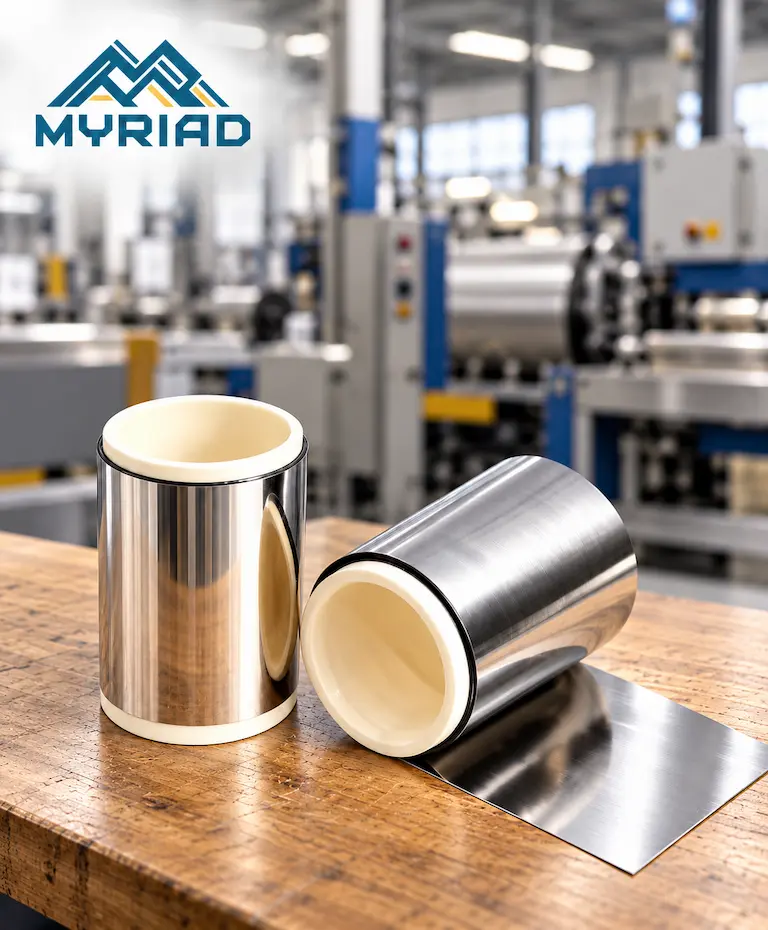
Thickness · width · temper · surface · edge
Overall supply range; the selected grade, width and condition require confirmation.
For 0.01 mm nominal thickness, the minimum width is 4 mm.
Specify the required grade; listing both does not establish dual certification.
Dimensions are controlled in millimeters. Inch values are approximate conversions for reference, not separate acceptance limits.
Build the specification around the part you need to make.
Use the ranges below to start a 304 or 304L inquiry. Availability is checked against the complete combination of grade, thickness, width, condition and product form.
| Item | Quotation range and options |
|---|---|
| Grade | Type 304 / UNS S30400 or Type 304L / UNS S30403. Identify any additional designation and the required product specification. |
| Thickness | Overall range: 0.01–0.30 mm, about 0.000394–0.011811 in. |
| Coil / slit-strip width | Overall range: 1.5–620 mm, about 0.059–24.409 in. At 0.01 mm thickness, width starts at 4 mm, about 0.157 in. |
| Condition and properties | State the delivery condition and known hardness and/or tensile limits. The specific 304 or 304L size–condition combination is reviewed before quotation. |
| Surface | BA and 2B are the principal options. Mirror finish needs separate assessment of the dimensions and surface acceptance criteria. |
| Edge | Slit, deburred, rounded/conditioned and scraped edge options. Include the edge profile and permissible burr where these affect processing. |
| Flat foil / thin sheet | Cut-to-length sheets: 70–500 mm wide, about 2.756–19.685 in. Requested length, condition, dimensional tolerances and flatness are confirmed for the order. |
The table describes Myriad's overall supply envelope, rather than every possible 304/304L combination. Here, “thin sheet” means flat foil cut to an agreed length; requests for thicker conventional sheet need separate review.
Apply each declared thickness tolerance only to its stated nominal size or interval. Confirm the rule for the selected grade and condition, together with the measurement and sampling arrangements.
| Nominal thickness, mm | Declared deviation, mm | Boundary or resulting range |
|---|---|---|
| 0.010 | +0.002 / 0 | Result: 0.010–0.012 mm |
| 0.015 | +0.002 / 0 | Result: 0.015–0.017 mm |
| 0.020 to 0.100 | ±0.002 | Both endpoints included |
| Above 0.100 up to 0.300 | ±0.030 | 0.100 excluded; 0.300 included |
At exactly 0.100 mm, the applicable deviation is ±0.002 mm. Nominal sizes between 0.010 and 0.020 mm other than the two listed sizes need an agreed tolerance; the listed values do not define an interpolation rule.
| Nominal coil / strip width, mm | Declared width deviation, mm |
|---|---|
| 1.5 to below 3 | To be confirmed for the requested specification |
| 3 to below 50 | ±2 |
| 50 to 100, including both limits | ±3 |
| Above 100 | ±5 |
The width table applies to normally processed coil material. It does not define flat-sheet width or length tolerances. The 4 mm minimum at 0.010 mm thickness still applies. Send any tighter limits for feasibility review; acceptance must be agreed before ordering.
Use the table for condition comparison, then agree the actual acceptance requirements. These historical reference minimum values are retained from Myriad's 304 & 304L Stainless Steel Coil Technical Datasheet, R1, based on ASTM A666—15; they are not Myriad batch test results or guaranteed properties for every configuration.
| Grade | Reference condition | 0.2% proof strength, MPa (ksi), min. | Tensile strength, MPa (ksi), min. | Elongation reference, min. |
|---|---|---|---|---|
| 304 | Annealed | 205 (30) | 515 (75) | 40% |
| 304 | ¼ hard | 515 (75) | 860 (125) | 10% |
| 304 | ½ hard | 760 (110) | 1035 (150) | 6% |
| 304L | Annealed | 170 (25) | 485 (70) | 40% |
| 304L | ¼ hard | 515 (75) | 860 (125) | 8% |
| 304L | ½ hard | 760 (110) | 1035 (150) | 5% |
The cold-worked elongations refer to material below 0.015 in (0.381 mm), a category that includes the stated 0.01–0.30 mm thickness envelope; annealed values are listed separately. The reference uses a 2 in or 50 mm gauge-length basis. Agree the actual gauge length, specimen geometry, direction, test method, standard edition and numerical limits for acceptance.
A listed temper does not establish availability of every foil or sheet combination, or conformity to a current standard edition.
Thin-foil tests need a valid measurement setup. Review ASTM E345's metal-foil tensile-test scope when selecting a method. For hardness, identify the method, test force, dwell time and valid specimen thickness/support conditions; a converted hardness value does not replace a specified tensile test.
These maxima and ranges summarize Myriad's previous material-testing compilation. They are mass percentages, not a single-heat analysis or a table of ASTM composition limits. Use heat-specific analysis and the agreed specification to accept the material being ordered.
| Grade | C max. | Mn max. | S max. | P max. | Si max. | Cr range | Ni range |
|---|---|---|---|---|---|---|---|
| 304 | 0.08 | 2.0 | 0.03 | 0.045 | 1.0 | 18–20 | 8.0–10.5 |
| 304L | 0.03 | 2.0 | 0.03 | 0.035 | 1.0 | 18–20 | 8.0–12.0 |
The underlying historical reports, individual sample identities and compilation method are not supplied with this summary. It does not certify the composition of a new order.
Choose the grade for service and fabrication, then specify the condition for processing. Grade and temper answer different questions: 304L’s lower carbon addresses particular welding concerns, while cold work changes strength and remaining ductility. ATI’s 304/304L technical data provides the material background.
Consider 304 for parts that need a balance of formability and corrosion resistance. State the forming route and known mechanical limits so the delivery condition can be assessed. Check the actual environment rather than selecting on the grade name alone.
Consider 304L when lower carbon matters to the welding specification. It helps address sensitization and associated intergranular-corrosion concerns, but does not automatically provide better resistance to chloride pitting or crevice corrosion. Service conditions and the joint still need assessment.
Match condition to the required forming allowance and finished strength. Cold work raises strength and hardness while reducing ductility. Annealed, half-hard and full-hard flat-sheet options are reviewed by grade and dimensions; quarter-hard sheet is an inquiry for separate supply confirmation. Welding can reduce strength gained by cold work, so assess any post-weld requirement separately.
Ask for dual certification explicitly if the order requires both grades. “304/304L” on a page identifies two quotation options; it does not mean every offered coil qualifies as both. The supplied material and its documentation must satisfy the agreed requirements.
Set the acceptance basis before the material is ordered. Myriad’s report-review process gives you a confirmation step before shipment; it does not replace the need to agree the required limits and valid test methods.
Resolve the open specification items before order confirmation. Align grade, dimensions, condition, surface and edge with the sampling and test basis. For very thin foil, consider handling, contact pressure, specimen preparation and gripping where these affect valid measurement.
The report package depends on the order and reporting policy. A Myriad report plus a third-party report applies when this order actually takes at least 500 kg of one identical specification—same grade, thickness, width and condition—from the same heat and the same parent coil before slitting. Different parent coils cannot be added together, and the original parent-coil weight is not the threshold basis.
Below that threshold, the policy provides a Myriad report without third-party testing under this rule. For qualifying third-party tests, the order defines any special items; tensile strength alone is the routine default if no special tests are required.
Shipment follows your confirmation of the material reports. Reports are prepared after production and applicable testing, then sent for review. Normal delivery also requires payment of the remaining balance; exceptions need separate approval.
The supply and table references come from Myriad's confirmed supply records and technical-library 304 & 304L Stainless Steel Coil Technical Datasheet, R1. The library's 304 and 304L Stainless Steel Coil: Data and Evidence Boundaries is used to distinguish historical chemistry, selection references and order acceptance. Those sources do not turn a reference value into a batch guarantee.
Select the governing product standard by the material form and condition. ASTM A666/A666M's public scope covers annealed or cold-worked austenitic flat products; the full current tables have not been reviewed for this page. Any A240/A480, A666 or other specified route, edition and unit system must be checked for the actual order. The declared tolerances above are Myriad supply references, not an assertion that all sizes meet a named dimensional standard.
Choose continuous or flat material to suit handling and production. Request either grade in the required form, then confirm the dimensions, condition and acceptance requirements together.
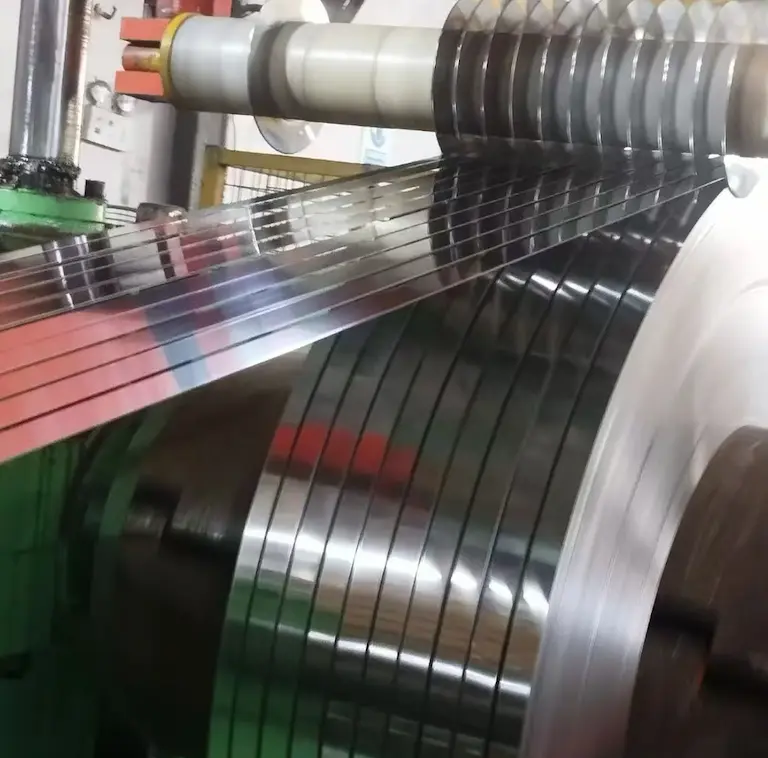
Specify the coil geometry as well as the metal dimensions. Include inside diameter/core, maximum outside diameter, required coil weight, winding arrangement and edge condition. These requirements are confirmed for the selected 304 or 304L specification.
Specify width, cut length and the flatness your process needs. Flat-sheet width is 70–500 mm; length is reviewed to your request. Coil width tolerances do not define sheet width or length acceptance, and a temper name does not set a flatness limit.
Inquire about flat foil sheets ↗
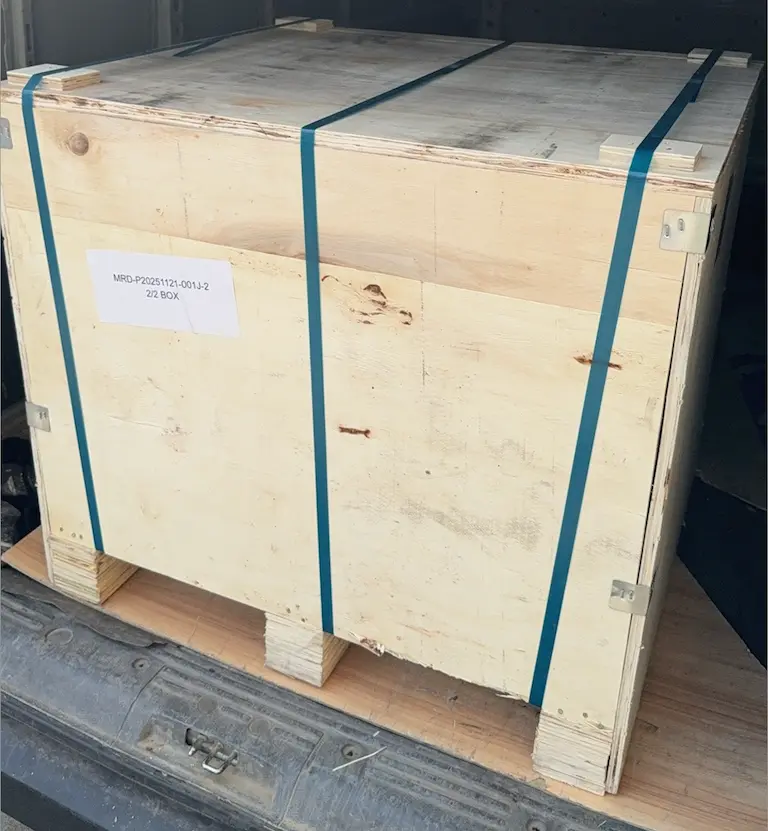
Packing is selected for the shipment and handling requirements. Myriad offers moisture-protective packing, pallets, wooden cases and customer-specified arrangements; wooden cases are the main option. Confirm the packing combination, unit weights and any special requirements with the order.
Submit the requested temper with numerical properties for review. Half hard is an established flat-sheet condition option, subject to the particular grade and dimensions. Quarter-hard flat sheets require separate supply confirmation. The reference table describes material conditions; it is not a stock list. For 304L, likewise specify the grade rather than assuming 304 requirements transfer unchanged.
That combination falls outside the declared minimum-width rule. At 0.01 mm nominal thickness, the minimum is 4 mm. The overall 1.5 mm width capability should not be combined automatically with the minimum thickness; other narrow specifications require their own review.
Cold working can increase the magnetic response of these austenitic grades. Attraction alone cannot establish grade, temper or acceptance. Specify the material identity, mechanical requirements and any magnetic requirement separately.
Assess the welded condition separately from the delivered foil condition. Welding may reduce cold-worked strength, while thin material also requires attention to heat input, fixturing and shielding. Lower-carbon 304L does not by itself verify the finished joint's properties or corrosion performance.
Yes—send the numerical limits and measurement basis for feasibility review. Identify the exact grade, condition and product form. Tighter dimensions, sheet tolerances and flatness are agreed requirements only after confirmation, rather than automatic extensions of the listed ranges.
Lower carbon does not make 304L a universal upgrade for chloride service. Pitting and crevice-corrosion suitability also depend on exposure, temperature and surface conditions. Describe those conditions if grade selection is open; request a material review rather than relying only on the “L” designation.
Send the requirements already decided, and identify what still needs advice. If dimensions and hardness and/or tensile requirements are complete, send them directly. If a property is undecided, describe the component function, forming process and relevant service conditions; include a drawing when it resolves that specific gap. Proposed property values need your confirmation before becoming order requirements.
Provide your name, company, email and destination, together with any required schedule. Myriad will review the specification, clarify unresolved items and confirm the available supply options and quotation terms.
Nothing has been sent yet. Review the information below, then confirm your details in the email form and click Send 304 / 304L inquiry.