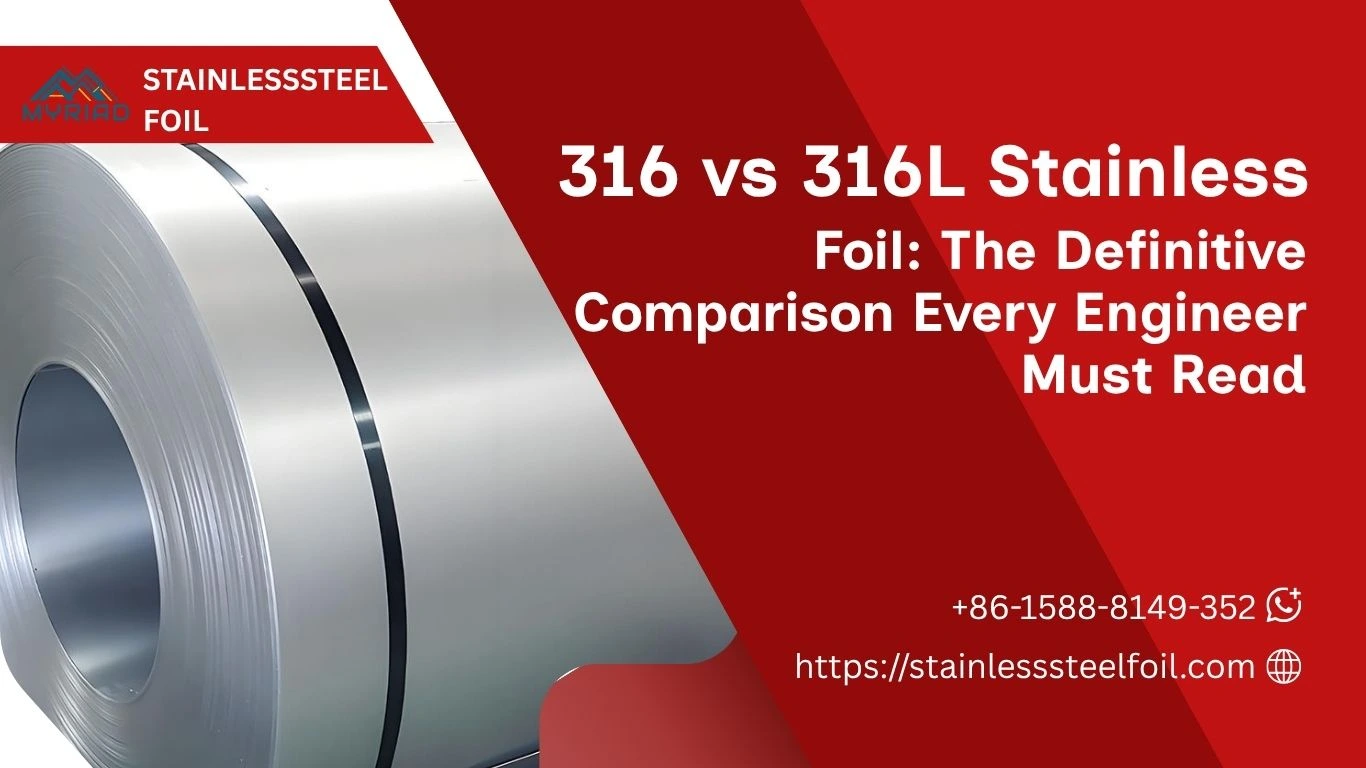
When sourcing precision materials for high-performance applications, the “316 or 316L” dilemma is one of the most common hurdles for procurement teams and engineers alike. At a glance, these two grades look identical, feel identical, and offer nearly identical chemical profiles. However, choosing the wrong one can lead to catastrophic structural failure or localized corrosion in as little as a few months.
The fundamental question is: What is the actual difference, and does it really matter for my application?
The short answer is a single number—the carbon content. While standard 316 stainless steel foil is the go-to for general marine and chemical environments, the “L” in 316L stands for “Low Carbon.” This subtle shift in chemistry is the deciding factor in weldability and resistance to intergranular corrosion. Understanding this distinction is critical before you finalize your 316 stainless steel foil order.
Understanding the Chemistry: What “L” Actually Means
Both 316 and 316L belong to the austenitic stainless steel family. They are molybdenum-bearing grades designed for environments where standard 304 stainless steel may fail due to chloride attack or chemical exposure.
Chemical Composition of 316 Stainless Steel
Typical composition of standard 316:
- Chromium (Cr): 16–18%
- Nickel (Ni): 10–14%
- Molybdenum (Mo): 2–3%
- Carbon (C): ≤0.08%
International designations:
- EN: 1.4401
- UNS: S31600
Chemical Composition of 316L Stainless Steel
Typical composition of 316L:
- Chromium (Cr): 16–18%
- Nickel (Ni): 10–14%
- Molybdenum (Mo): 2–3%
- Carbon (C): ≤0.03%
International designations:
- EN: 1.4404
- UNS: S31603
The chemistry is nearly identical except for one factor:
The Ultra-Low Carbon Difference
316L contains less than 0.03% carbon, while standard 316 allows up to 0.08%.
That lower carbon content significantly reduces the risk of sensitization during welding.
Sensitization occurs when stainless steel is exposed to temperatures between approximately 450°C and 850°C. Carbon combines with chromium to form chromium carbides at grain boundaries. This process depletes chromium from nearby areas, weakening corrosion resistance and creating localized attack zones.
316L minimizes this risk.
Why Molybdenum Matters
The addition of molybdenum is what separates both 316 grades from standard 304 stainless steel.
Molybdenum improves:
- Pitting corrosion resistance
- Crevice corrosion resistance
- Chloride resistance
- Marine environment durability
- Acid resistance
This is why AISI 316 foil and AISI 316L foil are widely used in marine, pharmaceutical, medical, and chemical-processing applications.
For a broader understanding of stainless steel metallurgy, see:
Stainless Steel Overview
PREN Value: Predicting Corrosion Resistance
Engineers often compare stainless steels using the Pitting Resistance Equivalent Number (PREN).
The formula is:
PREN=%Cr+3.3(%Mo)+16(%N)PREN = \%Cr + 3.3(\%Mo) + 16(\%N)
Higher PREN values indicate stronger resistance to chloride pitting corrosion.
Typical PREN values:
- 304 Stainless Steel: ~18–20
- 316 Stainless Steel: ~24–26
- 316L Stainless Steel: ~24–26
This explains why 316 grades outperform 304 in saltwater and aggressive chemical environments.
If you are comparing grades for thin-gauge precision applications, this guide may also help:
How Thin Can Stainless Steel Foil Actually Get?
Side-by-Side Comparison: 316 vs 316L Properties
The table below provides a comprehensive comparison of every property an engineer or buyer needs to evaluate when choosing between AISI 316 foil and AISI 316L foil for a stainless steel foil sheet application:
| Property | 316 | 316L |
| Max Carbon (%) | 0.08 | 0.03 |
| Tensile Strength (MPa, min) | 515 | 485 |
| Yield Strength (MPa, min) | 205 | 170 |
| Elongation (%, min) | 40 | 40 |
| Hardness (HB, max) | 217 | 217 |
| Max Service Temp (°C) | 870 | 870 |
| Sensitization Range | Susceptible (450–850°C) | Resistant |
| Weldability | Good (post-weld anneal advised) | Excellent (no anneal needed) |
| Magnetic Behavior (annealed) | Non-magnetic | Non-magnetic |
| PREN | 24–26 | 24–26 |
| Relative Price | Baseline | +3–8% premium |
Several points deserve emphasis. First, the tensile strength difference (515 MPa vs a minimum of 485 MPa) is modest and becomes significant only in applications where the foil operates near its mechanical limits at elevated temperatures. For most foil applications — shielding, gasketing, barrier films — this difference is negligible.
Second, both grades are non-magnetic in the annealed condition. Cold working can induce a slight degree of magnetism in either grade due to the formation of strain-induced martensite, but this is generally minor at typical foil gauges.
Third, the temperature ratings are identical for continuous service (870°C). The advantage of 316L appears specifically in the 450–850°C sensitization range, where it resists carbide precipitation far more effectively than standard 316. For cryogenic applications, both grades retain excellent toughness and ductility down to liquid nitrogen temperatures (−196°C), making them suitable for LNG and cryogenic storage components.
Finally, from a processing standpoint, both grades cold-roll, form, and polish identically. There is no difference in machinability, bendability, or surface finish quality at any temper. The choice between 316 and 316L is purely a corrosion-engineering and welding decision, not a manufacturing one.
When to Choose Standard 316 Foil
Standard 316 is the correct choice in a well-defined set of circumstances. Understanding these will help you avoid paying the 316L premium when it is unnecessary. The key principle is simple: if no welding is involved and the operating environment stays below the sensitization temperature range, standard 316 provides identical corrosion performance at lower cost.
Non-welded applications requiring maximum strength. The higher permissible carbon content gives 316 a modest tensile strength advantage. For precision shims, spring elements, and mechanical components that will never be welded, standard 316 offers marginally better performance.
Service temperatures below 450°C. Below the sensitization temperature range, carbon content has no bearing on corrosion performance. Both grades behave identically in ambient and moderately elevated temperature environments.
Marine hardware without welded joints. Fastener shims, non-welded brackets, gasket materials, and similar components in marine environments benefit from 316’s chloride resistance without needing the weldability advantage of 316L.
Chemical processing at elevated temperatures. In certain reactor and heat exchanger applications where the foil is not welded but must resist creep, the additional carbon strengthening in 316 provides a small but meaningful advantage.
Budget-sensitive projects without welding. The 3–8% cost difference between 316 and 316L is significant at scale. When welding is not part of the fabrication process, there is no technical justification for paying the premium.
When 316L Is the Only Correct Choice
There are applications where specifying anything other than 316L stainless steel foil is a technical error. These fall into several clearly defined categories.
Any welded assembly. This is the primary use case for 316L and the reason the grade exists. The ultra-low carbon content virtually eliminates intergranular corrosion in the heat-affected zone, meaning welded joints retain full corrosion resistance without the need for post-weld solution annealing. For foil below 0.1 mm, where conventional arc welding is replaced by vacuum brazing or laser welding, 316L remains the correct specification because even these lower-heat processes can locally raise temperatures into the sensitization range.
Medical devices and surgical implants. ASTM F138 specifies 316LVM (vacuum-melted 316L) as the standard grade for surgical implant applications. Even non-implant medical foil — flexible surgical tool sheaths, sterilization packaging, diagnostic sensor housings — defaults to 316L foil for medical applications due to its superior biocompatibility and corrosion resistance in body-fluid environments.
Pharmaceutical equipment. Both FDA and EU GMP regulations require 316L for product-contact surfaces in pharmaceutical manufacturing under current Good Manufacturing Practice (cGMP). This applies to reactor vessels, piping, and any foil used as a barrier or gasket material in drug production environments.
Nuclear applications. Radiation environments generate conditions that accelerate intergranular corrosion. The combination of elevated temperatures, aggressive coolant chemistry, and radiation-enhanced diffusion makes sensitization a far greater risk than in conventional industrial settings. 316L’s resistance to sensitization makes it the standard grade for nuclear fuel processing, reactor containment components, spent fuel storage, and related applications.
Food and beverage equipment with welded joints. Welded pipe runs, tank fittings, and processing equipment in food production facilities require 316L to maintain corrosion resistance at weld points, particularly in environments involving acidic foods, brines, or cleaning chemicals.
View our 316 stainless steel coil product listing for available 316L specifications.
Real-World Applications by Industry
The 316 vs 316L decision plays out differently across industries. The following breakdown shows how each sector typically specifies these grades, drawn from our experience supplying foil to manufacturers in North America, Europe, and Russia over nearly three decades.
Offshore and Marine
Non-welded hardware — shims, gaskets, spacers, and spring elements — uses standard 316 for its combination of chloride resistance and mechanical strength. Any welded structural element, pipeline component, or pressure-containing assembly specifies 316L. The marine environment is unforgiving of sensitized grain boundaries, and chloride-induced stress corrosion cracking can propagate rapidly in improperly graded weld zones. Offshore platforms, desalination plants, and shipboard equipment represent some of the highest-volume applications for both grades.
Medical Device Manufacturing
This sector overwhelmingly favors 316L. Flexible surgical tool sheaths, implant packaging, catheter reinforcement layers, and diagnostic sensor housings all require the low-carbon grade. For implantable devices, ASTM F138 mandates 316LVM, which adds vacuum melting to the 316L specification for enhanced cleanliness and inclusion control. The vacuum melting process reduces non-metallic inclusions — primarily sulfides and oxides — that could serve as initiation sites for pitting corrosion in the highly aggressive body-fluid environment. Even for non-implant medical devices, the trend across the industry is toward specifying 316L as the default foil grade, driven by regulatory caution and the desire to simplify incoming material qualification.
Chemical Processing
Reaction vessels, heat exchanger plates, chemical barrier films, and sensor housings in chloride-containing chemical environments default to 316L. The grade’s resistance to sulfuric acid, acetic acid, and phosphoric acid at moderate concentrations and temperatures makes it a workhorse material for the chemical industry. The exception is non-welded components in mild chemical service below 450°C, where standard 316 is acceptable and more cost-effective.
Food and Beverage Processing
For welded equipment — piping runs, tank internals, valve components — 316L is mandatory. Non-welded food-contact surfaces such as countertops, chutes, and barrier foils, can use standard 316, which meets all FDA requirements for direct food contact. The brewing, dairy, and winemaking industries are particularly heavy users of 316L due to the combination of acidic product exposure, frequent wash-down cycles with caustic cleaning chemicals, and extensive welded piping networks. In these environments, the cost premium of 316L is trivial relative to the expense of replacing prematurely corroded equipment.
Decision Flowchart
A simplified decision logic for grade selection: Is the component welded? This flowchart applies to the vast majority of industrial purchasing decisions and eliminates the most common specification errors. Of course, edge cases exist — high-temperature cycling, cryogenic applications, and specific regulatory mandates may override this general logic — but for everyday procurement, it is a reliable framework.
For applications where 304 is the better fit, read our 304 stainless steel strip supplier page or our guide on 301 stainless steel foil.
Myriad’s 316 and 316L Foil: Available Specifications
As one of China’s established stainless steel foil suppliers, Myriad produces both 316 and 316L foil across a comprehensive specification range:
Thickness: 0.01 mm (10 microns) to 0.1 mm (100 microns), produced on our 20-roll Sendzimir mill with CNC thickness control within ±0.005 mm.
Width: 3 mm to 610 mm (24″), with custom precision slitting to your exact specifications.
Temper: Annealed (soft), Quarter Hard (1/4H), and Half Hard (1/2H) available in both grades.
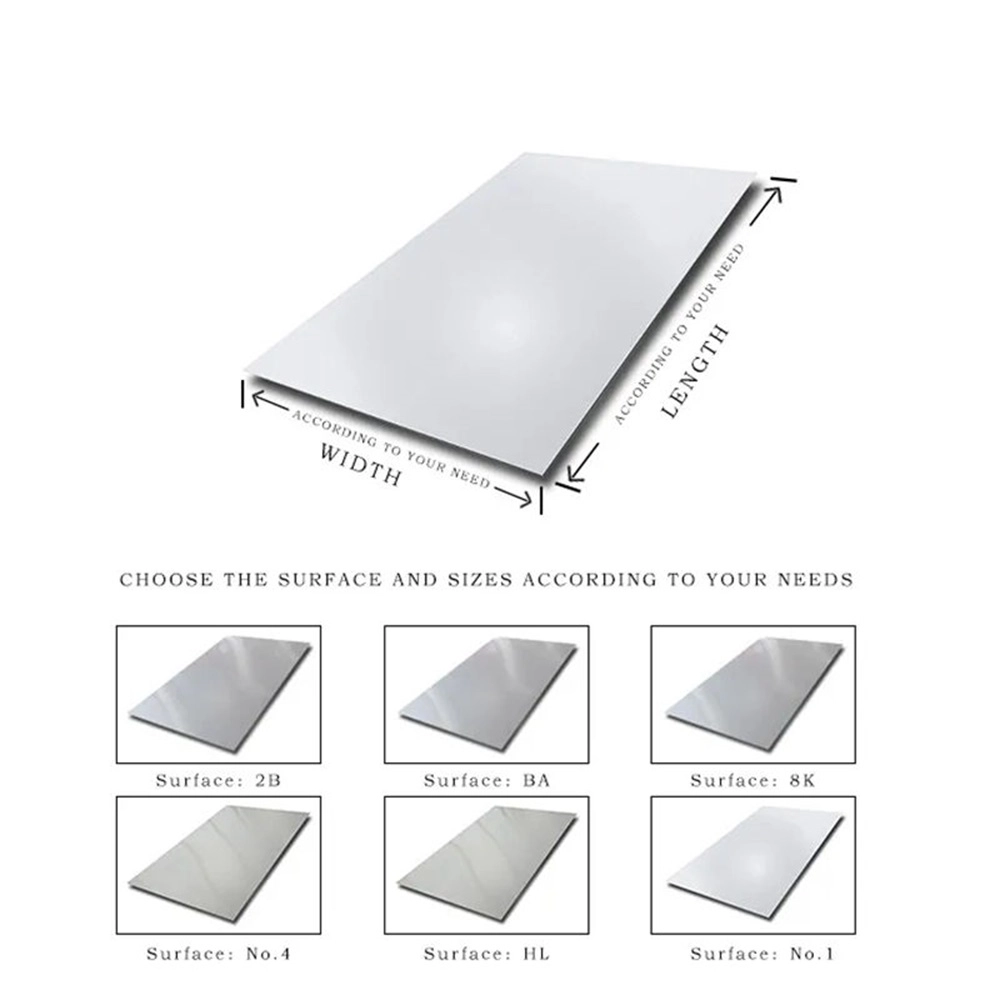
Surface Finish: 2B (standard smooth), BA (bright annealed), No. 4 (brushed), and mirror (No. 8).
Quality Assurance: Every production batch undergoes spectrometer verification of molybdenum and carbon content. Mill test certificates (MTC) are provided with each shipment, documenting full chemical composition, mechanical properties, and dimensional measurements.
Inventory: We maintain over 100 tons of stainless steel foil in ready stock, including 316 and 316L in multiple thicknesses for fast dispatch. Common stock sizes ship within 5–7 business days.
Export Packaging: All shipments are interleaved with protective paper, wrapped in PVC film, strap-banded, and crated on fumigation-certified wooden pallets for international shipping.
When evaluating stainless steel foil price, keep in mind that Myriad offers competitive pricing from our Ningbo production base, with an MOQ of 100 kg and free samples for qualified buyers. Our ISO 9001-certified facility has been producing ultra-thin foil since 1996.
Learn more about how thin our foil can go, or contact us directly for pricing and samples.
Final Thoughts
The difference between 316 and 316L stainless steel foil may seem small on paper, but in real-world applications, it can determine the success or failure of an entire project.
Choose standard 316 when:
- Welding is not required
- Slightly higher strength matters
- Budget optimization is important
Choose 316L when:
- Welding is involved
- Corrosion resistance is critical
- Medical, pharmaceutical, or sanitary standards apply
For engineers and procurement teams, selecting the correct foil grade ensures longer service life, fewer failures, and better overall performance.
To explore available specifications and request technical support, visit: Myriad Stainless Steel Foil Solutions
FAQs
Is 316L always more expensive than 316 stainless steel?
Usually yes.
316L typically carries a 3–8% premium because tighter carbon control increases production complexity and quality testing requirements.
Can 316L handle saltwater?
Yes.
Both 316 and 316L offer significantly better chloride resistance than 304 stainless steel. For welded marine structures, 316L is preferred.
Do I need 316L for my food production line?
If the system involves welding, 316L is strongly recommended.
For non-welded food-contact components, standard 316 is often acceptable.
Can 316L replace 316 everywhere?
Almost always.
316L matches or exceeds 316 in corrosion resistance. The only limitation is slightly lower high-temperature tensile strength.
How do I confirm the foil is truly 316L?
Request:
- Mill Test Certificates (MTC)
- Chemical analysis report
- PMI (Positive Material Identification) testing
Reliable suppliers provide full traceability documentation.
What is the MOQ for 316L foil from Myriad?
Typical MOQ is 100kg.
Qualified buyers can also request free samples for evaluation and prototyping.