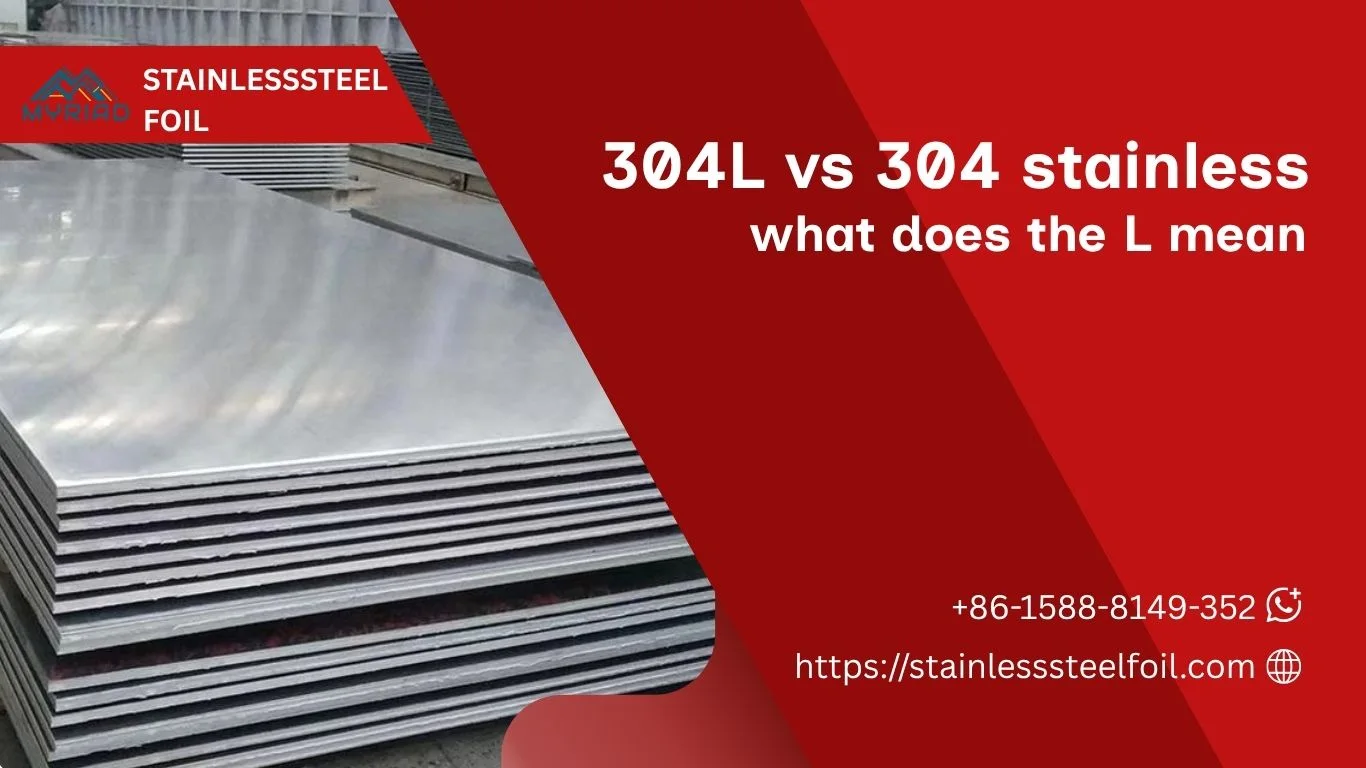
When comparing stainless steel materials, one question appears repeatedly among engineers, buyers, fabricators, and manufacturers: 304L vs 304 stainless steel—what does the L mean?
At first glance, these two grades seem nearly identical. Both belong to the popular 300-series stainless steel family. Both offer excellent corrosion resistance, good formability, and outstanding versatility. In many applications, they even look exactly the same.
However, a small difference in chemical composition creates an important distinction between the two materials. That single letter “L” influences welding performance, corrosion resistance after fabrication, and suitability for specific industrial environments.
Understanding the difference between 304L vs 304 stainless steel is especially important when selecting materials for stainless steel foil, heat treatment applications, food processing equipment, pressure vessels, chemical systems, and welded structures.
In this guide, we’ll explain what the “L” designation means, compare the properties of both grades, discuss real-world applications, and help you determine which material is best for your project.
If you are unfamiliar with stainless steel foil materials, you may first want to read this guide on what stainless steel foil is before exploring grade selection in greater detail.
What Does the “L” Mean in 304L Stainless Steel?
The letter “L” stands for Low Carbon. This simple designation indicates that 304L stainless steel contains less carbon than standard 304 stainless steel.
Standard 304 stainless steel typically contains a maximum carbon content of 0.08%, while 304L limits carbon content to a maximum of 0.03%.
Although the numerical difference appears small, it has a significant effect on how the material behaves during welding and high-temperature fabrication.
When stainless steel is heated during welding, chromium carbides can form along grain boundaries. This process may reduce corrosion resistance in the affected area. Lower carbon content helps minimize carbide precipitation, allowing the material to maintain better corrosion resistance after welding.
This is the primary reason why many industries choose 304L instead of standard 304 for fabricated and welded components.
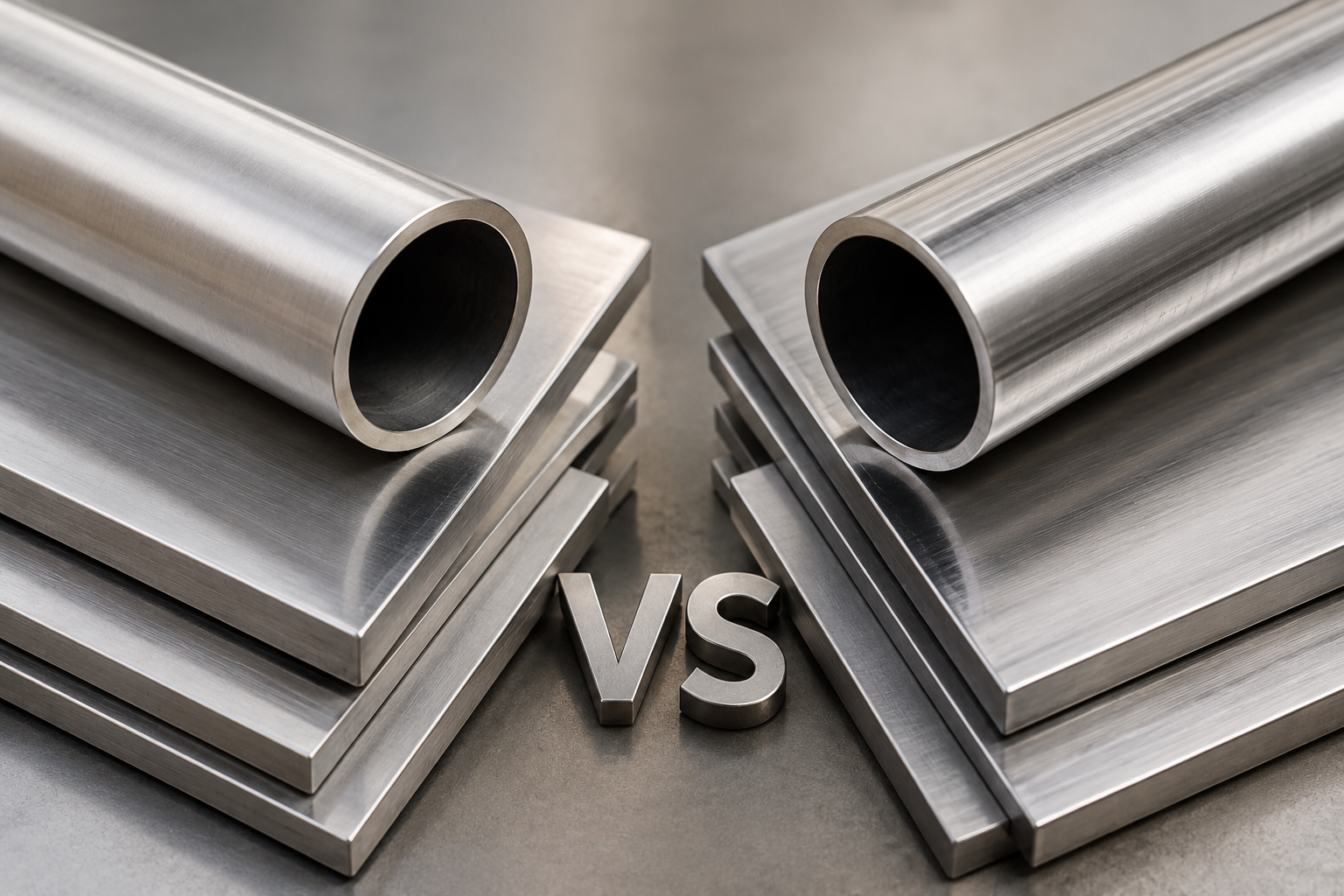
The Importance of Carbon in Stainless Steel
To fully understand the debate surrounding 304L vs 304 stainless steel, it helps to examine the role carbon plays in stainless steel metallurgy.
Carbon increases hardness and strength in steel. However, excessive carbon can create challenges during welding.
When temperatures rise between approximately 450°C and 850°C, chromium can combine with carbon to form chromium carbides. These carbides reduce the amount of chromium available to protect the material against corrosion.
As explained in the technical overview of stainless steel metallurgy, chromium is the element responsible for forming the protective passive layer that prevents rust and corrosion.
Reducing carbon content minimizes carbide formation. As a result, 304L often performs better in welded applications where long-term corrosion resistance is critical.
304L vs 304 Stainless Steel Chemical Composition
The most significant difference between these materials is carbon content.
| Element | 304 Stainless Steel | 304L Stainless Steel |
|---|---|---|
| Chromium | 18-20% | 18-20% |
| Nickel | 8-10.5% | 8-12% |
| Carbon | Max 0.08% | Max 0.03% |
| Manganese | Max 2.0% | Max 2.0% |
| Silicon | Max 1.0% | Max 1.0% |
| Iron | Balance | Balance |
Aside from carbon content, the chemical compositions remain remarkably similar.
Because the difference is so small, many buyers assume the materials are interchangeable. In reality, application requirements often determine which grade delivers the best results.
304L vs 304 Stainless Steel Mechanical Properties
One common misconception is that 304L significantly outperforms 304 in every category. The truth is more nuanced. Standard 304 generally offers slightly higher tensile and yield strength because of its higher carbon content. However, the difference is relatively small for most applications.
304L sacrifices a small amount of strength in exchange for improved weldability and better resistance to intergranular corrosion.
For many industrial projects, this trade-off is worthwhile.
When components require extensive welding, long service life, and corrosion resistance, engineers frequently prefer 304L despite the slight reduction in mechanical strength.
Why 304L Is Often Preferred for Welding
The welding advantage is the main reason the discussion around 304L vs 304 stainless steel remains important. During welding operations, stainless steel experiences localized heating. Standard 304 can become sensitized if chromium carbides form in heat-affected zones.
Once sensitization occurs, corrosion resistance may decline in those specific areas. Because 304L contains less carbon, the risk of carbide precipitation decreases significantly.
This allows manufacturers to weld the material without requiring additional post-weld heat treatments in many situations.
Industries such as food processing, pharmaceutical manufacturing, water treatment, and chemical production frequently select 304L for this reason.
The reduced need for post-processing can lower fabrication costs while improving long-term reliability.
Corrosion Resistance: Is 304L Better Than 304?
In most everyday environments, both grades provide very similar corrosion resistance. However, differences become noticeable after welding. Standard 304 performs exceptionally well in atmospheric conditions, fresh water, food processing environments, and many industrial settings. 304L delivers comparable corrosion resistance while offering better protection against intergranular corrosion after fabrication.
This distinction becomes especially important when components operate in corrosive environments for extended periods.
For welded tanks, pressure vessels, piping systems, and fabricated assemblies, many engineers consider 304L the safer long-term choice.
304L vs 304 Stainless Steel in Stainless Steel Foil Applications
The choice between these grades often extends beyond heavy industrial equipment. Manufacturers of precision foil products also evaluate the benefits of 304L vs 304 stainless steel.
For many foil applications, standard 304 remains the most widely used material because it offers excellent corrosion resistance, availability, and affordability.
You can learn more in this comprehensive guide to 304 stainless steel foil.
However, when foil products require extensive welding, thermal processing, or exposure to aggressive environments, 304L may provide additional protection.
Businesses sourcing premium materials often review available options through the stainless steel foil product range before selecting a grade.
Heat Resistance and High-Temperature Performance
Heat resistance is another factor worth considering. Both grades perform well in elevated-temperature environments. However, carbon content influences long-term behavior.
304 provides excellent oxidation resistance at high temperatures. Yet prolonged exposure within sensitization temperature ranges can increase the risk of carbide precipitation.
304L reduces this concern because its lower carbon content minimizes chromium carbide formation.
As a result, industries involved in thermal processing frequently evaluate 304L when selecting foil materials for high-temperature applications.
Additional information can be found in resources discussing the best stainless steel foil grade for heat and stainless steel foil for heat treatment.
Cost Comparison Between 304 and 304L
Many buyers assume that 304L costs substantially more than 304. In reality, pricing differences are often relatively small. Market conditions, nickel prices, supplier availability, and order volume typically influence cost more than carbon content alone.
In many cases, the difference is minimal enough that buyers choose 304L simply to gain the additional welding benefits. This trend has become increasingly common in modern manufacturing.
As a result, some suppliers stock larger quantities of 304L than standard 304.
Industries That Commonly Use 304L Stainless Steel
The advantages of lower carbon content make 304L attractive across a wide range of industries. Food processing facilities frequently use welded tanks and piping systems manufactured from 304L.
Pharmaceutical manufacturers value its corrosion resistance and cleanability. Chemical processing plants often select 304L because welded structures maintain better long-term performance.
Energy companies exploring advanced materials can also benefit from resources discussing stainless steel grades for hydrogen energy systems.
Meanwhile, electronics manufacturers continue exploring applications such as stainless steel foil EMI shielding.
When Should You Choose 304 Instead of 304L?
Despite the popularity of 304L, standard 304 still has an important place in industry. If a component requires minimal welding and slightly higher strength, standard 304 may be the better choice.
Many decorative, architectural, and consumer products successfully use 304 without experiencing any corrosion-related issues. When fabrication conditions do not create sensitization concerns, standard 304 often performs exceptionally well.
The final decision should always consider operating environment, fabrication methods, and performance requirements.
304L vs 304 Stainless Steel: Which One Is Better?
The answer depends entirely on the application. For heavily welded components, 304L often provides a clear advantage. For general-purpose applications where welding is limited, standard 304 may be perfectly suitable.
Neither grade is universally superior. Instead, each material offers strengths that make it ideal for specific situations. Understanding those strengths allows manufacturers and engineers to make informed material selections that maximize performance and value.
Summary
304L vs 304 stainless steel begins with understanding the role of carbon. Although these grades appear nearly identical, the lower carbon content of 304L significantly improves weldability and resistance to intergranular corrosion.
For welded structures, tanks, piping systems, and many industrial applications, 304L often delivers the best long-term performance. Standard 304 remains an excellent material for countless general-purpose uses where welding concerns are minimal.
Choosing the right grade ultimately depends on your fabrication process, operating environment, and performance expectations.
For more information about stainless steel foil products, technical specifications, and custom material solutions, visit our stainless steel foil website. If you need help selecting the right material, please contact us and our team will be happy to assist.
FAQs
Q: What does the L mean in 304L stainless steel?
A: In the comparison of 304L vs 304 stainless steel, the letter L stands for low carbon, indicating reduced carbon content and improved weldability.
Q: Is 304L stronger than 304 stainless steel?
A: When evaluating 304L vs 304 stainless steel, standard 304 generally offers slightly higher strength because it contains more carbon.
Q: Is 304L more corrosion resistant than 304?
A: For most environments, 304L vs 304 stainless steel offers similar corrosion resistance. However, 304L performs better after welding because it resists carbide precipitation.
Q: Why is 304L preferred for welding?
A: The main advantage of 304L vs 304 stainless steel is that lower carbon content reduces sensitization and improves corrosion resistance in welded areas.
Q: Is 304L more expensive than 304?
A: The cost difference between 304L vs 304 stainless steel is usually small and often outweighed by the fabrication benefits provided by 304L.