316 Stainless Steel Coil vs 304 and 316L: A Selection Guide

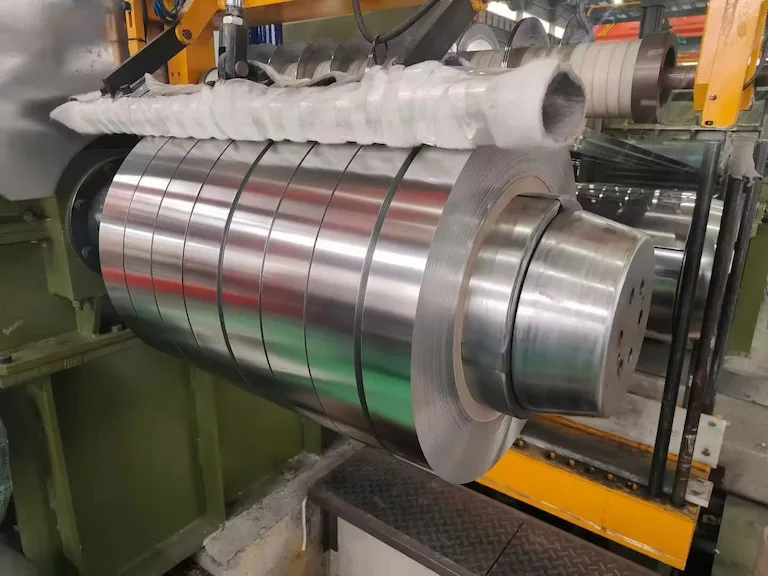
316 stainless steel coil is a flat-rolled, molybdenum-bearing austenitic stainless steel supplied in wound form. Compared with 304, its molybdenum addition improves resistance to certain forms of localized corrosion; compared with 316L, its higher permitted carbon content changes the welding and specification discussion. Selecting a coil still requires the delivery condition, service environment and acceptance requirements—not just the grade name.
Stainless Steel Foil Testing Examples
Hardness Testing
Chemical Composition Analysis
Tensile Strength Test


Table of Contents
What Is 316 Stainless Steel Coil?
The designation 316 identifies the alloy, while coil describes the delivery form. Here, “316 ss coil” means flat strip wound into a coil, rather than coiled tubing or a wound-wire component. Thickness, width, surface, edge and mechanical condition remain separate specification items.
The selected composition limits below show the practical difference between the three American grade descriptions. Values are mass percentages, not measured results for a supplied heat; the table is a reference comparison rather than a complete purchase specification.
| Selected element | 304 / UNS S30400 | 316 / UNS S31600 | 316L / UNS S31603 |
|---|---|---|---|
| Carbon, maximum | 0.08% | 0.08% | 0.030% |
| Chromium | 18.0–20.0% | 16.0–18.0% | 16.0–18.0% |
| Nickel | 8.0–10.5% | 10.0–14.0% | 10.0–14.0% |
| Molybdenum | Not specified in this reference table | 2.0–3.0% | 2.0–3.0% |
An unspecified molybdenum range for 304 does not mean that every heat contains exactly zero molybdenum. Likewise, a maximum carbon limit is not the actual carbon content of every coil. Use the applicable product specification and material report to assess the offered material.
316 Stainless Steel Coil vs 304: Corrosion and Selection
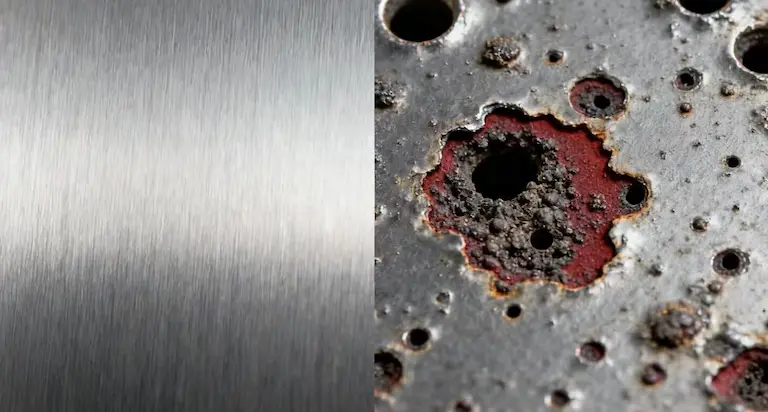
316 is worth considering when localized corrosion is a concern that 304 stainless steel may not adequately address. Its molybdenum addition helps resist pitting and crevice attack, but chloride concentration, temperature, pH, deposits and crevice geometry still influence the outcome. A “marine grade” label cannot establish suitability for continuous seawater immersion.
The useful choice is the grade that meets the actual exposure and fabrication requirements. For a formed cover exposed to chloride-bearing wash water, for example, engineering should review cleaning chemistry, temperature, drainage and trapped-liquid locations before choosing 304 or 316. This is a selection example, not a claim about a tested Myriad component.
316 and 316L also remain susceptible to chloride stress corrosion cracking under relevant combinations of tensile stress and environment. Choosing 316L for its low carbon content does not resolve that separate failure mechanism. SSINA chloride stress corrosion cracking
Compare cost only after aligning the technical scope. Obtain quotations for the same dimensions, condition, finish, quantity and inspection requirements; this guide assumes no fixed price premium or service-life advantage for either grade.
316 Stainless Steel Coil vs 316L: Welding and Certification
Tensile strength and hardness describe different aspects of the material, and neither should be hidden behind a temper name. Tensile strength describes the maximum engineering stress reached during a tensile test. Hardness measures resistance to indentation under a specified test method. “Annealed,” “half hard” and “full hard” describe material conditions, but they do not create one universal strength or hardness value across all grades and thicknesses.
Published Annealed Reference Values
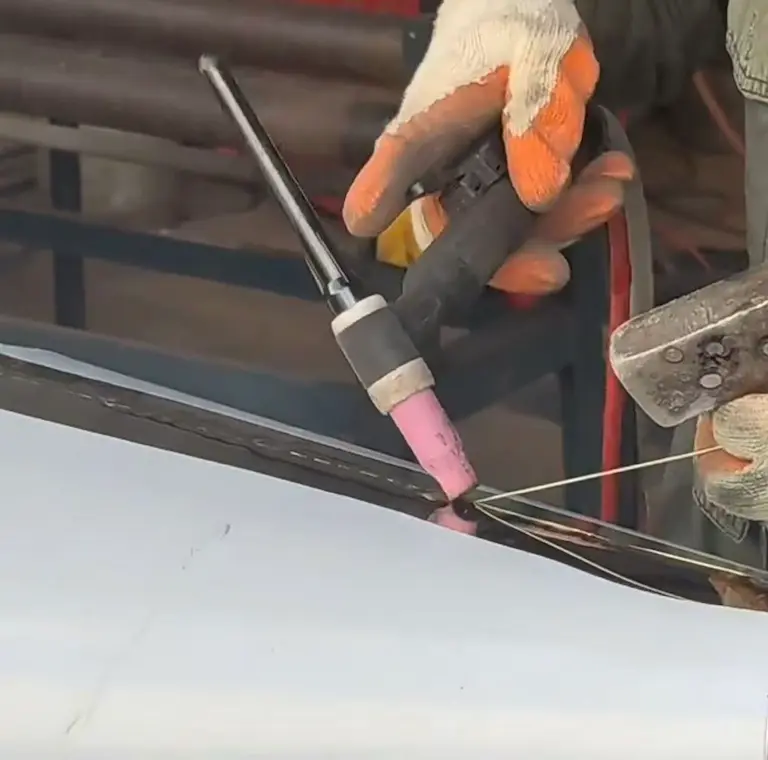
316L’s lower carbon limit reduces the risk of sensitization during relevant welding thermal cycles. Sensitization involves chromium carbide precipitation and chromium depletion near grain boundaries, which can enable intergranular attack in a susceptible environment. Low carbon addresses this risk; it does not make the material immune to every corrosion mechanism or every prolonged thermal exposure.
Both grades can be welded, so the decision is more specific than “weldable versus unweldable.” Assess the required grade with section thickness, fabrication sequence and service conditions.
Dual certification requires the material to meet the applicable requirements of both grades within the specified standard. A low carbon result alone does not establish compliance with all chemistry, mechanical, processing and inspection requirements. If a drawing requires 316, verify the offered 316/316L certification or obtain an authorized substitution rather than assuming any 316L coil is acceptable.
How 316 Stainless Steel Coil Is Produced?
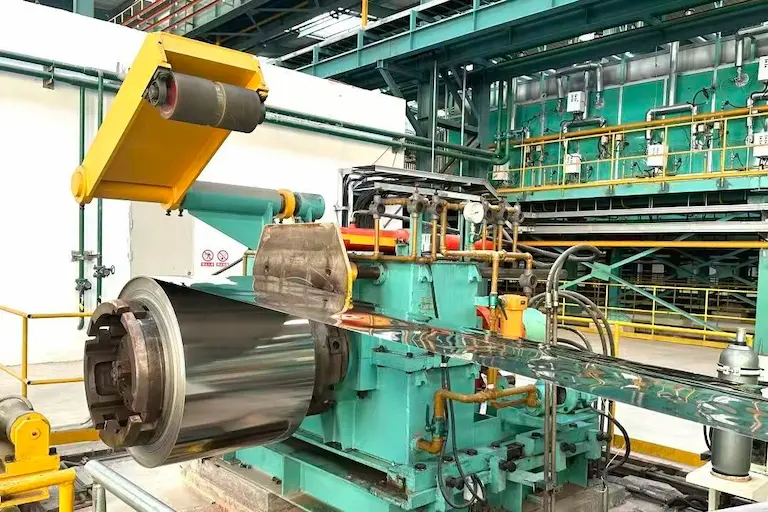
The production route determines more than thickness: it also establishes the material’s condition, surface and readiness for subsequent forming. The sequence below summarizes common flat-product operations; intermediate rolling and annealing cycles vary with the required product. It describes an industry route, rather than a claim that Myriad operates every stage.
| Operation | Main purpose | What the finished-coil specification should resolve |
|---|---|---|
| Melting, refining and casting | Establish chemistry and cast starting material | Grade and traceable heat identity |
| Hot rolling | Reduce the cast material to flat product | Required hot- or cold-rolled product route |
| Cold rolling, where required | Reduce thickness and control strip profile | Thickness, tolerance and mechanical condition |
| Annealing and surface treatment | Restore ductility after cold work; control surface condition | Annealed or work-hardened delivery; treatment route |
| Finishing | Establish the specified surface and shape | Finish designation and agreed shape requirements |
| Slitting and recoiling | Produce the ordered width and coil configuration | Edge, burr, width, winding and coil dimensions |
Surface finish and mechanical acceptance need separate descriptions. Cold-rolled product table describes 2B as heat-treated, pickled and skin-passed, 2R as bright-annealed, and 2H as work-hardened. A finish name should therefore be read with its governing standard and the actual tensile or hardness requirement, rather than used as a universal hardness value. A BA (bright-annealed) description still needs an agreed mechanical condition and acceptance criteria.
Related reading: A complete guide to AISI 304L stainless steel.
Mechanical Properties of 316 Stainless Steel Coil
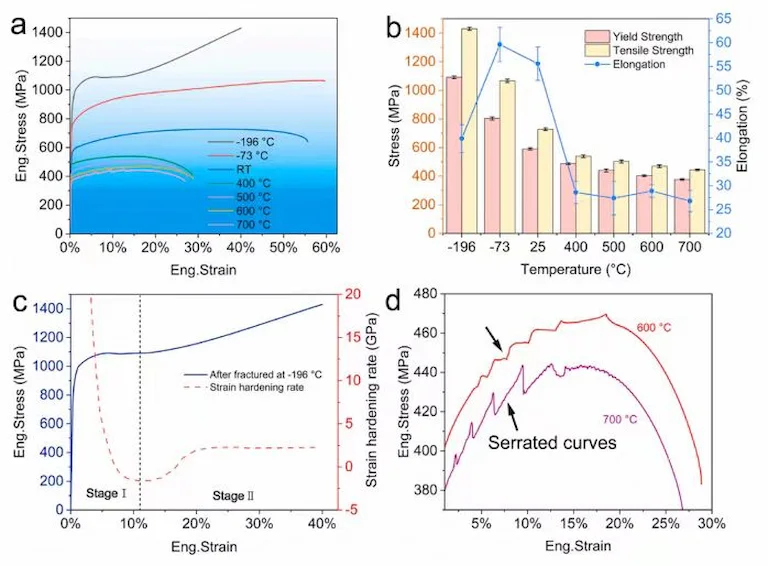
Mechanical values are meaningful only with their product form and condition.
| Reference minimum | 316 | 316L | Condition or test qualification |
|---|---|---|---|
| 0.2% offset yield strength | 30 ksi / 205 MPa | 25 ksi / 170 MPa | Annealed flat product; room temperature |
| Tensile strength | 75 ksi / 515 MPa | 70 ksi / 485 MPa | Same published product basis |
| Elongation | 40% | 40% | Published 2 in. / 51 mm gauge-length basis; check applicable specimen and thickness provisions |
These minima do not prove that a particular 316 coil is stronger than a particular 316L coil. Actual results can overlap, and a different specification can change the comparison: Outokumpu’s EN 10088-2 cold-rolled table lists the same minimum yield strength and tensile range for its 1.4401 and 1.4404 entries. Outokumpu Supra datasheet, Tables 5–6
Cold working can raise strength while reducing available elongation, so annealed and work-hardened coils should not share an unqualified property table. Specify tensile strength and/or hardness where they matter, and retain the elongation requirement needed for forming. A hardness conversion is not automatically an acceptable replacement for a specified tensile test.
Standards for 316 Stainless Steel Coil: US, Europe, Japan and China
A grade cross-reference is a starting point, not an automatic substitution approval. Select the governing product specification and edition, then check chemistry, delivery condition, properties, tolerances and inspection documents against the order.
| System | Grade identification or reference | Product-standard role | What to confirm |
|---|---|---|---|
| United States | 316 / S31600; 316L / S31603 | ASTM A240/A240M covers relevant stainless plate, sheet and strip; A480/A480M supplies general requirements | Product scope, ordered edition and any supplementary requirements |
| Europe | Common references include 1.4401 and 1.4404, respectively | EN 10088-2 addresses general-purpose corrosion-resistant sheet, plate and strip delivery conditions | Exact EN designation and applicable properties; do not copy American carbon limits into an EN table |
| Japan | SUS316 and SUS316L are common JIS references | JIS G4305 concerns cold-rolled stainless plate, sheet and strip | The agreed edition and full requirements; do not assume every chemical range matches ASTM |
| China | Use the exact Chinese grade specified in the order and certificate | GB/T 3280 concerns cold-rolled stainless plate, sheet and strip | Exact grade, edition, delivery condition and acceptance requirements; an AISI label alone is insufficient |
The public catalogs support these standards’ roles, rather than certifying a coil to them. This guide has not reproduced the complete normative requirements: the JSA product service was under maintenance during research, and the Chinese standard’s full text was not reviewed. ASTM A240/A240M, ASTM A480/A480M, BSI EN 10088-2, JSA JIS G4305 entry, JICQA JIS G4305 grade listing, SAMR GB/T 3280 catalog
How to Inspect and Test 316 Stainless Steel Coil
An inspection plan should connect each requirement to a suitable measurement and a traceable sample. Grade identity, carbon content, mechanical condition, dimensions and corrosion behavior answer different questions; no single test establishes all of them.
| Requirement | Suitable evidence or method | Important limit |
|---|---|---|
| Traceability | Match the order, material report, heat/coil identifiers and delivered labels | A generic datasheet does not identify the delivered batch |
| Chemistry and grade | Review heat analysis; use validated analytical methods where required | Confirm all specified elements and relevant method range |
| Low-carbon designation | Obtain reliable carbon analysis tied to the material | Handheld XRF alone cannot establish the 316L carbon limit |
| Yield, tensile strength and elongation | Tensile testing with the ordered method, specimen and sampling basis | Record orientation, gauge length and material condition |
| Hardness | Agree the scale, load, specimen preparation and thickness suitability | An HRB value or conversion is not universally suitable for thin strip |
| Thickness, width and shape | Agree calibrated measurement, locations, sampling and any camber/flatness assessment | A nominal size alone leaves acceptance limits unresolved |
| Surface, edge and coil configuration | Inspect against agreed finish, defect, burr, edge and winding criteria | A surface name does not specify every defect allowance |
| Corrosion performance, when specified | Select the test for the relevant mechanism and preparation condition | Laboratory comparison is not a universal service-life prediction |
Handheld XRF can help identify chromium, nickel and molybdenum, but it cannot measure carbon. Where the L designation matters, use a suitable carbon-capable method and traceable results; check preparation and applicability for the actual thin material before specifying a test.
Tensile and hardness tests require different acceptance details. ASTM E8/E8M addresses tensile testing; ASTM E18 addresses Rockwell testing and minimum-thickness considerations; ASTM E384 covers microindentation methods that can be relevant to small or thin specimens. Select a valid procedure for the material rather than copying a generic hardness number. ASTM E8/E8M, ASTM E18, ASTM E384
Corrosion testing should address a defined risk rather than become an unexplained checklist item. ASTM A262 concerns susceptibility to intergranular attack, while ASTM G48 uses ferric-chloride methods for pitting and crevice comparisons under specified conditions. Agree the relevant practice, sample preparation and acceptance criterion; neither reference makes every coil automatically tested or seawater-qualified. ASTM A262, ASTM G48
Specifying 316 Stainless Steel Coil for a Myriad Inquiry
Myriad offers 316 and 316L for quotation within its stainless foil, precision strip and coil business. Its support starts with clarifying the material requirement; the offered grade, size, condition and inspection combination must be confirmed for the inquiry. The general product range does not mean every combination is stocked or available.
Small-quantity requests should include the required quantity for each specification. Myriad’s regular MOQ is 100 kg per specification item within one order, defined by the same grade, thickness, width and material condition; quantities across matching coils can be combined, while different specifications are separate. Requests below this level require special review rather than automatic acceptance.
If your requirements are already defined
Send the existing specification directly for quotation. Include the following applicable items; an application description or drawing is only needed to resolve a genuine open requirement.
- Grade, governing standard and edition; any dual-certification requirement.
- Thickness, width and their separate tolerances.
- Delivery condition, surface and edge requirements.
- Defined tensile strength and/or hardness criteria, plus other required properties and test basis.
- Coil inside diameter, permitted outside diameter or coil weight, where required by handling equipment.
- Quantity per specification and required inspection documents.
If you need help defining the properties
Describe the intended fabrication and service conditions together with the requirements already known. Relevant inputs may include forming severity, welding, contact chemicals and temperature; provide a drawing only where geometry is needed to resolve an open question. Any proposed material or mechanical requirement remains subject to your confirmation before it becomes an order requirement.
Email the specification or the unresolved selection question to Myriad. For further contact options, use the Myriad contact page; if hardness or tensile strength is not yet defined, email allows that uncertainty to be explained without entering an invented value in the form.