If you’re choosing stainless steel for a new project, one question almost always comes up: 201 vs 304 Stainless Steel—which one offers better value? At first glance, both grades look nearly identical. They have a bright silver finish, good strength, and are widely used in kitchens, construction, automotive parts, industrial equipment, and stainless steel foil manufacturing. However, beneath that similar appearance lie significant differences in chemical composition, corrosion resistance, durability, fabrication, and long-term cost.
Many buyers focus only on the purchase price. While 201 stainless steel is generally less expensive than 304, the lower upfront cost does not always translate into better overall value. In environments with moisture, chemicals, or coastal air, choosing the wrong grade can lead to corrosion, higher maintenance costs, and premature replacement. On the other hand, for indoor decorative applications with limited exposure to harsh conditions, 201 stainless steel can be an economical and practical solution.
This guide takes a deep dive into 201 vs 304 Stainless Steel, explaining their differences in composition, mechanical properties, corrosion resistance, applications, pricing, and overall performance. Whether you’re buying stainless steel foil, sheets, or industrial components, this comparison will help you make an informed decision. For premium stainless steel foil products, visit stainless stee lfoil
What Is 201 Stainless Steel?
201 stainless steel is an austenitic stainless steel developed as a lower-cost alternative to traditional nickel-rich grades. To reduce manufacturing costs, part of the nickel content is replaced with manganese and nitrogen.
This change makes 201 stainless steel more affordable while maintaining good strength and formability. It is commonly used for indoor architectural trim, decorative panels, furniture, cookware, appliances, and general industrial applications where corrosion exposure is relatively low.
Although 201 performs well in dry environments, it is generally less resistant to corrosion than 304 stainless steel.
What Is 304 Stainless Steel?
304 stainless steel is the world’s most widely used stainless steel grade. It contains approximately 18% chromium and 8% nickel, providing an excellent balance of corrosion resistance, strength, weldability, and durability.
Because of its outstanding performance, 304 stainless steel appears in food processing equipment, medical devices, chemical plants, kitchen appliances, pharmaceutical equipment, architectural structures, and precision stainless steel foil.
Its ability to resist rust in humid and mildly corrosive environments makes it the preferred choice for countless industrial applications.
For high-quality 304 stainless steel foil products, visit best 304 stainless steel foil
201 vs 304 Stainless Steel Chemical Composition
Although both grades belong to the austenitic stainless steel family, their chemical compositions differ significantly.
| Element | 201 Stainless Steel | 304 Stainless Steel |
|---|---|---|
| Chromium | 16–18% | 18–20% |
| Nickel | 3.5–5.5% | 8–10.5% |
| Manganese | 5.5–7.5% | Up to 2% |
| Carbon | ≤0.15% | ≤0.08% |
| Nitrogen | Higher | Lower |
The higher nickel content in 304 stainless steel improves corrosion resistance, ductility, and long-term durability. Meanwhile, the increased manganese content in 201 helps reduce manufacturing costs.
Corrosion Resistance: The Biggest Difference
When comparing 201 vs 304 Stainless Steel, corrosion resistance is the most important factor. 304 stainless steel performs exceptionally well in humid climates, food-processing environments, and outdoor installations. The higher chromium and nickel content strengthens its passive oxide layer, helping it resist oxidation and staining.
In contrast, 201 stainless steel performs adequately indoors but becomes more vulnerable to rust when exposed to saltwater, coastal air, acidic cleaners, or industrial chemicals.
For projects requiring superior corrosion resistance, 304 is usually worth the higher initial investment. If extreme corrosion resistance is required, explore 316 stainless steel foil corrosion resistance explained
Strength and Mechanical Performance
Many buyers assume the more expensive material is always stronger. Interestingly, that’s not entirely true. 201 stainless steel often exhibits slightly higher yield strength due to its increased manganese and nitrogen content.
However, 304 stainless steel offers better ductility, impact resistance, and long-term toughness. It also performs better after repeated forming, welding, and fabrication operations.
For most industrial applications, both grades provide sufficient mechanical strength. The deciding factor usually becomes environmental exposure rather than tensile strength alone.
Weldability and Fabrication
Fabricators frequently compare 201 vs 304 Stainless Steel because welding quality directly affects production costs. 304 stainless steel is widely regarded as easier to weld.
It produces stronger welds with lower cracking risk and requires less post-weld treatment in many applications. Although 201 stainless steel can also be welded successfully, it demands greater process control, especially in demanding industrial environments.
For manufacturers producing precision stainless steel foil and thin-gauge products, consistent weld quality often favors 304.
Appearance Differences
Visually, distinguishing 201 from 304 can be difficult. Both exhibit a bright metallic finish and attractive appearance. However, after years of service, the difference becomes more obvious.
304 stainless steel maintains its shine longer, especially in humid environments. Meanwhile, 201 stainless steel may gradually develop discoloration or surface staining if maintenance is neglected. This long-term appearance often influences purchasing decisions for architectural and decorative projects.
Cost Comparison
Price remains one of the main reasons buyers consider 201 stainless steel. Because nickel is one of the most expensive alloying elements, replacing part of it with manganese significantly lowers production costs.
As a result, 201 stainless steel usually costs between 15% and 35% less than 304, although market conditions constantly change. Current market trends can be found here 201 stainless steel price increase You can also read 201 stainless steel futures prices fell why did the actual prices not drop
Which Grade Offers Better Long-Term Value?
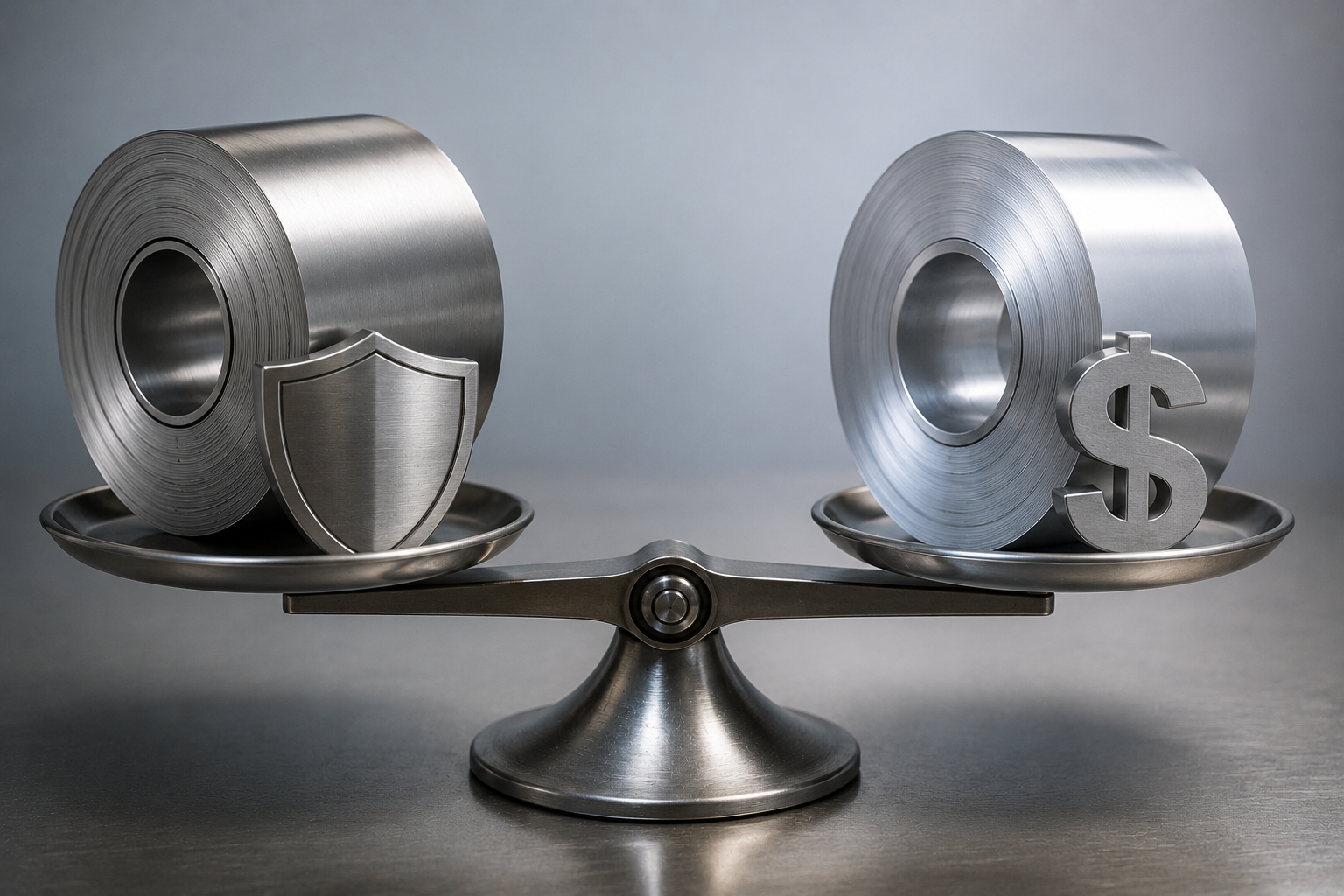
This question depends entirely on the application. If your project remains indoors with minimal moisture exposure, 201 stainless steel often provides excellent value because of its lower purchase price.
However, outdoor construction, marine equipment, commercial kitchens, hospitals, laboratories, and food-processing facilities benefit greatly from 304 stainless steel.
Although the initial investment is higher, reduced maintenance, longer service life, and improved corrosion resistance frequently lower total ownership costs. That is why many engineers focus on lifecycle cost rather than purchase price alone.
Applications of 201 Stainless Steel
201 stainless steel appears in many industries where corrosion demands remain moderate. Common applications include decorative trim, furniture, household appliances, elevator interiors, automotive trim, kitchen utensils, shelving, and general construction.
Its attractive appearance and affordability make it especially popular for interior architectural projects.
Applications of 304 Stainless Steel
304 stainless steel serves industries requiring dependable corrosion resistance. It is commonly used in food equipment, pharmaceutical machinery, breweries, hospitals, chemical processing plants, water treatment systems, architectural facades, pressure vessels, precision foil, and industrial fabrication.
Many premium stainless steel foil manufacturers rely heavily on 304 because of its excellent forming characteristics and stable mechanical performance. Browse available foil products here products/stainless steel foil You may also explore stainless steel foil sheets
Choosing the Right Stainless Steel Foil
When selecting foil rather than thicker sheet, material consistency becomes even more important. Thin foil experiences repeated bending, stamping, laser cutting, and precision forming.
304 stainless steel generally delivers better dimensional stability, smoother surface finish, and improved corrosion resistance throughout manufacturing. However, 201 foil remains an economical solution for decorative applications where environmental exposure remains limited.
Explore best-selling stainless steel foil products best selling stainless steel foil Spring applications may also require 301 stainless steel foil spring steel solution
Expert Recommendation
There is no universal winner in the 201 vs 304 Stainless Steel comparison. Instead, the better choice depends on your operating environment, maintenance expectations, fabrication requirements, and budget.
If minimizing upfront cost is your primary goal, 201 stainless steel offers excellent value. If durability, corrosion resistance, hygiene, and long-term performance matter more, 304 stainless steel remains the industry standard.
Summary
The debate over 201 vs 304 Stainless Steel ultimately comes down to balancing budget with performance. While 201 stainless steel provides a cost-effective solution for indoor and decorative applications, 304 stainless steel offers superior corrosion resistance, easier fabrication, and longer service life in demanding environments. Understanding your project’s operating conditions, maintenance requirements, and long-term goals will help you select the grade that delivers the greatest overall value rather than simply the lowest purchase price. Additional technical resources are available at stainless steel foil blog Need project-specific guidance? stainless steel foilcontact us
For general stainless steel information, visit wiki/Stainless_steel Manufacturing videos are available at youtube@MyriadStainlessSteel2014
FAQs
Q: Which is better, 201 vs 304 Stainless Steel?
A: Choosing between 201 vs 304 Stainless Steel depends on the application. For corrosion resistance and durability, 304 is usually the better choice, while 201 offers lower initial cost.
Q: Is 201 stainless steel suitable for outdoor use?
A: Although 201 vs 304 Stainless Steel comparisons show that 201 can be used outdoors, it is generally less resistant to moisture, salt, and industrial pollution than 304.
Q: Why is 304 stainless steel more expensive?
A: In the 201 vs 304 Stainless Steel comparison, 304 costs more because it contains significantly higher nickel content, improving corrosion resistance and long-term performance.
Q: Can 201 replace 304 stainless steel?
A: For certain indoor decorative applications, 201 vs 304 Stainless Steel analysis shows that 201 may be an economical substitute. However, harsh environments usually require 304.
Q: Which grade is better for stainless steel foil?
A: For precision manufacturing, 201 vs 304 Stainless Steel evaluations generally favor 304 because of its superior corrosion resistance, weldability, and forming performance.