In industrial manufacturing, precision procurement is not just a line item; it is a pillar of risk management. When your operations depend on high-performance materials to withstand severe environments, choosing the wrong supplier can lead to catastrophic component failures, costly production delays, and ballooning operational expenses.
For businesses utilizing premium alloys, 316 stainless steel is frequently the material of choice. Prized for its exceptional corrosion resistance and mechanical strength, it serves as the backbone for critical equipment across numerous aggressive environments. However, securing a stable, high-quality, long-term supply requires more than just scanning the lowest quotes on the market.
This comprehensive guide breaks down how buyers, procurement managers, and engineers can evaluate and select a trusted 316 stainless steel manufacturer to protect their supply chain, ensure regulatory compliance, and guarantee optimal material performance for years to come.
Understanding the 316 Stainless Steel Grade Before You Buy
Before evaluating manufacturers, it helps to understand the 316 stainless steel grade itself, since this knowledge will help you ask sharper questions during supplier vetting.
The 316 family includes several sub-grades, each suited to different operating conditions:
- 316 – the standard grade, used across food processing, marine hardware, and chemical equipment
- 316L – a low-carbon variant that resists sensitization during welding, ideal for heavy fabrication
- 316Ti – stabilized with titanium for high-temperature applications
- 316N – nitrogen-enhanced for higher mechanical strength
A manufacturer worth your long-term commitment should be able to clearly explain which 316 stainless steel grade fits your specific use case, rather than pushing a one-size-fits-all product. If their sales team can’t differentiate between 316 and 316L in a technical conversation, that’s a warning sign about the depth of their manufacturing knowledge.
Manufacturer’s Capabilities in 316 Stainless Steel Applications
A trusted stainless steel manufacturer must possess a deep operational understanding of how their material will perform in end-user environments. You should partner with a supplier whose production tolerances align with the demands of your sector.
| Target Industry | Critical Demands | Common 316 Stainless Steel Applications |
| Marine & Offshore | Saltwater corrosion resistance, high tensile strength | Propeller shafts, marine hardware, offshore oil rigs, subsea enclosures. |
| Chemical & Petrochemical | Resistance to acids, high-temperature stability | Processing vessels, heat exchangers, chemical transport piping. |
| Pharmaceutical & Medical | Biocompatibility, easy sterilization, ultra-smooth finish | Surgical implants, pharmaceutical cleanroom equipment, medical devices. |
| Food & Beverage Processing | Resistance to organic acids and sanitizing chemicals | Commercial brewing vats, industrial ovens, food storage tanks. |
Evaluate Processing Infrastructure
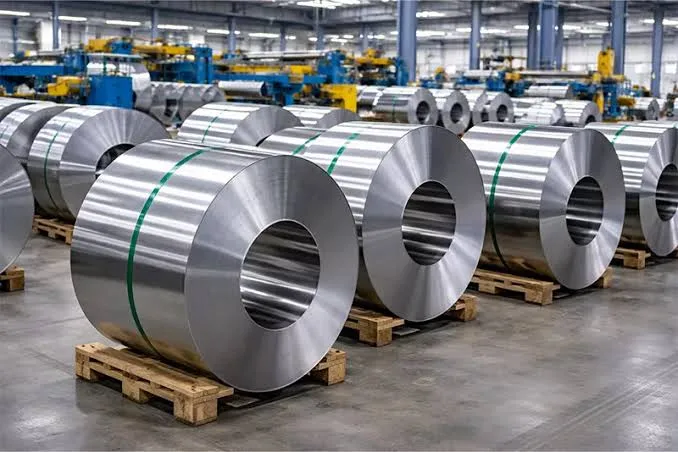
A dependable supplier must exhibit absolute control over their manufacturing line. High-quality output starts with how efficiently a factory processes structural raw materials into usable industrial forms, such as 316 stainless steel coils.
When auditing a factory’s technical capabilities, look for the following processing infrastructure:
Advanced Slitting and Cut-to-Length Lines
Industrial applications rarely use master coils in their raw, wide states. A tier-one manufacturer should house precision slitting machinery capable of slicing a wide 316 stainless steel coil into narrow, highly accurate strips with minimal edge burr. For precision foils, look for thickness tolerances constrained within micrometers (e.g., down to $\pm 0.005\text{ mm}$).
Annealing and Surface Treatment Equipment
Cold-working increases material hardness, which can make the metal brittle if left unmanaged. A trusted manufacturer must utilize bright annealing furnaces with protective atmospheres (like pure hydrogen or nitrogen) to relieve internal stresses without oxidizing the surface. This ensures your cold rolled 316 stainless steel arrives with the exact hardness (ANN, $1/4\text{H}$, $1/2\text{H}$, Full Hard) your blueprints mandate.
Matching the Manufacturer to Your 316 Stainless Steel Applications
Different industries place very different demands on stainless steel performance, so it’s worth confirming that a manufacturer has proven experience in your specific sector before committing to a long-term contract. Common 316 stainless steel applications include:
- Marine and offshore equipment – fittings, fasteners, and structural components exposed to saltwater
- Chemical processing – tanks, piping, and valves handling corrosive media
- Pharmaceutical and food processing – hygienic equipment requiring smooth, contamination-resistant surfaces
- Medical devices – surgical instruments and implant-grade components
- Architecture – facades, handrails, and coastal building elements
A manufacturer experienced across multiple 316 stainless steel applications is better positioned to advise on alloy selection, surface treatment, and fabrication methods specific to your industry rather than offering generic commodity-grade material that may underperform in specialized environments.
Quality Control and Certification Frameworks
In high-stakes industries, material traceability is a legal and operational necessity. A single batch of sub-par steel can compromise entire production runs, resulting in structural failures or regulatory recalls.
When reviewing a manufacturer’s quality control protocols, verify that they test for:
Chemical Composition Spectroscopy: Verifies the exact percentages of Chromium, Nickel, and crucially, Molybdenum. If the Molybdenum content drops below 2.0%, it does not comply with international standards for the 316 stainless steel grade (such as ASTM A240 or EN 10088-2).
Mechanical Property Testing: Documents yield strength, ultimate tensile strength, elongation percentages, and Rockwell/Vickers hardness levels.
Dimensional Verification: Utilizes automated, continuous laser or contact-gauge thickness monitoring during the rolling and slitting processes.
International Management Certifications: Ensure the facility operates under an audited ISO 9001:2015 quality management system. For automotive or medical supply chains, look for IATF 16949 or ISO 13485 compliance, respectively.
Questions to Ask Before Signing a Long-Term Supply Agreement
When you’ve narrowed your list, bring these questions into final discussions with any prospective 316 Stainless Steel Manufacturer:
- Can you provide sample MTCs from a comparable past order?
- What is your current production lead time, and how does it change during peak demand?
- Do you offer volume-based pricing tiers for long-term contracts?
- What is your defect rate, and how do you handle non-conforming material claims?
- Can you scale production if our order volume increases by 30–50%?
- Do you have flexibility across coil, sheet, and plate forms, or are you specialized in just one?
A manufacturer that answers these confidently, with documentation to back up their claims, is signaling the kind of operational maturity needed for a dependable long-term relationship.
Supply Chain Stability and Long-Term Partnership
Choosing a long-term supply partner requires looking past the product itself to evaluate the business entity behind it. Price volatility, geopolitical trade shifts, and logistics bottlenecks can disrupt raw material access. A trustworthy manufacturer should actively mitigate these systemic supply chain risks.
Financial and Raw Material Stability
Inquire about the manufacturer’s sourcing strategy for raw billets. Do they partner with top-tier, certified smelting mills? Do they maintain buffer stocks of popular alloy compositions? A manufacturer with strong raw material backings can insulate your business from sudden global supply contractions.
Scalability and Flexible Minimum Order Quantities (MOQs)
While large enterprise buyers require high-volume production, developmental engineering projects or specialized product lines may require smaller test batches. A versatile partner balances high-capacity industrial output with flexible MOQ frameworks, allowing you to scale up processing volumes seamlessly as your business expands.
Protective Packaging and Global Logistics Expertise
Thin-gauge strips, precision foils, and polished coils are highly vulnerable to physical indentation and moisture damage during transit. Your supplier must utilize heavy-duty export packaging, including anti-rust VCI (Volatile Corrosion Inhibitor) paper, robust wooden pallets, and securely strapped metal cores to ensure the steel arrives at your facility in pristine condition.
Final Summary
Selecting a long-term 316 stainless steel supplier is a strategic partnership that directly impacts your brand’s reputation, product reliability, and bottom line. By prioritizing manufacturers that offer transparent material traceability, verified ISO compliance, precise processing controls, and deep application expertise, you effectively de-risk your operational pipeline.
Do not settle for transactional vendors. Seek out an industrial manufacturer that views your production goals as their own, ensuring that every coil, strip, and sheet delivered matches your exact engineering parameters batch after batch, year after year.
FAQs
What is 316 Stainless Steel and why is it widely used?
316 Stainless Steel is an austenitic stainless steel grade that contains chromium, nickel, and molybdenum. The addition of molybdenum provides excellent resistance to corrosion, especially in marine, chemical, and chloride-rich environments. Its durability, strength, and corrosion resistance make it a preferred material for industries such as food processing, pharmaceuticals, medical equipment, and marine engineering.
How do I choose a reliable 316 Stainless Steel manufacturer?
When selecting a 316 Stainless Steel manufacturer, consider factors such as industry experience, product quality, certifications, manufacturing capacity, quality control processes, customization options, delivery reliability, and customer support. A trusted manufacturer should also provide material test certificates and comply with international quality standards.
What certifications should a 316 Stainless Steel manufacturer have?
A reputable 316 Stainless Steel manufacturer should comply with internationally recognized standards such as ISO 9001 and provide material certifications like ASTM, EN, or other applicable standards. Material Test Certificates (MTCs) are also important to verify the chemical composition and mechanical properties of the steel.