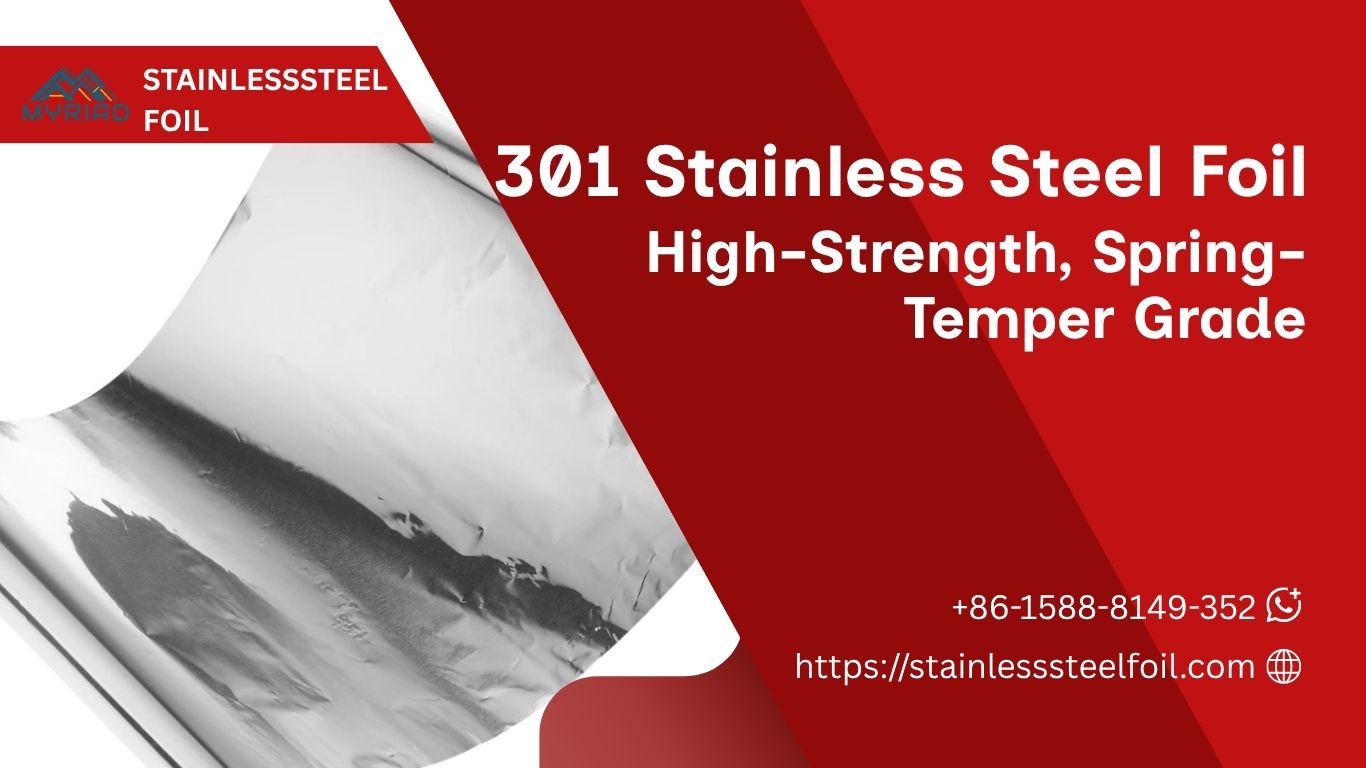
When performance, flexibility, and strength must come together in a thin material, engineers often turn to 301 Stainless Steel Foil Guide. This specialized alloy has earned a reputation for its exceptional tensile strength, excellent fatigue resistance, and ability to perform in demanding environments.
In industries ranging from electronics to aerospace, 301 Stainless Steel Foil plays a critical role. It offers a unique balance between strength and formability, especially when processed into spring temper conditions. If you’re evaluating materials for high-performance applications, understanding how this foil behaves—and where it excels—can save both time and cost.
What Is 301 Stainless Steel Foil?
At its core, 301 Stainless Steel Foil is an austenitic chromium-nickel alloy known for its ability to harden through cold working. Unlike some other grades, it doesn’t rely on heat treatment for strength. Instead, it gains strength as it is mechanically deformed.
If you want a foundational understanding, this detailed guide on what is stainless steel foil explains how foil differs from sheets and plates.
The composition of 301 typically includes:
- Chromium: 16–18%
- Nickel: 6–8%
This slightly lower nickel content compared to 304 gives it a higher work-hardening rate. As a result, 301 Stainless Steel Foil can reach very high strength levels while maintaining good corrosion resistance.
For a broader technical overview, you can also explore this trusted explanation of stainless steel properties and classifications.
What Does “Spring Temper” Mean?
The term “spring temper” is essential when discussing 301 Stainless Steel Foil. It refers to the level of hardness and strength achieved through cold rolling.
How It Works
During manufacturing, the foil is rolled to reduce thickness. This process increases:
- Tensile strength
- Yield strength
- Elastic limit
At the same time, it reduces ductility.
Spring temper conditions are classified into different levels such as:
- Quarter hard
- Half hard
- Full hard
- Extra hard
Each level offers a different balance of flexibility and strength. Engineers select the appropriate temper depending on the application.
Properties of 301 Stainless Steel Foil
Exceptional Strength
One of the biggest advantages of 301 Stainless Steel Foil is its high tensile strength. In full-hard condition, it can exceed 1850 MPa, making it significantly stronger than many other stainless steel grades.
Excellent Fatigue Resistance
Components made from this material can withstand repeated stress cycles without failure. That’s why it’s widely used in springs and clips.
Good Corrosion Resistance
While not as corrosion-resistant as 316, 301 Stainless Steel Foil still performs well in most indoor and mild outdoor environments.
Lightweight and Thin
Its thin profile makes it ideal for compact applications where space is limited.
301 vs. 304 vs. 316 Stainless Steel Foil
Choosing the right grade depends on your priorities. Let’s compare 301 Stainless Steel Foil with other common options.
| Property | 301 Stainless Steel Foil | 304 Stainless Steel Foil | 316 Stainless Steel Foil |
|---|---|---|---|
| Strength | Very High | Moderate | Moderate |
| Corrosion Resistance | Good | Very Good | Excellent |
| Work Hardening | Excellent | Moderate | Low |
| Cost | Lower | Medium | Higher |
| Best Use | Springs, clips | General use | Marine, chemical |
If you want deeper insights into these alternatives, explore:
Applications of 301 Stainless Steel Foil
Electronics Industry
In electronics, precision matters. 301 Stainless Steel Foil is used in:
- Battery contacts
- EMI shielding
- Connectors and terminals
Its conductivity and durability make it ideal for these applications.
Automotive Sector
Modern vehicles rely on lightweight yet strong materials. This foil is used for:
- Springs and clips
- Sensor components
- Flexible connectors
Aerospace Engineering
In aerospace, weight reduction is critical. 301 Stainless Steel Foil provides strength without adding unnecessary mass.
Medical Devices
Medical equipment requires both strength and hygiene. This material meets strict industry standards.
You can explore a range of applications and options on the stainless steel foil products page.
Why Choose 301 Stainless Steel Foil for Spring Applications?
Not all materials can handle repeated bending and stress. 301 Stainless Steel Foil stands out because it combines elasticity with strength.
Elastic Recovery
After bending, it returns to its original shape. This makes it ideal for springs and clips.
Long Service Life
Its fatigue resistance ensures long-term reliability.
Cost Efficiency
Compared to higher-grade alloys, it offers excellent performance at a lower cost.
Manufacturing Process and Quality Factors
Cold Rolling
The defining feature of 301 Stainless Steel Foil Guide is its cold rolling process. This step determines the final strength and temper.
Surface Finish
Different finishes are available depending on the application. Smooth finishes are preferred for electronics, while matte finishes work well for structural parts.
Precision Thickness
High-quality foil maintains consistent thickness, which is critical for performance.
For sourcing reliable materials, you can visit the main stainless steel foil website.
Advantages and Limitations
Advantages
301 Stainless Steel Foil offers unmatched strength in thin sections. It also provides excellent fatigue resistance and cost efficiency.
Limitations
However, it is not the best choice for highly corrosive environments. In marine or chemical settings, 316 is usually preferred.
Industry Trends and Demand
Demand for high-performance materials is growing. Industries like electronics and renewable energy require materials that are both strong and lightweight.
Recent reports suggest that the global stainless steel market continues to expand, driven by technological advancements and infrastructure development.
Within this market, 301 Stainless Steel Foil remains a key player due to its versatility.
How to Select the Right 301 Stainless Steel Foil
Choosing the right foil involves more than just selecting the grade.
Consider the Application
Different uses require different temper levels.
Evaluate Environmental Conditions
If corrosion is a concern, consider whether 301 is sufficient.
Work with Reliable Suppliers
Quality consistency is essential. You can connect with experts through the contact page.
Maintenance and Handling Tips
Although 301 Stainless Steel Foil is durable, proper handling ensures longevity.
Keep the material clean and dry. Avoid exposure to harsh chemicals unless necessary. Store it in controlled environments to prevent contamination.
Summary
Today’s demanding industries, 301 Stainless Steel Foil offers a powerful combination of strength, flexibility, and reliability. Its ability to achieve high strength through cold working makes it the preferred choice for spring applications and precision components.
While it may not match the corrosion resistance of higher grades like 316, 301 Stainless Steel Foil remains a cost-effective and high-performance solution for a wide range of applications. For more information, visit Stainless Steel Foil and feel free to contact us for expert assistance and product inquiries.
FAQs
Q. What is 301 Stainless Steel Foil used for?
A. 301 Stainless Steel Foil is widely used in springs, clips, connectors, and precision electronic components due to its high strength.
Q. Is 301 Stainless Steel Foil corrosion-resistant?
A. Yes, 301 Stainless Steel Foil Guide offers good corrosion resistance, but it is not ideal for marine environments.
Q. What makes 301 Stainless Steel Foil strong?
A. Its strength comes from cold working, which increases hardness and tensile strength without heat treatment.
Q. Can 301 Stainless Steel Foil be used in high-temperature applications?
A. 301 Stainless Steel Foil performs well at moderate temperatures, but extreme heat may affect its properties.
Q. Where can I buy 301 Stainless Steel Foil?
A. You can find reliable options on the products page.