In the realm of metallurgy, one grade stands undisputed as the industry workhorse. To put its dominance into perspective, 304 stainless steel accounts for roughly 50% of all global stainless steel production—more than any other single grade in existence. When reduced to its thinnest form, 304 stainless steel foil becomes an indispensable material for high-tech industries requiring precision and durability.
Essentially, 304 stainless steel foil is an ultra-thin, cold-rolled austenitic stainless steel sheet that typically measures below 0.2mm in thickness. It represents the “sweet spot” for engineers, procurement managers, and manufacturers because it offers a perfect balance of cost-efficiency, excellent corrosion resistance, and superior machinability. Whether it is protecting sensitive electronics or acting as a thermal barrier in aerospace, this versatile ss foil is the go-to solution for modern engineering challenges.
What Exactly Is 304 Stainless Steel Foil? (Definitions & Standards)
304 stainless steel foil is a chromium-nickel austenitic stainless steel alloy manufactured into ultra-thin gauges through precision cold rolling. It is commonly referred to by several international standards and specifications.
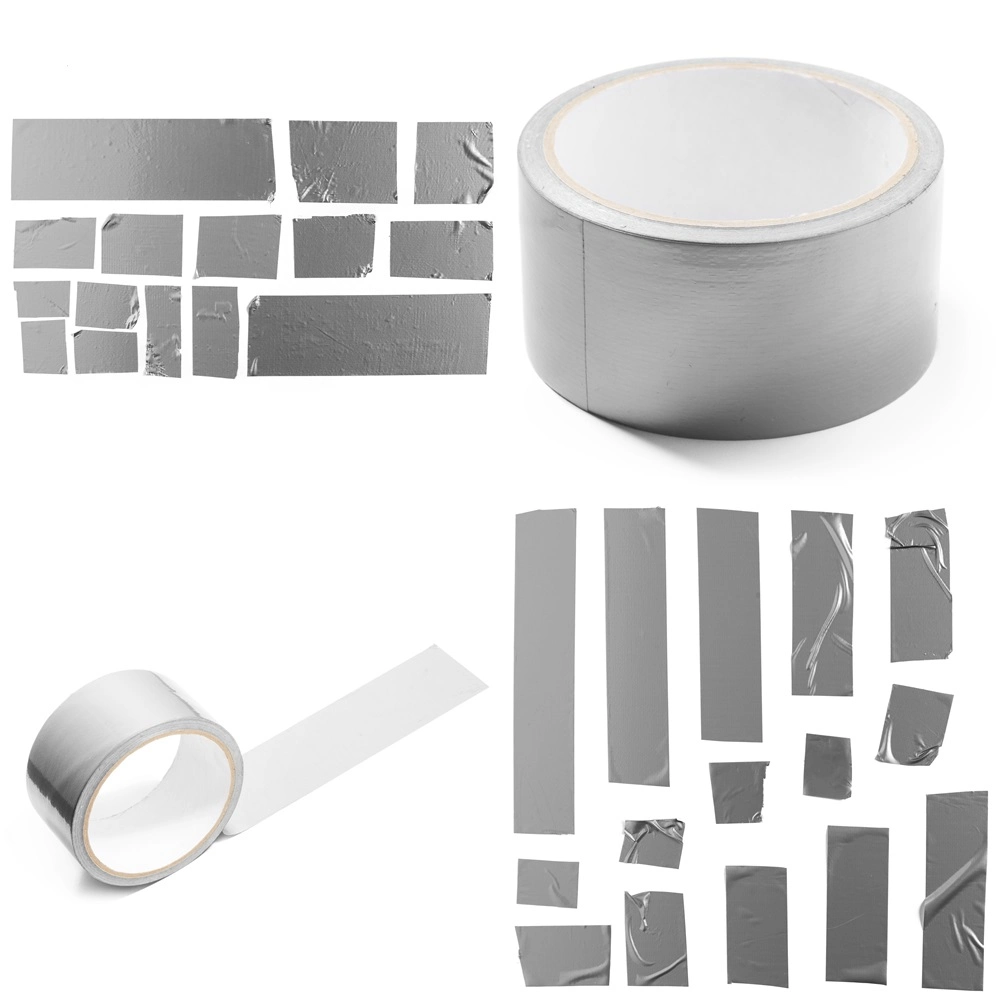
International Standards Equivalency Table
| Standard System | Grade Equivalent |
|---|---|
| AISI | 304 |
| UNS | S30400 |
| EN | 1.4301 |
| JIS | SUS304 |
| GB/T | 06Cr19Ni10 |
| GOST | 08Kh18N10 |
This globally recognized alloy is often referred to as AISI 304 foil in industrial procurement documents and engineering drawings.
Chemical Composition of 304 Stainless Steel Foil
| Element | Composition |
|---|---|
| Chromium (Cr) | 17.5–20% |
| Nickel (Ni) | 8–10.5% |
| Carbon (C) | ≤0.08% |
| Iron (Fe) | Balance |
The low carbon variant, 304L, reduces carbon content to ≤0.03% to improve weldability and reduce carbide precipitation risks.
Austenitic Structure and Why It Matters
304 belongs to the austenitic stainless steel family and features a face-centered cubic (FCC) crystal structure. This gives the material:
- Excellent ductility
- High toughness
- Strong corrosion resistance
- Good formability
- Non-magnetic behavior in annealed condition
These characteristics make ss foil ideal for applications requiring deep drawing, forming, or repeated flexing.
Thickness Classification
| Product Type | Thickness |
|---|---|
| Foil | Below 0.2mm |
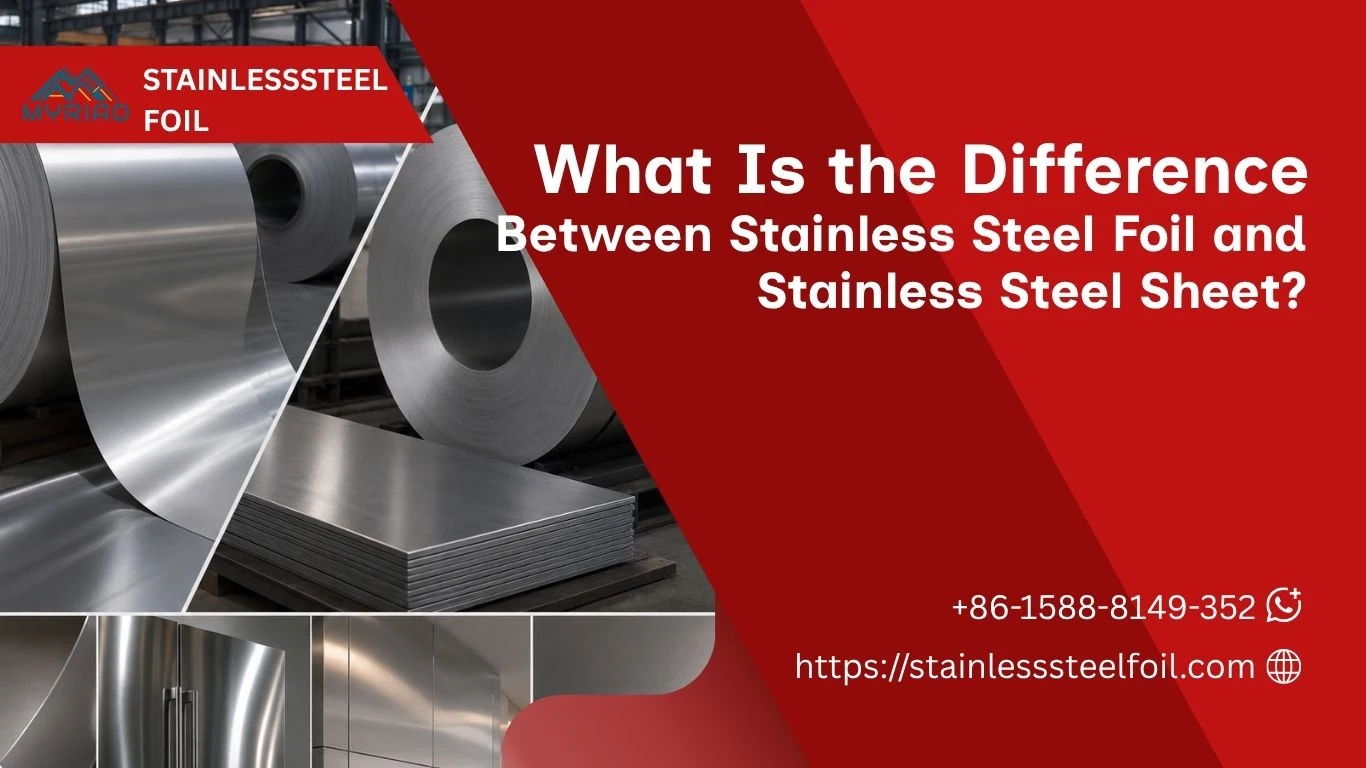
| Strip | 0.2mm–2mm |
| Sheet | Above 2mm |
Myriad specializes in ultra-thin foil manufacturing from 0.01mm to 0.1mm, serving industries requiring extreme precision and flatness.
Learn more about stainless strip manufacturing:
Stainless Steel Strip Products
For broader technical information on stainless steel metallurgy:
Stainless Steel Overview.
Mechanical Properties by Temper
| Temper | Tensile Strength (MPa) | Yield Strength (MPa) | Elongation | Hardness |
|---|---|---|---|---|
| Annealed | 515 | 205 | ≥40% | ≤200 HV |
| Quarter Hard | 760–930 | 515 | ≥25% | ~250 HV |
| Half Hard | 930–1130 | 690 | ≥10% | ~320 HV |
| Full Hard | 1275+ | 1035+ | Limited | ~400 HV |
Myriad’s advanced rolling processes achieve elongation rates exceeding 10% even at half-hard conditions, outperforming many conventional suppliers.
Work Hardening Explained
304 stainless steel work hardens rapidly during cold rolling. Each rolling pass increases:
- Tensile strength
- Surface hardness
- Spring properties
At the same time, ductility gradually decreases. This makes temper selection extremely important depending on the final application.
For example:
- Annealed foil is ideal for deep drawing
- Half-hard foil suits spring components
- Full-hard foil works for precision mechanical parts
Thermal & Physical Properties
| Property | Value |
|---|---|
| Thermal Conductivity | 16.2 W/m·K |
| Density | 7.93 g/cm³ |
| Continuous Service Temp | 870°C |
| Melting Range | 1400–1450°C |
ASTM Standards
Common standards for stainless steel foil sheet production include:
- ASTM A240
- ASTM A666
Interestingly, there is still no universally standardized production specification for stainless steel foil thinner than 0.06mm. Because of this, many precision manufacturers follow AISI standards as the global benchmark.
For related heat treatment processes, visit:
Stainless Steel Foil Heat Treatment Guide
8 Top Industries Using 304 Stainless Steel Foil (With Real Use Cases)
304 stainless steel foil has become indispensable in modern industrial manufacturing.
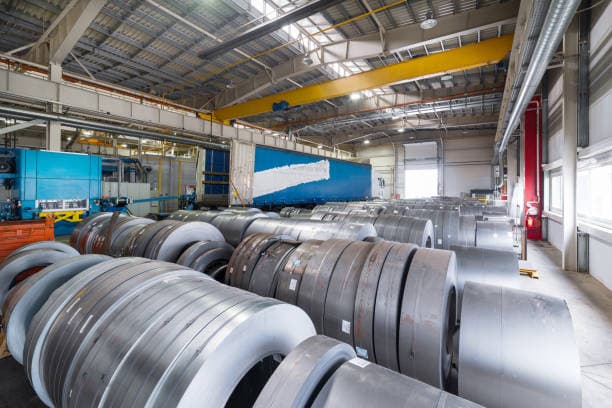
1. Electronics Industry
Electronics manufacturers use ultra-thin foil for:
- EMI/RFI shielding
- Flexible printed circuit boards (FPCB)
- Battery current collectors
- Sensor shielding layers
The rapid growth of electric vehicles and lithium-ion batteries is driving substantial demand for precision foil products.
2. Aerospace Applications
Aerospace companies utilize foil in:
- Honeycomb composite structures
- Turbine insulation wraps
- Heat treatment contamination barriers
- Lightweight shielding systems
Its combination of low thickness and heat resistance makes it highly effective in aerospace thermal systems.
3. Automotive Manufacturing
Automotive applications include:
- Exhaust gaskets
- Catalytic converter wraps
- Precision shims
- Fuel cell bipolar plates
As hydrogen fuel technologies advance, stainless foil demand continues to increase globally.
4. Medical Industry
Medical-grade 304 foil is used for:
- Surgical instrument shielding
- Sterilization packaging
- Implant barrier systems
These applications often require compliance with FDA regulations and ISO 10993 biocompatibility standards.
5. Food Processing Industry
One of the most common questions buyers ask is whether 304 stainless steel foil is food safe.
The answer is yes.
304 stainless steel is widely recognized as food-grade stainless steel because of its corrosion resistance and hygienic properties. It is commonly used in:
- Food packaging barriers
- Conveyor systems
- Processing equipment
- Commercial kitchen components
6. Chemical Processing
Chemical plants use foil for:
- Corrosion-resistant liners
- Sensor housings
- Reactor vessel insulation
- Precision sealing systems
7. Energy & Hydrogen Applications
Hydrogen fuel systems increasingly rely on stainless steel foil for:
- Fuel cell assemblies
- Pipeline sealing systems
- Thermal management components
8. Architecture & Decorative Applications
Architectural designers use stainless steel foil roll materials for:
- Decorative trim
- Surface laminates
- Cladding systems
- Reflective design elements
Explore additional stainless steel product categories here:
Myriad Product Catalog
How 304 Stainless Steel Foil Is Manufactured: From Coil to 0.01mm
Producing ultra-thin foil requires highly specialized equipment and tight process control.
Step 1 — Raw Material Selection
Production begins with premium hot-rolled coils sourced from major steel mills such as:
- TISCO
- POSCO
Incoming material undergoes spectrometer verification before processing.
Step 2 — Annealing
Annealing softens the steel structure, restoring ductility before cold rolling operations.
Step 3 — Pickling
Acid pickling removes oxide scale and contaminants from the surface.
Step 4 — Cold Rolling on a 20-Roll Sendzimir Mill
This is the most critical manufacturing stage.
Producing 0.02mm foil can require:
- Multiple rolling passes
- Intermediate annealing cycles
- 24 hydraulic pressure cycles
- Rolling forces approaching 180 tons
The 20-roll Sendzimir mill provides extremely precise thickness control.
Step 5 — Tension Leveling & Skin Pass
This process improves:
- Surface brightness
- Flatness
- Internal stress balance
Step 6 — Precision Slitting
Master coils are slit into custom widths with burr-controlled edges.
Step 7 — Quality Control
Advanced testing includes:
- Chemical composition analysis
- Hardness testing
- Surface inspection
- CNC thickness measurement
Myriad maintains thickness tolerances as tight as ±0.005mm.
Step 8 — Export Packaging
Finished materials are packed using:
- Interleave paper
- PVC protective film
- Steel strap banding
- Wooden export pallets
Learn more about ultra-thin foil capabilities:
How Thin Can Stainless Steel Foil Actually Get?
Specifications, Tolerances & Available Dimensions
Understanding dimensional specifications is essential when sourcing thin stainless steel foil.
Thickness Range
| Metric Thickness | Inch Equivalent |
|---|---|
| 0.01mm | 0.0004″ |
| 0.02mm | 0.0008″ |
| 0.05mm | 0.002″ |
| 0.1mm | 0.004″ |
Thickness Tolerance Table
| Nominal Thickness | Tolerance |
|---|---|
| 0.06mm | ±0.02mm |
| 0.05mm | ±0.03mm |
| 0.02mm | ±0.005mm |
Width Specifications
| Width Range | Tolerance |
|---|---|
| Above 100mm | ±5mm |
| Below 50mm | ±2mm |
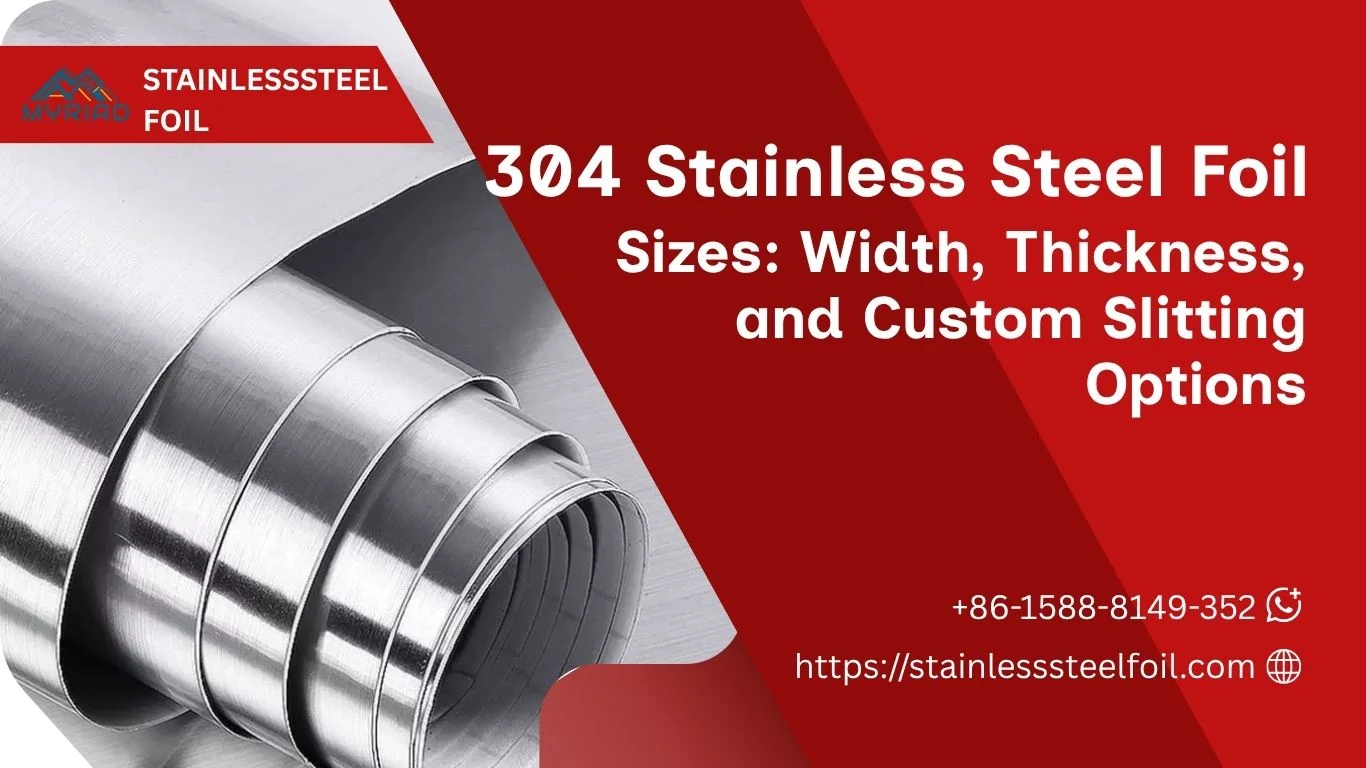
Available widths range from 3mm to 610mm (24″).
Surface Finish Options
| Finish | Description |
|---|---|
| 2B | Standard smooth finish |
| BA | Bright annealed mirror-like finish |
| #4 | Brushed finish |
| Mirror (#8) | High reflectivity finish |
Edge Types
Available edge conditions include:
- Standard slit edge
- Deburred edge
- Rounded smooth edge
Temper Options
Customers can specify:
- Annealed (soft)
- 1/4 Hard
- 1/2 Hard
- 3/4 Hard
- Full Hard
When ordering a stainless steel foil roll, always specify:
- Thickness
- Width
- Surface finish
- Hardness requirement
- Coil ID/OD
- Edge condition
Explore stainless steel coil supply options:
Stainless Steel Coil Products
304 vs 304L: When Does the “L” Grade Matter?
Although 304 and 304L are extremely similar, one small difference significantly impacts weldability.
Carbon Content Comparison
| Grade | Carbon Content |
|---|---|
| 304 | ≤0.08% |
| 304L | ≤0.03% |
Why Lower Carbon Matters
During welding, carbon can combine with chromium to form chromium carbides at grain boundaries. This process is called sensitization.
Sensitization reduces corrosion resistance near weld zones.
304L minimizes this issue.
Choose 304L When:
- Welding is required
- Chemical exposure is severe
- Intergranular corrosion resistance is critical
- Nuclear or pharmaceutical applications are involved
Choose Standard 304 When:
- No welding is involved
- Higher elevated-temperature strength is needed
- Lower material cost is preferred
Because tighter carbon control is required during steelmaking, 304L generally costs slightly more than standard 304.
For buyers comparing alloys, also review:
What Is 301 Stainless Steel Foil?
Why Source 304 Stainless Steel Foil from Myriad?
When sourcing china 304 stainless steel foil, supplier capability matters just as much as material grade.
Myriad has specialized in ultra-thin stainless foil manufacturing since 1996.
Why Source 304 Stainless Steel Foil from Myriad?
If you are wondering where to buy 304 stainless steel foil, the answer is simple: Myriad Stainless Steel Foil Co.
Established in 1996 by a metallurgy graduate, Myriad brings over 28 years of exclusive focus to ultra-thin foil manufacturing. Unlike massive steel conglomerates where foil is a tiny afterthought, foil is 100% of our business.
Here is why global buyers trust Myriad for china 304 stainless steel foil:
- Advanced Mill Capabilities: Our 20-roll Sendzimir mills are explicitly calibrated for the 0.01mm–0.1mm range, featuring CNC thickness control within ±0.005mm.
- Guaranteed Chemistry: We utilize a German-imported spectrometer to verify the chemical composition of every single batch, ensuring you never receive off-spec material.
- Massive Ready Stock: We maintain over 100 tons of inventory, including 70+ tons of ready-to-ship 304, 316, and 301 foil. This means lightning-fast lead times for standard sizes.
- Total Customization: From custom slitting to any width (down to 3mm), to specific edge treatments and temper requirements, we tailor the product to your press or stamping machine.
- Global Service, Local Support: We are ISO 9001 certified and serve clients across North America, Europe, and Russia. We offer 24/7 support in English, Chinese, and Russian.
- Low Barrier to Entry: We offer a low standard MOQ of just 100kg and provide free samples for qualified buyers to test in their facilities before committing to a production run.
As a leading 304 stainless steel strip supplier, we understand that precision is non-negotiable. Ready to start your order? Contact our engineering team today to discuss your specifications.
Final Thoughts
304 stainless steel foil remains the world’s most versatile ultra-thin stainless material because it delivers the ideal combination of corrosion resistance, flexibility, strength, manufacturability, and affordability.
From electronics and aerospace to food processing and hydrogen energy systems, its applications continue expanding rapidly as industries demand lighter, thinner, and more durable materials.
For buyers sourcing high-precision foil from trusted manufacturers, Myriad offers decades of production expertise, advanced rolling technology, and strict quality control for global industrial applications.
Browse products and request custom specifications here: Myriad Stainless Steel Foil Products.
FAQs
What is the thinnest 304 stainless steel foil available?
Myriad produces foil as thin as 0.01mm (10 microns) using precision 20-roll Sendzimir mills with CNC thickness control.
Is 304 stainless steel foil food safe?
Yes. 304 stainless steel is FDA-compliant for direct food contact and widely used in food processing and packaging industries.
304 vs 316 stainless steel foil — which should I choose?
Choose 304 for general-purpose corrosion resistance and lower cost. Choose 316 when exposure to chlorides, marine environments, or aggressive chemicals is expected.
You can also review related products here:
316 Stainless Steel Coil Products
What is the MOQ for 304 stainless steel foil?
Standard MOQ is typically 100kg. Free samples are available for qualified buyers.
Can ultra-thin 304 foil be welded?
Yes, but specialized methods such as vacuum brazing or MIG brazing are generally preferred. Conventional arc welding is usually not recommended for extremely thin gauges.
What surface finishes are available?
Common finishes include:
- 2B
- BA
- #4 brushed
- Mirror (#8)
Always specify finish requirements before ordering.