
Stainless Steel Roll: Types, Cold Rolling and Specification Guide
A stainless steel roll is flat stainless steel wound into a coil for storage, transport and downstream processing. It may be wide coil, narrow strip or thin foil. “Roll” describes its delivery form: it does not identify the grade, thickness, hardness or surface finish.
For an engineering specification, separate three questions: Which alloy? What final material condition? What dimensions and coil configuration? This guide explains those choices and the information needed to request stainless steel foil and strip from Myriad.
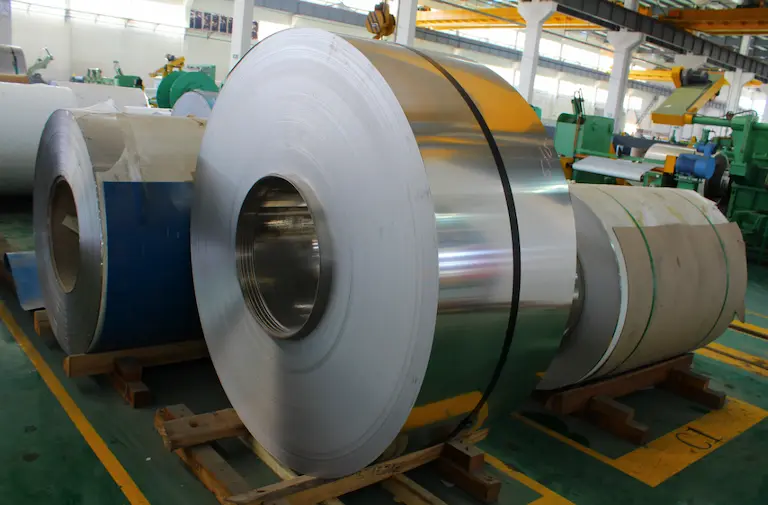
Table of Contents
Types of Stainless Steel Rolls and Their Uses
The most useful way to classify stainless steel rolls is by the material being supplied and the work it must perform. Names such as coil, strip and foil overlap in commercial use, so the order should define dimensions rather than rely on a name alone.
| Form or application | What it means | What to specify |
|---|---|---|
| Wide coil | Wound flat stock for further processing | Grade, thickness, width and downstream processing requirements |
| Slit strip coil | Narrower strip cut lengthwise from wider material | Width tolerance, edge condition, burr requirements and winding |
| Foil roll | Very thin material delivered in a continuous roll | Thickness and tolerance, handling needs, surface and test method |
| Sheet supplied from coil | Material cut to a specified length | Width, length, flatness and surface protection |
| Jacketing or flashing roll | Material selected for an insulation-covering or water-management application | Environment, grade, thickness and any required finish, backing or system specification |
These are general material categories, not a statement that Myriad supplies every form or finished system listed. For the distinction between continuous material and cut pieces, see our guide to stainless steel foil and sheet formats.
Grade selection is a separate decision from delivery form. The same roll geometry can be ordered in different alloys, but the environment, fabrication route and required properties determine which grade is suitable. Our 304 versus 316 stainless steel comparison provides a starting point for that evaluation; the grade name alone is not an application approval.
Hot-Rolled and Cold-Rolled Stainless Steel
Is cold-rolled steel stainless?
Not necessarily. Cold rolled describes a processing route; stainless describes an alloy family. Carbon steel can be cold rolled too. Stainless steel derives its corrosion resistance from its alloy chemistry and protective surface film, not simply from passing through cold rolls. See worldstainless’s introduction to stainless steels and the public scope of ASTM A1008/A1008M for cold-rolled steel sheet.
Is stainless steel cold rolled?
Many stainless steel strip and foil products are cold rolled, but stainless steel is also supplied through hot-rolling routes. Flat rolling reduces thickness; subsequent heat treatment and finishing help establish the final condition, surface and dimensions. Slitting changes strip width, while cutting to length produces individual sheets.
Cold rolled does not automatically mean hard temper. Austenitic stainless steel strengthens through cold work, but an appropriate subsequent annealing treatment can remove that work hardening. Ask for the final delivery condition and required properties, not only the words “cold rolled.” SSINA technical guidance explains this distinction.
Is Stainless Steel Harder Than Cold-Rolled Steel?
There is no reliable yes-or-no comparison without naming both materials and their final conditions. “Stainless steel” could mean annealed material or heavily cold-worked strip; “cold-rolled steel” could mean a carbon steel grade supplied in a different condition. Compare the actual grade, heat-treatment or temper designation, and hardness results obtained by suitable, comparable methods.
For stainless steel foil, the test method matters as much as the number. A thin specimen may not support the indentation required by a conventional hardness test. Microindentation methods such as Vickers or Knoop can be appropriate, but sample thickness, test force, preparation and indent spacing must be checked. SGS MSi identifies foil among microhardness applications; Struers explains Vickers specimen and preparation requirements.
Use the Myriad stainless steel hardness conversion calculator only when its material, condition and conversion range match your task. Treat a converted value as an estimate for comparison, not a replacement for the specified acceptance test. For an RFQ, include the original scale, test force where applicable, and required range rather than an unexplained “hardness” number.
Stainless Steel Roll Thickness, Gauge and Sheet Sizes
Order thickness in decimal inches or millimeters, with an explicit tolerance. Gauge numbers are useful search terms, but their relationship to thickness depends on the material and the chart or supplier being used. SSINA advises against specifying stainless steel by gauge alone. SSINA: stainless steel gauge guidance
For example, the UniPunch gauge chart lists 22-gauge stainless steel at 0.0312 in, approximately 0.79 mm. That is an illustrative nominal conversion, not a universal acceptance limit. It is also outside Myriad’s confirmed overall thickness range of 0.01–0.3 mm for the foil and strip discussed below.
A 4 × 8 stainless steel sheet normally refers to a flat piece 4 ft × 8 ft: 48 × 96 in, or 1,219.2 × 2,438.4 mm. It is not a coil-size designation. Do not substitute sheet dimensions for coil width, length, weight or inside diameter when requesting a quote; this sheet example is not a Myriad supply offer.
For rolls, the full dimensional requirement extends beyond thickness and width. Inside diameter must suit the receiving equipment, while outside diameter and coil weight affect handling. State any requirements for coil length, joints, winding direction and edge alignment so they can be reviewed together.
How to Roll Stainless Steel Sheet into a Cylinder
Rolling a sheet into a cylinder is roll bending, which changes its shape. It is different from mill rolling that reduces thickness, and from slitting that divides material into narrower widths. The process must be planned around the grade, final condition, thickness, sheet width and required radius.
A practical planning sequence is:
- Define the finished geometry. State the diameter or radius, dimensional tolerance, seam arrangement and any joining requirements.
- Check the machine and tooling. Confirm capacity for the actual stainless grade and condition, rather than assuming a mild-steel capacity rating applies unchanged.
- Protect the surface. Use clean tooling and handling practices that avoid transferring carbon-steel particles onto the stainless surface.
- Establish the forming sequence. Allow for springback and work hardening; use trials or qualified fabrication procedures to set passes and overbend.
- Inspect the formed piece. Check diameter, roundness, end geometry and surface condition against the drawing before accepting it.
No universal roller setting or minimum radius applies to every stainless sheet. Higher strength and prior cold work affect forming loads and springback; these effects need consideration before the production setup is approved. SSINA’s fabrication presentation discusses these forming and contamination-control issues.
If the requirement is narrower strip rather than a curved component, the relevant operation is stainless steel coil slitting and edge preparation. Specify the edge and winding requirements as well as the finished width.
How to Verify a Stainless Steel Roll
Verify material identity through traceable documentation and the tests required by the purchase specification. A bright surface or a magnet response does not establish a stainless grade: cold-worked austenitic stainless steel can become magnetic. Our explanation of why stainless steel can be magnetic covers that distinction.
Additional chemical testing must match the question being asked. Conventional handheld XRF can help identify alloying elements, but it cannot establish the carbon content needed to distinguish a low-carbon “L” grade from its standard-carbon counterpart. Where that distinction must be verified, use a suitable carbon-capable method and traceable results. ASSDA’s grade-confirmation guidance explains the limits of appearance, magnets and different test methods.
Dimensional and processing acceptance should also be agreed before ordering. Depending on the application, this may include thickness and width sampling, edge burr, camber, surface condition, winding quality and mechanical properties. A mill certificate addresses specified material results; it does not by itself establish that every downstream processing requirement has been met.
Stainless Steel Rolls from Myriad: Scope and Supply Conditions
Myriad is a specialized industrial materials supply partner focused on stainless steel foil, precision strip, narrow strip and coils. The following figures describe the overall confirmed supply range; each grade, size, condition and finish combination still requires confirmation.
| Item | Confirmed scope or quotation condition |
|---|---|
| Grades available for quotation | 301, 304, 304L, 316, 316L, 309S and 310S; not an inventory declaration |
| Overall thickness range | 0.01–0.3 mm |
| Overall width range | 1.5–620 mm; at 0.01 mm thickness, the minimum width is 4 mm |
| Surface options | Mainly BA and 2B; No. 8/mirror options require specific confirmation |
| Slitting and edges | Slitting and edge preparation can be arranged for supplied material; edge form and acceptance limits are confirmed with the complete specification |
| Quantity | Standard MOQ: 100 kg per specification item within one order; smaller quantities may be submitted for special review |
| Packaging | Mainly wooden cases, with moisture protection, pallets or customized arrangements as agreed for the order |
The 100 kg rule applies to material with the same grade, thickness, width and condition. Several coils of that specification may contribute to its total; different specifications cannot be combined to meet the threshold. A smaller-lot request is an assessment, not a promise of acceptance.
Customization starts with the requirement that matters to the receiving process. Send target tolerances, edge limits, coil configuration and packaging needs for review; the overall range does not establish a universal precision-slitting tolerance or guarantee every extreme combination. For cost planning, see the factors that affect stainless steel prices.
Specify Your Stainless Steel Roll for a Quote
If the material requirements are already defined, send the specification directly to info@myriadsteel.com. Include:
- Grade and applicable material specification, including the required edition where relevant.
- Thickness, width and tolerances, in clearly identified units.
- Delivery condition and required hardness and/or tensile properties, with test requirements.
- Surface, edge condition and any measurable acceptance limits.
- Quantity per specification item and preferred coil weight, inside/outside diameter or length.
- Packaging, destination and required delivery timing for review.
A drawing or application explanation is not a prerequisite when those requirements are complete. If the grade, condition or properties are still undecided, describe the relevant forming process, service environment and performance target; Myriad can help translate them into a material inquiry for your confirmation. For a grade-specific example, see our SS304 specification guide.
Are Stainless Steel Rolling Pins Good?
A stainless steel rolling pin can be a useful kitchen tool, but it is a finished utensil rather than a roll of industrial material. Judge the particular tool’s construction, surface and cleaning instructions; the words “stainless steel” alone do not establish nonstick performance or suitability for every food-contact use. Industrial foil and strip supply does not establish that Myriad supplies rolling pins.
Sources and Method
This guide combines published technical guidance with publicly usable supply information from Myriad’s knowledge base. Knowledge-base materials used include Primer on Flat Rolling, 2nd edition (《板带轧制基础》第2版); Cheng Tingyu and colleagues’ Cold Rolling Process of Precise Stainless Steel Strip (2009); Li Zhifeng’s study of shape and mechanical properties in cold-rolled SUS301/SUS304 strip (2014); and He Hui’s study of position–tension control in precision stainless strip slitting. These support the distinctions between thickness reduction, heat treatment, slitting and winding; they are not evidence of Myriad-owned equipment or testing.
The Myriad supply section uses the confirmed public entries in the Myriad Company Knowledge Base—Fact Master, v0.39. Technical links are attached to the relevant explanations. This is a technical synthesis and specification guide, not a report of new material tests or certification of a particular application.