SS Material Grades: 200, 300 and 400 Series Compared

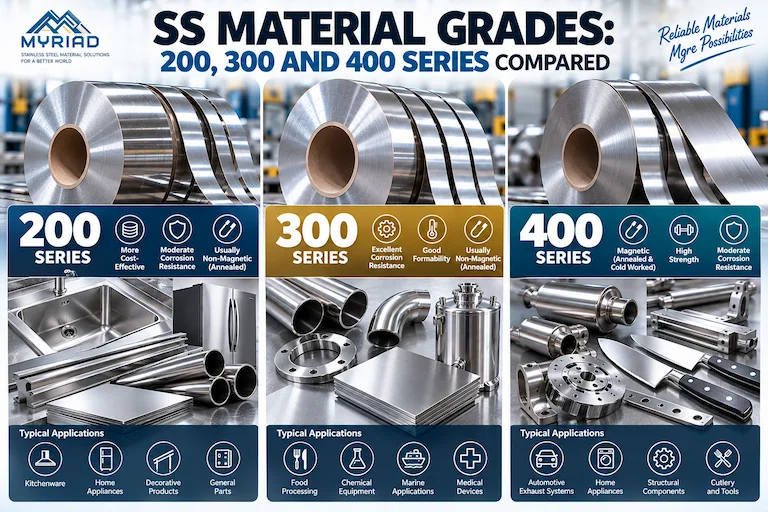
SS material grades describe different stainless steel compositions; the series number alone does not specify strength, corrosion resistance or suitability for a finished part. The 200 and 300 series contain familiar austenitic grades, while the 400 series includes both ferritic and martensitic grades. Choose the grade together with its product standard, material condition and service environment.
This guide focuses on practical differences between commonly encountered grades, with particular attention to sheet, strip and coil. A grade discussed here is not automatically part of Myriad’s confirmed supply range.
Stainless Steel Testing Examples
Hardness Testing
Chemical Composition Analysis
Tensile Strength Test


Table of Contents
SS material grades chart: series and families
Series and metallurgical family answer different questions. A series groups familiar grade designations; the family describes a microstructure that helps explain forming behavior, hardening response and magnetism.
| Series or family | Representative grades | Useful starting point | Important qualification |
|---|---|---|---|
| 200 series, austenitic | 201, 202 | Chromium–manganese–nickel alloys; nitrogen contributes to austenite stability and strength | A market label such as “201” needs a specified chemistry and standard |
| 300 series, austenitic | 301, 304, 304L, 316, 316L | Formability, toughness and corrosion resistance can be balanced for different duties | Cold-worked strength and magnetic response differ from the annealed condition |
| 400 series, ferritic | 409, 430, 439, 444 | Chromium-based grades with little or no deliberate nickel addition | These grades are magnetic; magnetic attraction is not proof of poor quality |
| 400 series, martensitic | 410, 420 | Heat-treatment response makes hardness and wear resistance important selection criteria | Specify the exact grade and heat-treated condition, not just “400 series” |
| Duplex | 2205, for example | A ferritic–austenitic structure offers another strength/corrosion option | It requires its own grade, fabrication and service assessment |
| Precipitation hardening | 17-4 PH, 17-7 PH, for example | Strength depends on the specified treatment route and condition | These are not interchangeable with ordinary annealed 300-series strip |
The four-versus-five-family count in different publications partly reflects whether martensitic and precipitation-hardening steels are grouped together. The useful distinction is the material’s actual structure and strengthening route.
Chemical composition of SS material grades
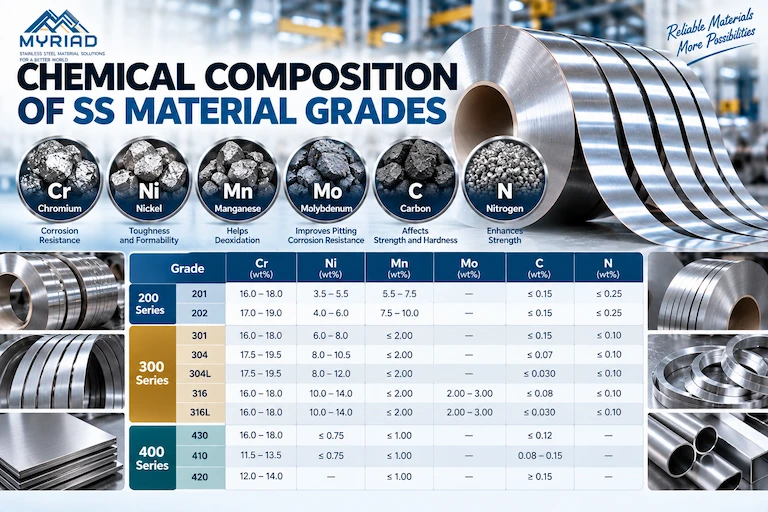
Composition limits help identify a grade, but they are not the measured chemistry of a particular coil. The following selected ranges are reference values from the cited technical publications, expressed as mass percent. They omit other controlled elements and do not replace the complete requirements of a specified standard and edition.
| Grade | Cr | Ni | Mn | Mo | C | N |
|---|---|---|---|---|---|---|
| 201 | 16.0–18.0 | 3.5–5.5 | 5.5–7.5 | — | ≤0.15 | ≤0.25 |
| 202 | 17.0–19.0 | 4.0–6.0 | 7.5–10.0 | — | ≤0.15 | ≤0.25 |
| 301 | 16.0–18.0 | 6.0–8.0 | ≤2.00 | — | ≤0.15 | ≤0.10 |
| 304 | 17.5–19.5 | 8.0–10.5 | ≤2.00 | — | ≤0.07 | ≤0.10 |
| 304L | 17.5–19.5 | 8.0–12.0 | ≤2.00 | — | ≤0.030 | ≤0.10 |
| 316 | 16.0–18.0 | 10.0–14.0 | ≤2.00 | 2.00–3.00 | ≤0.08 | ≤0.10 |
| 316L | 16.0–18.0 | 10.0–14.0 | ≤2.00 | 2.00–3.00 | ≤0.030 | ≤0.10 |
| 430 | 16.0–18.0 | ≤0.75 | ≤1.00 | — | ≤0.12 | — |
| 410 | 11.5–13.5 | ≤0.75 | ≤1.00 | — | 0.08–0.15 | — |
| 420 | 12.0–14.0 | — | ≤1.00 | — | ≥0.15 | — |
A dash means that a value is not included in this shortened table; it does not mean zero. These publications have different scopes: for example, EN 1.4016 data may specify a lower carbon maximum than the 430 reference shown here.
The alloying balance matters more than nickel content by itself. Chromium supports passivation; nickel, manganese and nitrogen help stabilize austenite in appropriate compositions. Molybdenum helps resistance to localized corrosion, while carbon can enable martensitic hardening or contribute to sensitization under relevant thermal conditions. The discussion of these competing effects also draws on the technical-library references identified at the end of this guide.
200-series SS material grades: 201 and 202
Standard 201 and 202 are legitimate austenitic grades, not simply “inferior 304.” Their manganese–nitrogen alloying route reduces the nickel requirement, but the resulting strength, forming response and corrosion behavior must be assessed for the actual composition and condition. Indoor trim, formed consumer components and hose clamps are examples of duties where an appropriate Cr–Mn grade may be considered; wet, salty or aggressive cleaning exposure needs a separate assessment.
The name “201” is especially important to verify when substituting material. Qi and colleagues’ Study on Corrosion Resistance of 200 Series Stainless Steel, consulted from Myriad’s technical library, explicitly investigated composition-adjusted commercial samples. Its findings should not be generalized to every standard-compliant 201 or 202 coil.
A useful substitution request therefore includes the required standard, heat chemistry, material condition and relevant service conditions. Comparing price per kilogram without those details can conceal differences in forming performance, corrosion risk or usable material yield.
300-series SS material grades: 301, 304 and 316
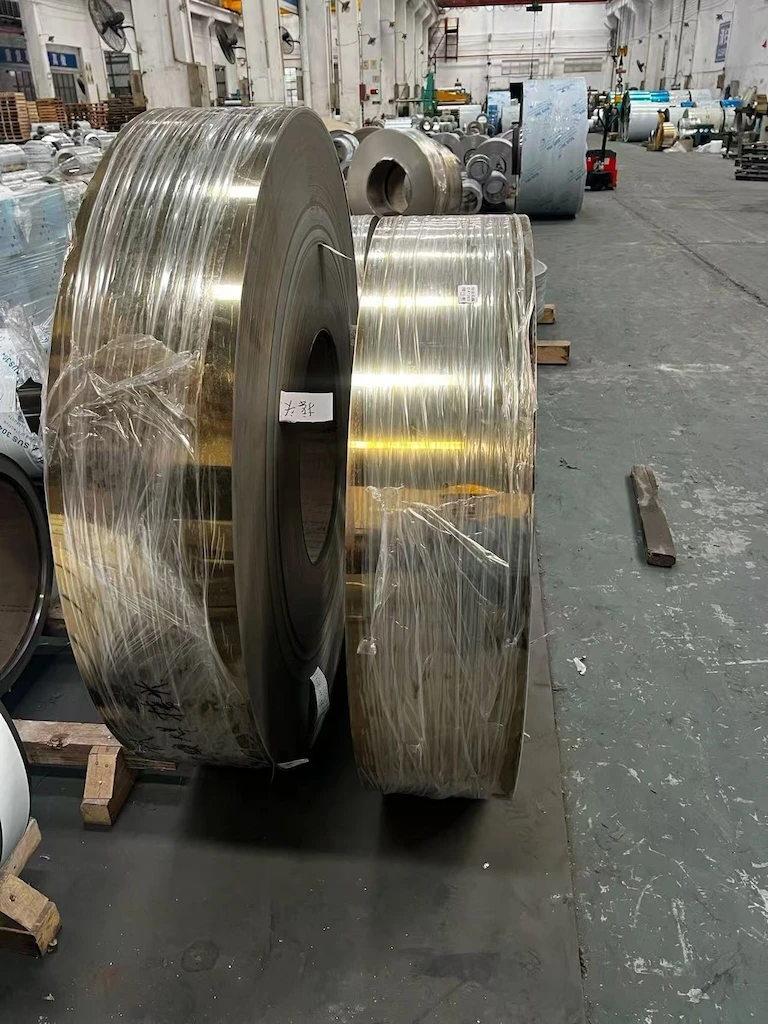
301 stainless steel is a useful starting point when cold-worked strip strength is central to the design. A spring or retaining component needs a specified temper and mechanical acceptance criteria; a generic annealed 301 value cannot describe a full-hard strip. Cold working can also change magnetic response, so magnetic attraction alone cannot establish a grade mix-up.
304 stainless steel is a common starting point for general-purpose formed and welded equipment. Choose 304L when its lower carbon limit is relevant to the welding and corrosion requirements; “L” does not identify a separate surface finish or automatically establish dual certification. The required chemistry and mechanical properties must both match the purchase specification.
316 and 316L stainless steel add molybdenum for improved resistance to pitting and crevice corrosion relative to conventional 304-type material. That improvement does not make 316 suitable for every chloride exposure or continuous seawater immersion. Temperature, concentration, deposits, crevices and tensile stress can change the selection.
Heat-resistant grades such as 309S and 310S stainless steel address another set of requirements. High-temperature oxidation, thermal cycling and load-bearing strength require their own assessment; a grade chosen for aqueous chloride resistance is not automatically the best choice for hot service.
400-series SS material grades: 430, 410 and 420
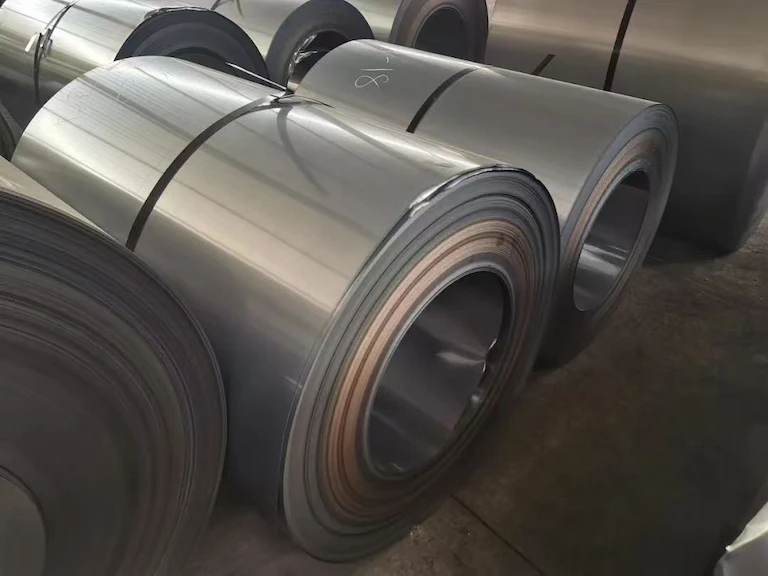
430 is ferritic, magnetic and not hardenable by conventional quench heat treatment. It can be useful for appliance parts, trim and suitable cooking-equipment components where its forming and corrosion performance meet the duty. For a replacement decision, examine actual drawing severity, weld requirements, surface appearance and exposure rather than rejecting it because a magnet sticks.
410 and 420 belong to the martensitic route, where carbon content and heat treatment strongly affect hardness, strength and toughness. Cutlery, wear-related components and selected shafts or turbine parts illustrate why this family is used. Material supplied for forming or machining may have very different properties from the hardened finished part.
“420” requires particular care because carbon ranges and related designations vary. Do not substitute a broad 420 label for a specific UNS, EN or JIS subgrade and heat-treatment requirement. Ferritic 430, martensitic 410/420 and low-carbon 410L should not be treated as equivalent choices simply because their numbers start with 4.
Related reading: A complete guide to AISI 304L stainless steel.
Physical properties and tensile strength of SS material grades
Physical properties affect weight, thermal movement and heat flow even before a strength requirement is considered. These approximate reference values are tied to the source conditions below; they are not batch measurements or design guarantees.
| Reference material | Density, g/cm³ | Mean thermal expansion, 20–100°C, ×10⁻⁶/K | Thermal conductivity, W/(m·K), with source temperature |
|---|---|---|---|
| ATI 201 HP | 7.86 | 16.6 | 16.3, listed for 20–100°C |
| ATI 304 | 7.90 | 16.6 | 16.3 at 100°C |
| 430 / EN 1.4016 | 7.70 | 10.5 | 25 at 20°C |
The conductivity values are not all reported at the same temperature. For dimensional movement, use the relevant temperature interval; for heat transfer, include geometry, surface conditions and the surrounding fluids rather than ranking grades by this column alone.
Tensile strength is meaningful only with a material condition and test basis. The table below presents selected room-temperature minimum reference values from ATI’s February 2014 data sheets for plate, sheet and strip. It is a condition comparison, not a statement of all requirements in the current editions of ASTM A240 or A666.
| Grade and condition | Tensile strength minimum, MPa (ksi) | 0.2% offset yield strength minimum, MPa (ksi) |
|---|---|---|
| 301, annealed | 515 (75) | 205 (30) |
| 301, full hard | 1,276 (185) | 965 (140) |
| 304, annealed | 515 (75) | 205 (30) |
| 304L, annealed | 485 (70) | 170 (25) |
The two 301 rows show why grade-only comparisons can mislead: processing condition can change strength more than a simple comparison between annealed grade numbers. Actual acceptance also needs the relevant thickness, specimen direction, test method and applicable standard edition. Elongation, hardness and fatigue behavior require their own criteria; tensile strength alone does not qualify a spring or a thin-foil component.
SS material grades and international standards
A grade designation and a product specification serve different purposes. “304” or UNS S30400 identifies an alloy; the applicable product standard adds requirements for a particular form, condition and acceptance basis. A bar, tube and cold-rolled strip carrying a similar grade label do not automatically have the same requirements.
| System | Relevant reference for this guide | What to establish when ordering |
|---|---|---|
| United States | ASTM A240/A240M for listed plate, sheet and strip; A480/A480M general requirements; A666/A666M for annealed or cold-worked austenitic flat products | Exact grade/UNS, product scope, condition, edition, dimensions and mechanical acceptance |
| Europe | EN 10088-2 for corrosion-resistant sheet/plate and strip for general purposes | EN number/name, delivery condition, product form and all specified chemistry/property limits |
| Japan | JIS G 4305 for cold-rolled stainless steel plate, sheet and strip | Exact SUS designation, including suffixes/subgrades, and the agreed condition and edition |
| China | GB/T 3280 for cold-rolled stainless steel plate, sheet and strip | Exact Chinese grade designation and the applicable composition, condition and acceptance requirements |
For orientation, commonly associated identifiers include 304 / S30400 / EN 1.4301 / SUS304, 316 / S31600 / EN 1.4401 / SUS316, and 430 / S43000 / EN 1.4016 / SUS430. These are comparison starting points, not certificates of full interchangeability. The IMOA tables explicitly warn that EN and ASTM chemistry do not correspond exactly.
The public ASTM A240 catalog, ASTM A666 scope, EN 10088-2:2024 scope, JICQA’s JIS certification listing and SAMR’s GB/T 3280-2015 record support the standard roles described here. Complete current standards have not been reproduced or fully reviewed for this guide. The JSA preview was under maintenance during research; obtain the agreed documents before accepting a substitution or contractual limit.
Food-grade stainless steel: what the designation leaves out
“Food grade SS material” is an application and compliance question, not a universal stainless steel grade number. A suitable decision considers the food, contact time, temperature, cleaning chemicals, surface finish, weld condition and cleanability of the finished equipment. A 304, 316 or 430 label alone does not establish that an item meets every food-contact requirement.
The FDA Food Code 2026 is a model offered for adoption by jurisdictions, not automatic proof of the rule in force at every US location. Its section 4-101.11 on equipment materials addresses safety, corrosion resistance, durability and smooth, easily cleanable food-contact surfaces. Confirm the requirements actually applicable to the equipment and location; a mill certificate is not a finished-equipment hygiene approval.
304 is a familiar starting point for many food-equipment duties, while 316/316L may be considered when the specific exposure needs greater localized-corrosion resistance. Ferritic grades can also have suitable applications. The selection still depends on the actual duty: stronger chemical exposure does not justify an unconditional claim that any one of these grades is “food safe.”
Selecting and verifying SS material grades
Start with the failure mechanisms and manufacturing route, then narrow the grade. For example, a formed spring asks different questions from a welded tank or a hardened cutting edge. The following checks turn a broad material name into a specification that can be reviewed.
- Define exposure: medium, chloride or other contaminants, temperature, wet/dry cycling, cleaning and crevices.
- Define the mechanical task: forming, elastic deflection, wear, welding, heat treatment and any known hardness or tensile requirement.
- Specify the material: exact grade and product standard, condition, thickness, width, finish and edge requirements.
- Define verification: heat/batch traceability, chemistry, mechanical tests, dimensions and surface acceptance, with relevant sampling and methods.
Grade verification and condition verification need different evidence. Handheld XRF can help screen important alloying elements, but it cannot establish carbon content or confirm an L-grade carbon limit. Use an appropriate carbon-capable method where required; on very thin material, ask the laboratory to confirm sample preparation and instrument suitability. An alloy identification result does not establish tensile strength or heat-treated condition.
Myriad supplies stainless steel foil, precision strip and coil; its confirmed quotable grade list includes 301, 304, 304L, 316, 316L, 309S and 310S. The 200- and 400-series discussion here explains materials and does not establish their availability from Myriad. Each grade–dimension–condition combination requires confirmation.
Small-quantity requirements can be discussed within the actual order conditions. Myriad’s regular minimum is 100 kg per specification item in the same order: matching grade, thickness, width and material condition. Weights across matching coils can be combined; different specifications are counted separately. Quantities below that regular minimum require a special request and are not automatically accepted.
If the grade, mechanical requirement and other acceptance details are already defined, send them directly for specification review. If performance is still undecided, describe the relevant service and processing conditions, with geometry or drawings only where needed to resolve an actual question; any suggested values need the buyer’s confirmation. Use Myriad’s contact page or email info@myriadsteel.com. The current form asks for hardness or tensile strength, so email is also available when those values are not yet known.
Technical sources behind this stainless steel grades guide
This article combines selected material from Myriad’s technical library with the linked industry and producer references. Library materials consulted include the following Chinese-language documents; English titles below are descriptive translations where indicated:
- 《200系列(锰系)不锈钢发展前景》, 严旺生, 2004 — Development Prospects of 200-Series (Manganese-Bearing) Stainless Steel (translated title): background for the nickel-saving alloying route; its historical market figures and pricing forecasts are not used as current facts.
- 《200系列不锈钢耐腐蚀性能研究》, 齐达、李晶、董力、余健, 2010; English title in the library copy: Study on Corrosion Resistance of 200 Series Stainless Steel — used to explain why composition-adjusted commercial samples cannot stand in for every standard 201/202 grade. Its test results are not service-life guarantees.
- 《现代不锈钢材料:结构、性能、特点和应用》, selected section 8 in the library copy — Modern Stainless Steel Materials: Structure, Properties, Characteristics and Applications (translated title): background for alloying elements, phases and property trade-offs. Only the relevant converted-text section was consulted, not a verified complete original edition.
These library copies were used with their source and conversion limitations; the numerical reference tables above rely on the specified linked publications. This is a literature-based guide provided by Myriad, not a report of original Myriad testing or an engineering approval for a particular application.