
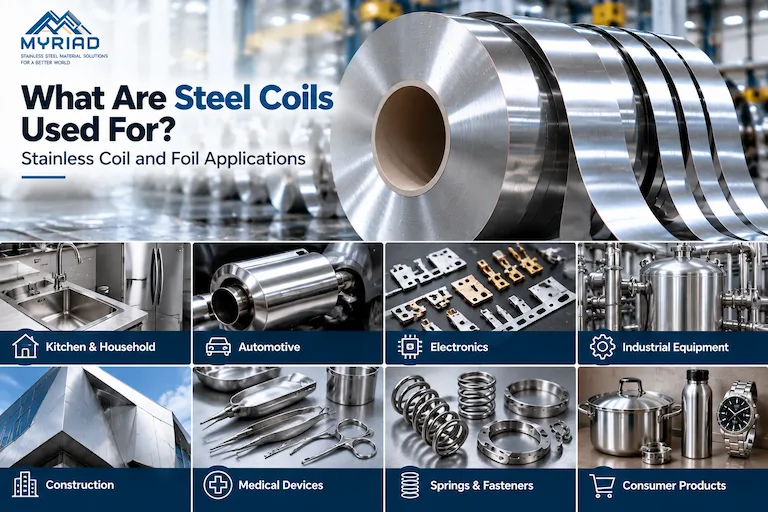
Steel coils supply flat material for making vehicle panels, appliance housings, building products, equipment components, precision parts, and welded tubing. Manufacturers uncoil the material, then slit, cut, stamp, form, or weld it into the required product. The application depends on the steel, its condition, and the subsequent manufacturing process. Forming flat steel and resistance-welding its seam produces welded tubing.
A steel coil is a continuous length of flat-rolled steel wound into a roll for delivery and processing. “Coil” identifies the product form; it does not identify an alloy or mean a finished heat-exchanger tube or wire spring. Carbon steel, coated steel, and stainless steel describe different material or surface systems, while cold rolling describes processing.
This article focuses on cold-rolled stainless steel coil, strip, and foil. For these materials, useful selection starts with the part’s function: a spring contact needs resistance to permanent set, a formed housing needs sufficient ductility, a diaphragm must respond consistently, and a heated component must withstand its actual thermal environment. Grade, delivery temper, thickness, and processing must work together.
Why Steel Coil Uses Differ by Stainless Grade?
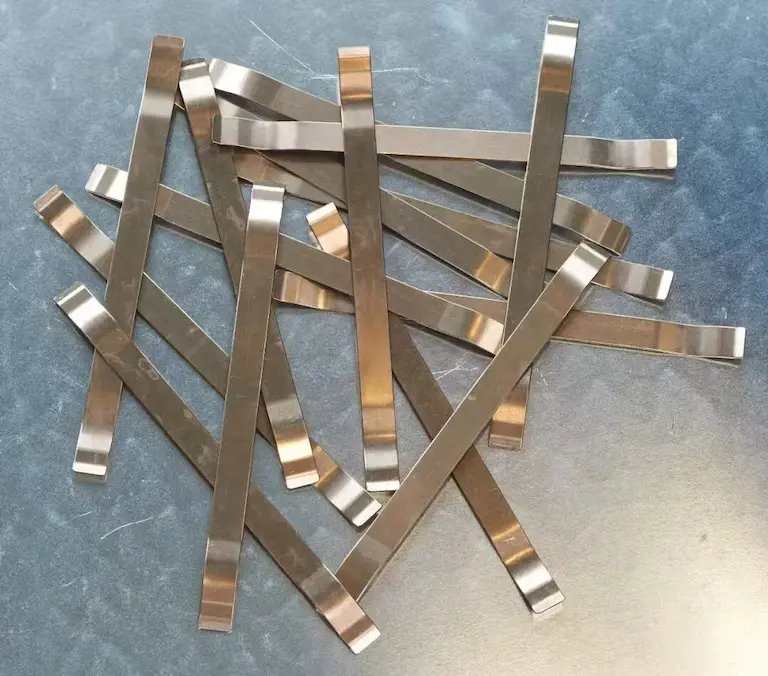
Different stainless grades address different service problems, so they should be compared by the failure mode they help control. Corrosion resistance, forming behavior, elastic loading, and heat exposure can each determine the choice; a grade that improves one property may add no benefit to another.
The following examples describe material applications, with delivery condition and part design still to be selected.
| Grade | Representative coil or strip applications | Why consider it? | Important selection boundary |
|---|---|---|---|
| 301 stainless steel | Spring contacts, clips, switch springs, and stamped elastic parts | Strong cold-work response supports parts that must resist permanent set. | Higher cold-worked strength reduces ductility; verify the temper against forming and cyclic loading. |
| 304 stainless steel | Formed equipment parts, food-processing equipment components, etched precision parts, and shims | Combines corrosion resistance in many common environments with formability and cleanability. | Select the forming condition and surface for the job; a food-equipment application does not establish regulatory compliance. |
| 304L stainless steel | Welded thin-wall components and formed assemblies exposed to a welding heat cycle | Lower carbon helps reduce sensitization-related intergranular corrosion risk in relevant welded conditions. | The “L” designation does not make every corrosion, strength, or forming property better than 304 stainless steel. |
| 316 stainless steel | Chemical-contact formed parts, diaphragms, and bellows requiring greater resistance to localized corrosion | Molybdenum improves resistance to certain pitting and crevice-corrosion conditions relative to 304 stainless steel. | Assess the actual medium, temperature, crevices, and cleaning conditions; it is not universally suitable for seawater. |
| 316L stainless steel | Welded chemical-contact parts, welded bellows, and instrument diaphragms | Combines the 316 corrosion-resistance approach with lower-carbon control of relevant welding-related risks. | Lower carbon does not prevent all pitting, stress-corrosion cracking, or effects of prolonged heat exposure. |
| 321 stainless steel | Heated welded strip assemblies and bellows | Titanium stabilization helps control sensitization-related corrosion after relevant thermal exposure. | Thermal history matters; stabilization does not establish greater chloride-pitting resistance. |
| 347 stainless steel | Heated welded components and bellows where stabilization is required | Niobium stabilization addresses a similar sensitization concern through a different stabilizing addition. | Select between stabilized grades using the component specification and exposure; they are not automatic substitutes. |
| 309S stainless steel | Furnace-related sheet or strip components | Its chromium/nickel alloy system supports high-temperature oxidation resistance. | Atmosphere, thermal cycling, time, and load affect suitability; “S” is not the same designation as “L.” |
| 310S stainless steel | High-temperature sheet or strip furnace liners, furnace components, and burner parts | Its alloy system provides another option where oxidation resistance at elevated temperature drives selection. | Compare the actual atmosphere and operating duty; oxidation resistance alone does not establish load capacity or service life. |
| 430 — sheet/strip comparison | Appliance trim, range hoods, and decorative formed parts in mild environments | A ferritic option for appropriate corrosion and appearance requirements. | Its stretch-forming and welding behavior differ from the austenitic grades. This comparison is separate from Myriad’s quotation range. |
Heat exposure requires two separate questions: will the material resist oxidation, and will its microstructure and mechanical behavior remain suitable? Stabilized 321/347 and oxidation-resistant 309S/310S address different concerns. For a component experiencing only welding or short heating, 304L stainless steel may already address the relevant sensitization risk; sustained exposure can change the decision.
Bellows also require geometry and wall thickness to be considered alongside the alloy.
Stainless Steel Foil Uses: Matching Grades to Thin Parts
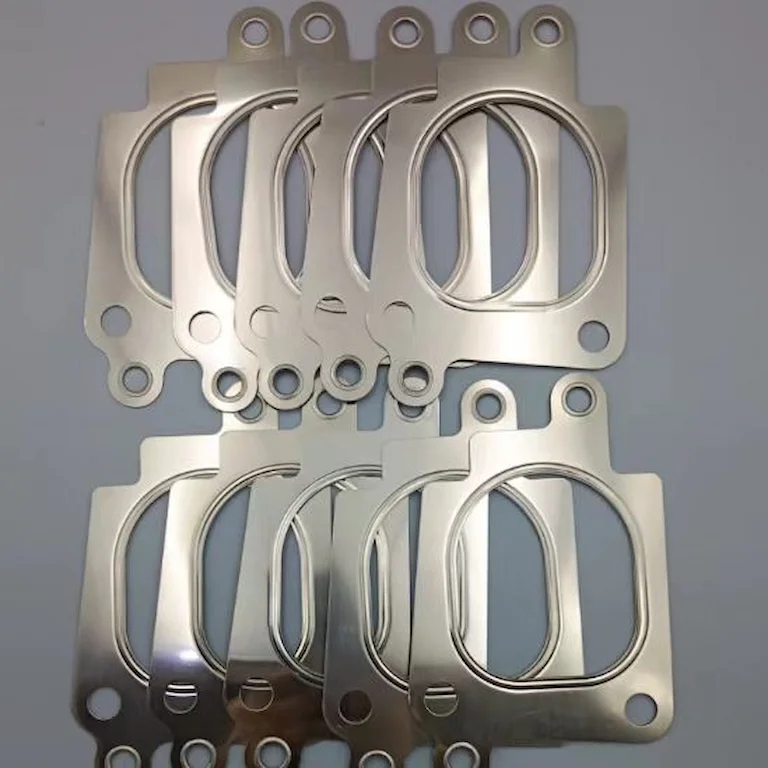
Thin stainless material serves functional parts whose behavior depends strongly on geometry, consistency, and processing. The grade identifies a material candidate; thickness tolerance, temper, surface, edges, and the finished shape determine whether that candidate can perform the job.
| Thin-part application | Grade example | Why it is considered | What to verify |
|---|---|---|---|
| Spring contacts, key springs, and clips | 301 | Cold-work strengthening can support elastic loading in compact parts. | Resistance to permanent set, bend feasibility, edge condition, and cyclic performance. |
| Etched precision parts and thin shims | 304 | A useful combination of corrosion resistance and processing options. | Flatness after the intended etching or cutting process, surface condition, and dimensional tolerance. |
| Mechanical-switch components | 304L | A documented strip/foil application where forming and corrosion requirements must be matched to the component. | Required movement, forming condition, joining heat, and service environment. |
| Metal diaphragms and isolator diaphragms | 316L; 304 and 316 also appear in diaphragm applications | Thin material can form a responsive membrane; grade selection also reflects the contacting medium. | Thickness consistency, formed geometry, pressure response, corrosion, and cycle requirements. |
| Heat-shielding parts | 309/309S strip and foil | A documented thin-material use of this heat-resistant alloy family. | Actual foil thickness, atmosphere, heat cycles, attachment, and mechanical duty. |
| Protective tool wrap; historical thin heat-shield components | 321 | Dedicated tool-wrap products protect workpiece surfaces during heat treatment. A historical precision-strip review also lists thin 321 heat-shield components. | Match the wrapping product to the heating cycle and atmosphere; a wrap rating does not establish a structural component’s rating. |
| Thin honeycomb stock in a historical application example | 347 | A precision-strip review records this stabilized grade in thin honeycomb structures; public catalogs also list 347 foil. | Component specification, joining process, thermal exposure, and qualification for the intended design. |
Historical examples help identify candidate materials, but they do not qualify a new component. Tian Xiaoqing’s 2009 precision-strip review lists 321 heat-shield material and 347 honeycomb stock at 0.05–0.13 mm. Those examples do not establish aerospace certification, a universal service temperature, or a suitable thickness for another design.
High-temperature sheet and strip applications also should not be transferred automatically to ultrathin foil. The 310S applications in the preceding grade table remain sheet/strip examples. A foil heat shield, a protective wrap, and a complete insulation system have different structural and thermal requirements.
How Temper Changes Stainless Steel Coil Uses
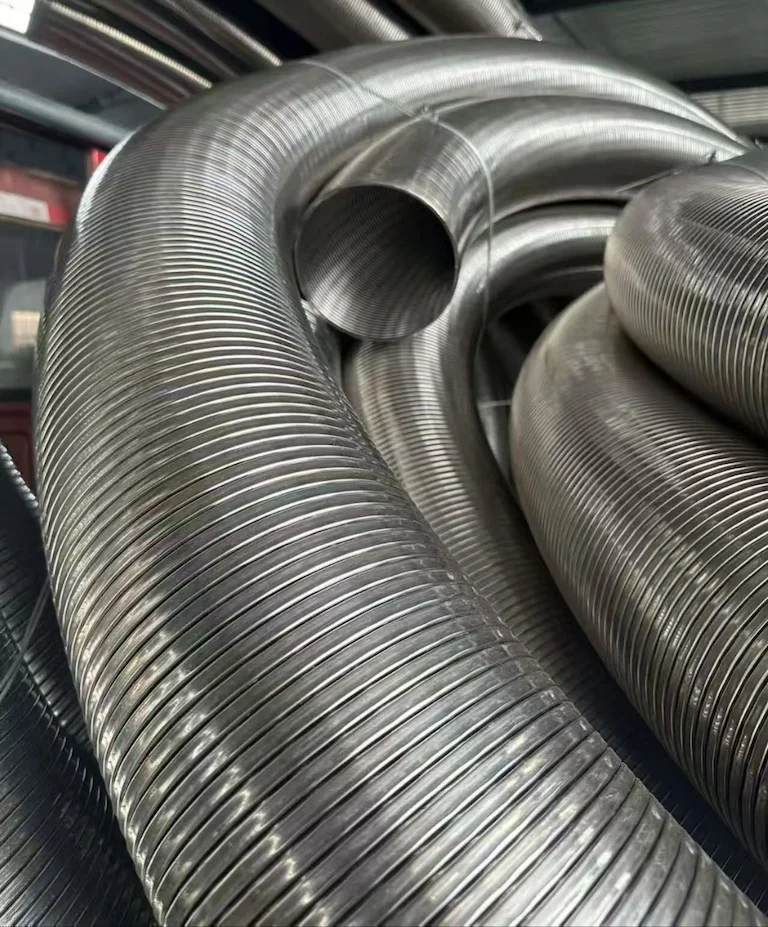
Cold-rolled stainless steel can be delivered in different material conditions, including an annealed condition. Cold rolling describes processing; the delivery temper describes the condition available for forming and service. A grade name alone therefore cannot establish strength, ductility, or spring performance.
For 301 elastic parts, increasing cold-worked strength can improve resistance to permanent set while reducing the available forming ductility. Tight bends or substantial forming may constrain the usable temper before the part reaches its working condition. Check the proposed material in the intended part geometry rather than selecting the highest hardness available.
Mechanical requirements should distinguish yield behavior, tensile strength, hardness, and elongation. Yield behavior is relevant to permanent set; elongation and bend performance help assess forming; hardness provides a specified acceptance measure when the test method is defined. None of these values alone proves fatigue life, and tensile strength alone does not determine spring force.
For etched 304 parts, incoming flatness does not establish flatness after material removal. Gong Meina’s 2015 master’s thesis describes warping in cold-rolled 304 etching stock when etching disrupts the previously balanced residual stresses. A useful qualification check is therefore to measure the part after its representative etching process, with the intended removal pattern and inspection support conditions. That check tests the manufacturing response the part actually needs; it does not require copying the study’s processing conditions.
Why Thickness Changes What a Coil Can Do
Thickness can change elastic bending response much more than a simple proportional comparison suggests. In an ideal linear-elastic thin-plate model, with the material parameters and other model conditions held constant, halving thickness reduces plate bending rigidity to 1/8. This is a calculation from the model, not a measured result for a particular stainless foil. MIT plate flexural-rigidity notes
The practical implication is to specify the required response as well as the alloy. A diaphragm or flexible strip may benefit from low bending rigidity, while a shim or cover may need dimensional stability. Selecting a stronger temper does not establish a corresponding increase in elastic bending rigidity. Corrugations, tension, multiple layers, supports, and large deflections require their own analysis; the thickness example does not predict fatigue life or forming success.
How to Choose Steel Coil for an Application
A practical selection sequence converts an application into material requirements and then checks the finished response. The following steps are engineering planning suggestions; the relevant design and acceptance requirements should be agreed for the actual component.
1. Define the function and service conditions
Start with what the part must do and how it could fail. Record whether it must spring back, retain a shape, isolate a medium, seal, or shield heat. Add the contacting medium, cleaning conditions, operating temperature and exposure time, applied load or movement, and any required cycles. “Corrosion resistant” or “heat resistant” alone leaves the selection unresolved.
2. Choose a grade for the controlling mechanism
Use the application matrix to identify a starting grade and a relevant comparison. Compare 304 with 316 when localized corrosion is the concern, consider low-carbon variants when welding-related sensitization matters, and distinguish stabilization from high-temperature oxidation resistance. For a spring contact, consider the strength/formability balance of 301 rather than choosing by corrosion resistance alone.
3. Match delivery condition to processing and service
Specify the required properties and the processing the material will undergo. Include forming, etching, welding, and subsequent heat exposure where relevant. Evaluate bends or formed features in representative material, check post-etch flatness for an etched part, and assess a welded part in the condition in which it will operate. Use an annealed condition as a delivery choice where appropriate; determine its suitability through the part requirements.
4. Define geometry, surface, edges, and feed requirements
Translate the selected concept into measurable incoming-material requirements. Define thickness and tolerance, width, surface condition, edge requirements, and applicable flatness criteria. Continuous length and coil dimensions must also fit the production equipment; an appropriate alloy cannot compensate for material that the line cannot feed or process. For cut-to-length blanks, specify the required length and inspection condition separately.
5. Validate the part and agree on acceptance
Use representative samples and tests that address the intended failure modes. Depending on the part, these may include bend trials, post-process dimensions and flatness, spring set and cycling, diaphragm response, or corrosion evaluation under relevant exposure. Agree on the material-property tests and reports as well. A material report supports incoming acceptance; it does not by itself validate the finished design.
Discuss Your Stainless Coil or Foil Requirements with Myriad
Myriad is a specialized industrial materials supply partner for stainless steel foil, precision and narrow strip, and coil. Grades available for quotation include 301, 304, 304L, 316, 316L, 309S, and 310S. Each grade, size, temper, and performance combination is confirmed for the order; the material comparison above serves a broader educational purpose.
Small-order planning has a defined quantity basis: the regular minimum is 100 kg (approximately 220 lb) per specification item within one order. An item shares the same grade, thickness, width, and temper; quantities from different specifications are not combined. Requests below that level require special approval.
Slitting, edge treatment, surface requirements, and cut-to-length foil sheets can be discussed against the required dimensions and acceptance criteria.
Email info@myriadsteel.com with the requirements you already have. If grade, dimensions, quantity, and required hardness and/or tensile properties are defined, send them directly. If material selection is still open, add the part’s function and relevant service and processing conditions so the remaining questions can be clarified. Provide a drawing when it helps resolve a specific geometry or tolerance requirement.
Questions About Steel Coil Uses
Does a welded thin part always need 316L stainless steel coil?
The need for 316L depends on the environment as well as the welding history. Low carbon addresses relevant sensitization-related risks, while the 316 stainless steel alloy system addresses certain localized-corrosion conditions. A suitable 304L component may meet a less demanding corrosion requirement; a 316L component still needs its medium, joint, and service conditions assessed.
Can 321 or 347 replace 309S or 310S stainless steel coil in a heated part?
A substitution should begin with the reason the original grade was specified. Stabilization against sensitization and resistance to high-temperature oxidation are different requirements. Compare thermal history, atmosphere, mechanical duty, and the component specification before treating these grades as interchangeable.
Should small parts be made from coil or cut-to-length material?
The preferred delivery form depends on the manufacturing route. A continuous feed process may need coil with suitable width, length, and equipment compatibility; a process using individual blanks may benefit from cut-to-length material. Keep the grade and condition requirements, then compare feeding, handling, blank dimensions, and post-process flatness for the actual part.
Sources and Preparation Notes
This overview combines original manufacturer technical literature with research on precision stainless strip, 301 strengthening, 304 etching behavior, and plate mechanics. Links beside the relevant comparisons lead to the public technical sources. Historical application examples are identified as such.
- Strengthening and etched flatness: Gong Meina (宫美娜), 300系奥氏体不锈钢薄带板形及性能控制研究 (Chinese-language master’s thesis, 2015), chapters 3 and 4.
- Historical thin-strip applications: Tian Xiaoqing (田晓青), 高强度不锈钢精密带钢发展概述, 冶金管理, 2009, no. 10, tables 4 and 5.
The purpose is to help turn an application into a reasoned material selection and a verification plan. The article presents literature-based explanations and engineering planning suggestions; it does not report independent material tests or qualification of a particular component.