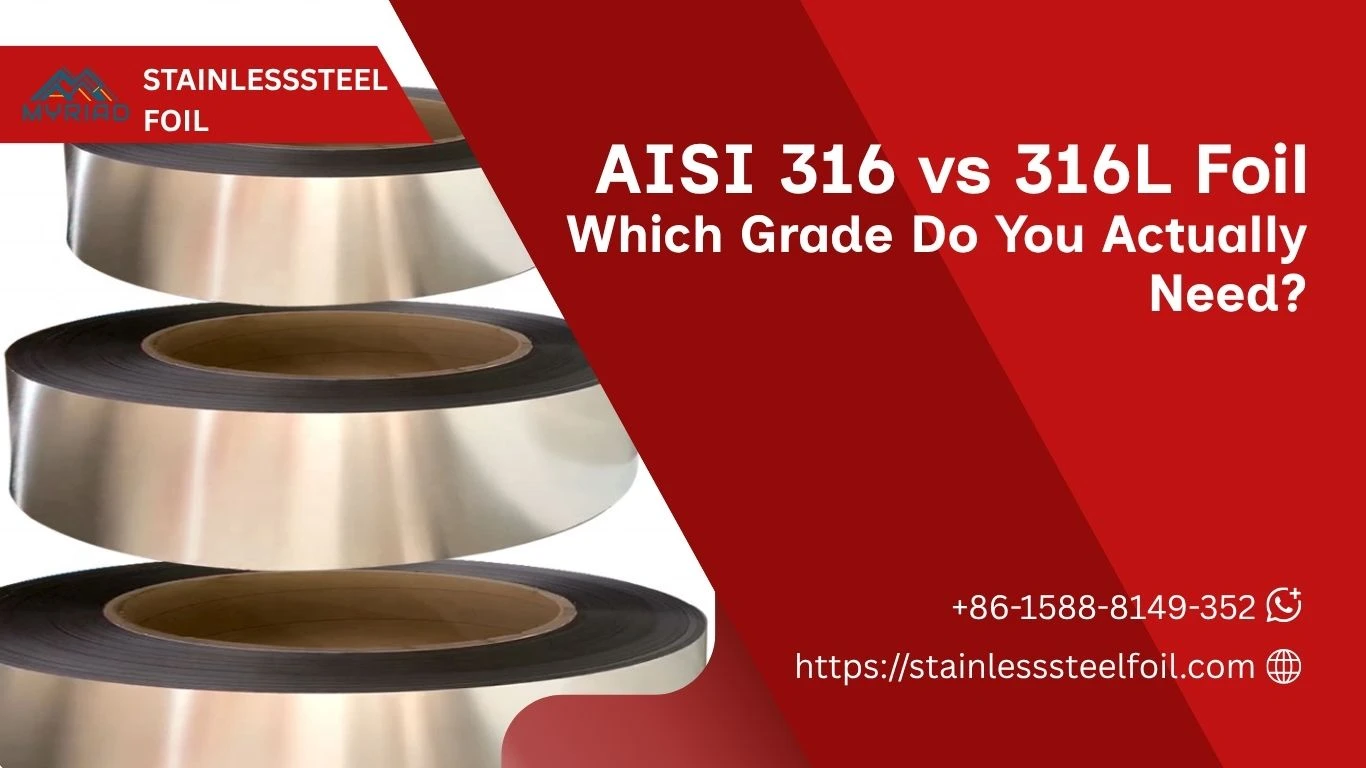
Choosing the right stainless steel foil is about much more than comparing specifications on a datasheet. Every application has different requirements, and selecting the wrong material can lead to corrosion, welding problems, higher maintenance costs, or even premature product failure. That is why understanding AISI 316 vs 316L Foil is essential before making a purchasing decision.
Although these two stainless steel grades look almost identical, one important difference changes how they perform in demanding environments. From chemical processing plants and marine equipment to medical devices and food processing machinery, both grades have earned an excellent reputation for durability and corrosion resistance. However, they are not always interchangeable.
In this guide, we’ll explain the real differences between AISI 316 and 316L foil, compare their chemical composition, mechanical properties, corrosion resistance, applications, and pricing, and help you decide which grade best fits your project.
If you’re looking for premium-quality stainless steel foil, explore the complete product range at stainless steel foil. You can also browse the full Stainless Steel Foil Collection
What Is AISI 316 Stainless Steel Foil?
AISI 316 stainless steel foil is an austenitic chromium-nickel stainless steel containing approximately 2–3% molybdenum. That additional molybdenum significantly improves corrosion resistance, especially against chlorides, seawater, and many industrial chemicals.
Because of these properties, manufacturers use 316 foil in industries where reliability matters. It performs exceptionally well in marine engineering, food processing, pharmaceutical production, petrochemical equipment, precision electronics, and architectural applications exposed to harsh environments.
If you’re new to stainless steel foil products, this overview explains different foil grades and specifications stainless steel foil
What Makes 316L Different?
At first glance, AISI 316L looks identical to standard 316 stainless steel. The biggest difference is the carbon content.
Standard 316 contains up to 0.08% carbon, while 316L contains a maximum of 0.03% carbon. That small reduction has a significant impact during welding.
Lower carbon minimizes chromium carbide precipitation, allowing the material to maintain excellent corrosion resistance around welded areas. This is why engineers often recommend 316L for fabrication projects requiring extensive welding or continuous exposure to aggressive environments.
When comparing AISI 316 vs 316L Foil, this single chemical difference often determines which material performs better over the long term.
AISI 316 vs 316L Foil: Chemical Composition
Although both grades share nearly identical alloying elements, carbon content separates them.
| Element | AISI 316 | AISI 316L |
|---|---|---|
| Chromium | 16–18% | 16–18% |
| Nickel | 10–14% | 10–14% |
| Molybdenum | 2–3% | 2–3% |
| Carbon | Max 0.08% | Max 0.03% |
The lower carbon level allows 316L to resist sensitization after welding, making it the preferred option in many industrial environments.
For a deeper technical comparison, read the complete guide here 316 vs 316l stainless steel foil comparison
Mechanical Properties: Is There Any Major Difference?
From a mechanical standpoint, both grades perform exceptionally well. They provide high tensile strength, excellent ductility, and outstanding formability, making them suitable for ultra-thin precision foil applications.
| Property | AISI 316 | AISI 316L |
|---|---|---|
| Tensile Strength | 515 MPa | 485 MPa |
| Yield Strength | 205 MPa | 170 MPa |
| Elongation | 40% | 40% |
| Density | 8.0 g/cm³ | 8.0 g/cm³ |
Although standard 316 offers slightly higher strength, the difference is relatively small for most foil applications. In practice, corrosion resistance and fabrication requirements usually influence purchasing decisions more than strength values.
Corrosion Resistance: Which Grade Performs Better?
One reason stainless steel remains one of the world’s most popular engineering materials is its remarkable resistance to corrosion. According to the overview published on Wikipedia, stainless steel owes its durability to a protective chromium oxide layer that continuously repairs itself when exposed to oxygen.
When discussing AISI 316 vs 316L Foil, both grades outperform 304 stainless steel in chloride-rich environments because they contain molybdenum. However, after welding, 316L generally maintains superior corrosion resistance because it minimizes carbide precipitation around the weld zone.
This advantage makes 316L particularly valuable for chemical processing plants, pharmaceutical manufacturing, desalination equipment, marine hardware, and medical instruments where corrosion failure can become extremely costly.
For more information about corrosion performance, visit 316 stainless steel foil corrosion resistance explained
Which Industries Use 316 and 316L Foil?
The versatility of these stainless steel grades explains why they appear across numerous industries. Standard 316 foil is widely used in industrial heat exchangers, food processing equipment, automotive heat shields, architectural panels, and precision manufacturing components where welding is minimal.
Meanwhile, 316L foil has become the preferred choice for pharmaceutical machinery, surgical equipment, laboratory instruments, semiconductor production, aerospace components, and marine engineering because these applications demand excellent weldability and maximum corrosion resistance. The growing popularity of stainless steel foil in modern manufacturing is also explained in this detailed article use-of-stainless-steel-foils
Welding Performance Matters More Than Many Buyers Realize
Many purchasing decisions come down to welding. If your stainless steel foil will be laser welded, TIG welded, or used in fabricated assemblies, 316L offers a clear advantage. Lower carbon significantly reduces the formation of chromium carbides during heating, helping preserve corrosion resistance after fabrication.
That means fewer maintenance issues, improved product reliability, and longer service life. For projects that involve little or no welding, standard 316 often performs equally well while offering nearly identical mechanical performance.
Cost Comparison: Is 316L Worth Paying More?
Price differences between the two grades are usually smaller than many buyers expect. In most markets, 316L costs only slightly more than standard 316 because both materials share nearly identical alloying elements.
However, considering reduced maintenance costs, improved weld quality, and longer operational life, many manufacturers view 316L as a better long-term investment rather than simply a more expensive material.
Should You Consider Other Stainless Steel Foil Grades?
While comparing AISI 316 vs 316L Foil, it is also worth understanding other popular stainless steel grades. If corrosion resistance is not your highest priority, 304 stainless steel may offer a more economical solution. Learn more in the 304 Stainless Steel Foil Properties & Applications Guide You can also read the Complete Guide for 304 Stainless Steel Foil For spring applications requiring exceptional strength, explore the 301 Stainless Steel Foil High Strength Spring Temper Grade Or discover why many manufacturers choose the 301 Stainless Steel Foil Spring Steel Solution
Summary
Choosing between AISI 316 vs 316L Foil ultimately depends on how and where the material will be used. If your project involves extensive welding, chemical exposure, pharmaceutical manufacturing, or marine environments, 316L is typically the smarter choice because its lower carbon content improves corrosion resistance after fabrication. On the other hand, standard 316 remains an outstanding solution for many industrial applications where welding is limited and slightly higher strength is preferred.
Selecting the right stainless steel foil from the beginning helps reduce maintenance costs, improve equipment reliability, and maximize long-term performance. For more information, visit stainless steel foil Stay tuned for more stainless steel foil guides, buying tips, and industry insights by exploring our latest articles If you have questions or need expert assistance choosing the right stainless steel foil for your application, don’t hesitate to contact us.
FAQs
Q: Is 316L always better than 316?
A: Not always. AISI 316 vs 316L Foil depends entirely on your application. If welding and corrosion resistance are priorities, 316L is generally the better choice.
Q: Which foil is better for marine environments?
A: When comparing AISI 316 vs 316L Foil, 316L usually performs better after welding because it offers greater resistance to intergranular corrosion.
Q: Can both grades be used in food processing?
A: Yes. AISI 316 vs 316L Foil are both widely approved for food processing equipment because they provide excellent hygiene, durability, and corrosion resistance.
Q: Does 316L cost much more?
A: No. AISI 316 vs 316L Foil usually shows only a small price difference, making 316L an excellent long-term investment for demanding applications.
Q: Where can I purchase high-quality stainless steel foil?
A: Browse the complete Stainless Steel Foil Sheets collection here: